
Rocket Men

How former UW reporters launched a generation of influencers (before there were influencers)
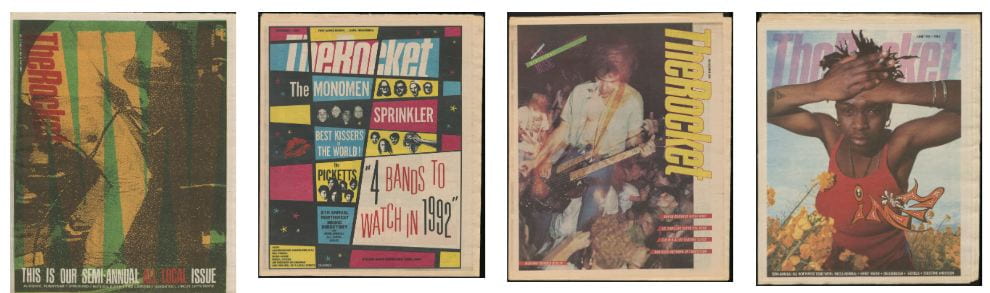
Last month, UW Libraries hosted a special reception for its exhibit Celebrating The Rocket, on display in Allen Library’s north lobby through February 15, 2025. Amidst a Seattle music soundtrack spun by “DJ Vallier” (aka faculty and curator for UW Ethnomusicology Archives), and a pizza buffet donated by Pagliacci, attendees meandered through the well-documented history of Seattle’s most iconic music publication featuring the paper’s artful covers, behind-the-scenes stories and related ephemera. Taking in the exhibit, viewers were transported back in time to moments that became touchstones of Seattle’s storied music scene during the paper’s run from 1979 to 2000.
Guests had the added benefit of hearing from special guest speakers whose perspectives served as a fitting tribute to the late Charles Cross (May 7, 1957 – August 9, 2024) — one of the country’s most respected music writers and editors, a 2024 Rock & Roll Hall of Fame inductee, and one of the The Rocket’s first writers, as well as its editor and final sole owner. Cross’ son, Ashland, spoke about his father’s draw to journalism describing how, in 1975, Cross arrived at UW originally wanting to be an architect, but ultimately found his way to The Daily (UW’s student newspaper) and never looked back. Ashland described his dad’s lifelong passion for music, including an unwavering admiration of Bruce Springstein. He explained that Cross’ inspiration for writing was rooted in the beat writers and vanguard writers like Tom Wolfe and Hunter S. Thompson who “proved that journalism wasn’t just a sideline observational thing, that sometimes you have to live it to know what it’s about.”
“I see my Dad’s work at The Rocket as a continuation of his admiration for the decades of counterculture writers, bringing that, in a local sense, to Seattle,” said Ashland. “The Rocket served as a nucleus for Northwest music… what Seattle music would become wouldn’t exist without The Rocket.”

The event was capped off by an insightful keynote address by comedian and television personality John Keister (UW ‘79), a close friend of Cross, and also one of the first staff writers for The Rocket. Cross (UW ‘81) and Keister met in 1975 while working at The Daily. Keister reminisced about the unbelievable combination of talent, timing and exceptional access that shaped his experience at The Daily such as his first interview assignments with the likes of Timothy Leary, Elizabeth Kubler Ross and Simon Wiesenthal, among other change-makers and influencers. Unbeknownst to all, five of his fellow staff writers at The Daily would go on to win a Pulitzer Prize–Suki Dardarian, Tim Egan, David Horsey and Mike Luckovich.
…”the things that I was able to do (in entertainment) are because of The Rocket and what it led to. It was everything, and I made it with the help of Charlie, and my other friends from The Daily.” – John Keister
After graduating from UW with a degree in English, Cross went to work for The Rocket in 1980 where Keister was already a writer. Keister was instrumental in getting the paper off the ground, using graduation gift money from his parents to help purchase a typesetting machine, which, at the time, was typically only available through third party printers for a fee. That machine, Keister explained, was the genesis of many Seattle music careers.
…”The Nirvana logo was done on (our) machine.” – John Keister

“That machine allowed us to bring in a lot more people, and allowed other people to print their stuff, and they started using it for all sorts of things. For example, the Nirvana logo…which is a fairly simple logo… was done on that machine.”
Beyond launching the careers of many musicians, that genesis also applied to The Rocket staff. As Keister noted, New York Magazine once said that The Rocket served as the “farm team” for New York talent as several former art directors went on to work at the heads of national media based in New York, and dream jobs in larger markets.
Keister recalled venue staff shouting “Rocket Man” in the tone of Elton John’s eponymous tune during his downtown delivery route where he got to see “one minute of every performance in every club in the city that night.”
The Rocket’s unbelievable photography from the front row perspective was initially delivered in anonymous envelopes under the office door. Eventually the anonymous photographer, Rex Rystedt would officially join The Rocket staff, and is credited with helping to establish the look and feel of the paper that gave readers a unique insider’s view to the burgeoning rock scene.
Keister described Seattle as a trial city for new artists and bands from the UK who would play here first before going on tour nationally. “We saw the first shows for Madonna, Elvis (Costello), the Clash… it was amazing,” said Keister.
Among the many aspiring musicians who sent demos and promotional materials to The Rocket with hopeful anticipation of recognition, was a group of young teens by the name of “Shadow.” As Keister tells it, they sent in a photograph of the band doing their best to look as “badass” as possible. While the staff weren’t convinced of the teens’ “badass-ness”, they were amused, and put the photo in the “letters” section of their next edition.
“Years later, Mike McCready (lead guitarist from Pearl Jam) told me that seeing their photo in that edition of The Rocket was the moment they decided to keep going,” said Keister.
Keister reflected on the impact of his first job and what it led to. “My work at The Rocket was the most deep and fulfilling part of my career. The Rocket gave me everything that I ever wanted — the things that I was able to do (in entertainment) are because of The Rocket and what it led to. It was everything, and I made it with the help of Charlie, and my other friends from The Daily.”
John Vallier, curator for the UW Ethnomusicology Archives and Charles started talking about digitizing The Rocket over a decade ago. The will and the resources finally fell into place in 2022. The exhibit and celebration event were the culmination of a 4-year collaboration between Cross, UW Libraries, and the Washington State Library to preserve The Rocket on microfilm and provide free access to it through the Washington Digital Newspapers website.
When the project began, the team discovered that the microfilm of the paper was essentially illegible, and they would need to source 333 original hard copy issues of the Seattle edition.
Jessica Albano, UW Libraries’ Head of Government Publications, Maps, Microforms and Newspapers spoke about working with Charles Cross on the years-long effort.

“To quote Charles, ‘trying to gather perfect scannable copies of 21 years of a defunct publication required the herculean efforts of a whole group of people.’ And Charles led that effort to get at least one copy of every issue. When we found that a page was missing or a coupon had been cut out, he would set off to find a replacement. If anyone here (at the event) contributed issues from your personal collections, thank you. It’s because of you and Charles we now have a complete run of the paper preserved on microfilm. It was during my last visit to drop Rockets off at his house that he invited me in to show me some old photographs from those days. That’s when we decided to keep our collaboration going by creating this exhibit intended to introduce an entirely new generation to The Rocket.”
“Preserving original sources like local news is important because they are the first drafts of shared history.” – Jessica Albano
The exhibit was thoughtfully curated by UW Libraries staff and several student employees who explored The Rocket archives and created the detailed displays highlighting Seattle’s rich musical history.
Albano added, “Preserving original sources like local news is important because they are the first drafts of shared history. During The Rocket’s 20 year run, it documented changes in communication (analog to digital), technology (cassettes to CDs to downloads), industry (prices, shopping at brick and mortar stores to online), popular culture (music, art, fashion), and Seattle’s cityscape. The Rocket archive and the exhibit are connecting a new generation to an important period in Seattle’s history.”
The Rocket is the legacy of Charles Cross and all those, like Keister, who helped him to create it for over two decades. It is a treasure trove of consequential music history that perfectly captured the zeitgeist of an era. While that era (and the operational days of The Rocket) are gone, this legacy remains preserved for all to revisit whenever they want, through microfilm held by the UW Libraries and online through Washington Digital Newspapers from the Washington State Library.
See and Learn more:
The Rocket Exhibit: History of the Rocket – A guide to the UW Libraries exhibit commemorating The Rocket.
###