
Preserving UW and Olympic History: Conserving the 1936 Rowing Uniforms
Update: Before we get into this special story about the preserving the past, we’d like to acknowledge the present moment in celebration of the University of Washington men’s rowing team’s 21st national title win on June 1,2025! Congratulations to the team, and also to the UW women’s rowing team on their fantastic fourth place finish at nationals! #GoDawgs
At the University of Washington Libraries, preserving history means protecting the materials behind the stories in our care. One such story is that of the University of Washington’s 8-man crew that stunned the world in 1936 by winning Olympic gold in Berlin. Their victory, achieved against the politically intense backdrop of Nazi Germany, incredible personal challenges, and odds heavily favoring teams from Europe, has been retold in the book and film The Boys in the Boat. Now, thanks to a recent conservation effort by UW Libraries conservation and preservation team, students, visitors and researchers are able to see a tangible piece of that history up close.
In June 2023, UW Libraries Special Collections received three rowing uniforms associated with the 1936 Olympic Games. The items were originally part of a donation to the George Pocock Rowing Foundation by the team’s coxswain, and local Washingtonian, Robert “Bobby” Moch himself. Recognizing the importance of keeping the uniforms with the broader Moch collection, the foundation transferred them to UW Libraries, where they are now preserved as part of the University’s Archives.
These items offer a rare and personal glimpse into an important part of UW athletic history as well as the U.S. victory at the 1936 Olympic Games. The uniforms belonged to athletes from the United States, Great Britain and Germany. While we do not have full documentation about how Moch came into possession of the British and German jerseys, it is likely that they were exchanged following the race, a common practice among competitors at the time. The British jersey is known to have belonged to John C. Cherry, a member of that year’s British rowing team. Sadly, Cherry was killed in action while serving in the Royal Navy in 1943 when a German submarine sunk the boat he was on.
“Reflecting on the athletic triumphs over the past 100 years, the Seattle Post-Intelligencer deemed it Washington state’s greatest sports achievement of the century.” – Washington’s Jewish Sports Heroes: Bob Moch (1914-2005); HistoryLink.org
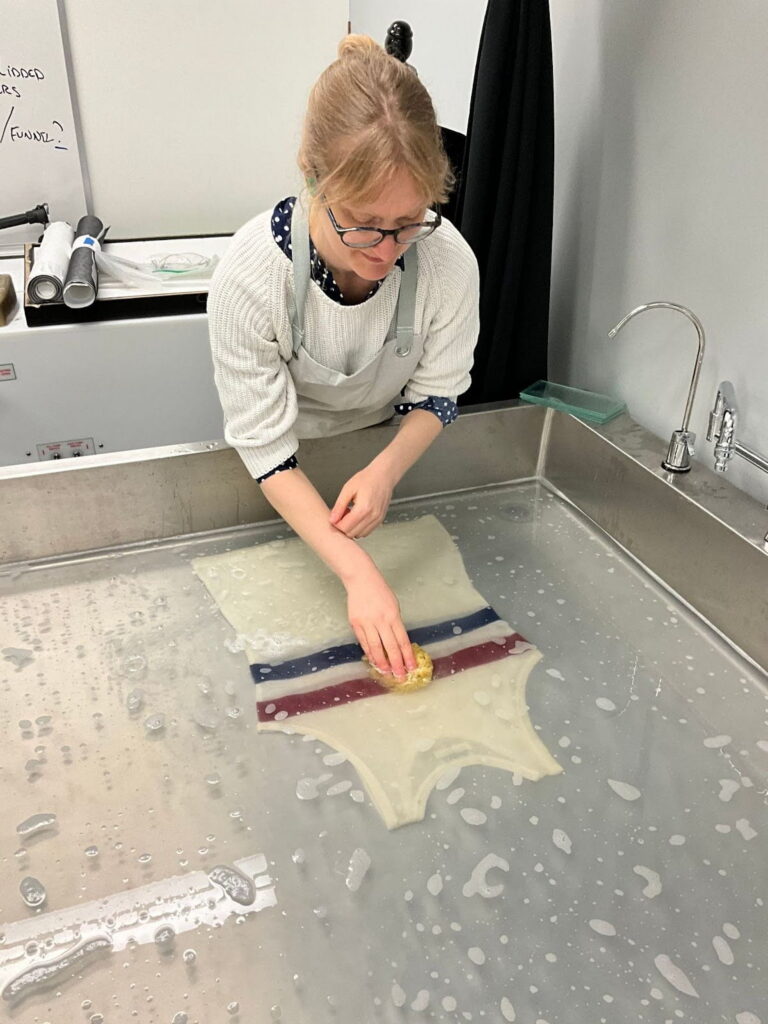
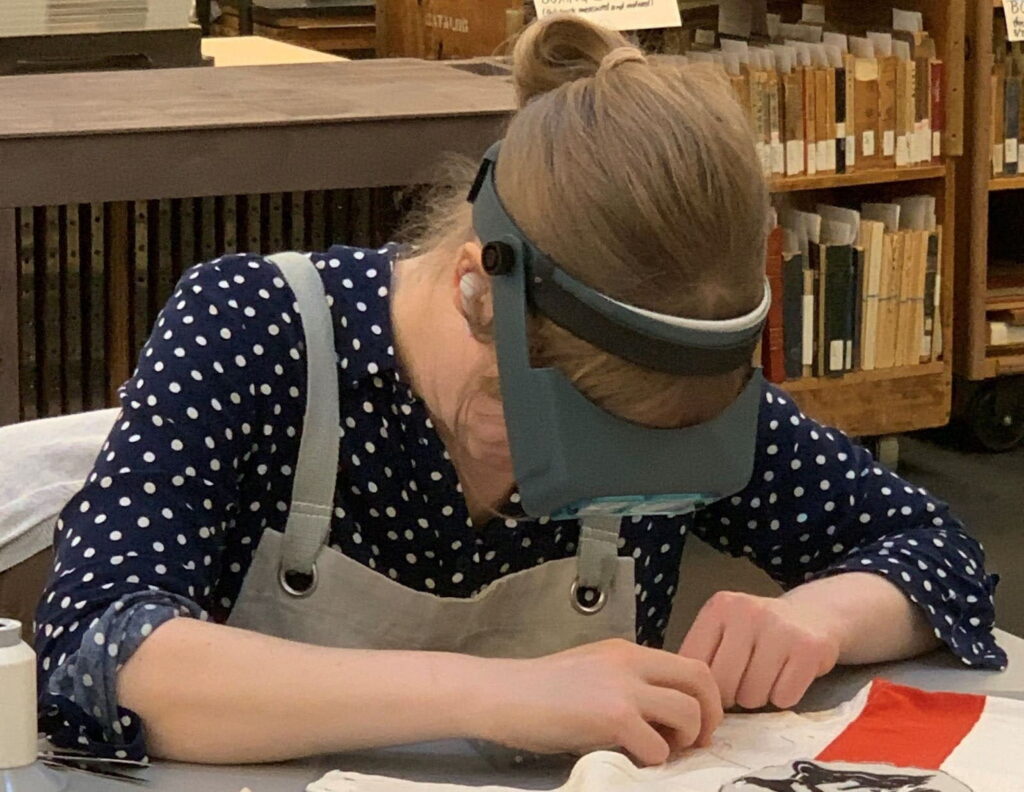
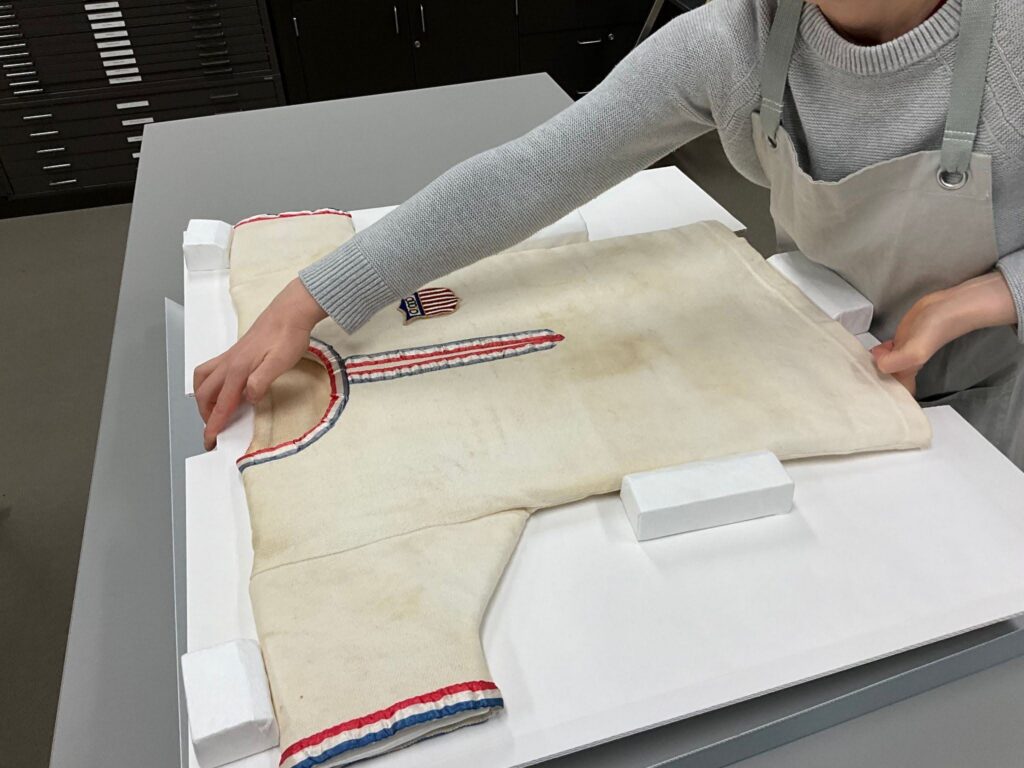
When the uniforms arrived, they were in fragile condition after years of being folded and displayed in a shadow box. They had visible creases, staining and small tears. After loan for exhibition, Special Collections asked textile conservator Kate Clive-Powell to carry out a detailed conservation assessment and to create a treatment plan to stabilize the materials while maintaining the integrity and historical evidence of each garment.
Each uniform was treated with care tailored to its specific condition. Moch’s jersey, with sweat stains from competition, was left untreated in those areas to preserve its historical authenticity. The British jersey was gently washed to reduce age-related staining and remove creases.
The German jersey received spot cleaning and repairs to small holes using hand-dyed patches that blend seamlessly into the original fabric. None of the work attempted to restore the items to a brand-new appearance. Instead, the goal was to stabilize the uniforms to ensure they can be handled, studied and displayed safely.
Working collaboratively, Conservation Technician Alex Hines and Kate designed and built custom housing for each item. The uniforms are now supported by lightweight internal mounts made of polyester wadding covered in silk, helping to prevent future creasing or strain. Each has a custom-made storage box with a removable internal tray that allows for access with minimal handling.
“It is satisfying to know that because of the conservation and re-housing of these historically important textiles they can now be safely accessed, viewed and enjoyed by many more people”
– Textile Conservator Kate Clive-Powell, UW Libraries
The conservation of the uniforms was made possible with support from the Sustainable Cooperative Conservation Services at the University of Washington grant. This grant currently funds Textile Conservator, Kate Clive-Powell, on a two-year appointment to conserve textiles in the collection of UW Libraries, the Henry Art Gallery and the Burke Museum of Natural History and Culture in support of shared conservation services. The nature of short-term grants like this and what can be accomplished, highlights the importance of sustained funding for shared conservation services to preserve important and fragile collections.
Did You Know?
Each year, UW Libraries Conservation staff repair, bind or make enclosures for an estimated 10,000 items in the UW Libraries. This care helps to preserve, stabilize or restore the usability of book, paper, and photograph materials.
This project demonstrates our mission to care for the University’s collections in ways that honor their past and safeguard their future as valuable artifacts for teaching, learning and research. These uniforms are not just records of history but human stories woven into fabric.
To explore the collection, visit: Robert G. Moch Collection on Archives West. Note: The jerseys are not on display to minimize further damage, but can be viewed with an advance appointment. To learn more and view other materials, see the UW 1936 Olympic Rowing Team digital collection.
For questions about this project and/or to learn more about the UW Libraries Conservation Center and preservation work, contact: [email protected]
###