
Conservation Spotlight: Restoring a 16th Century Text
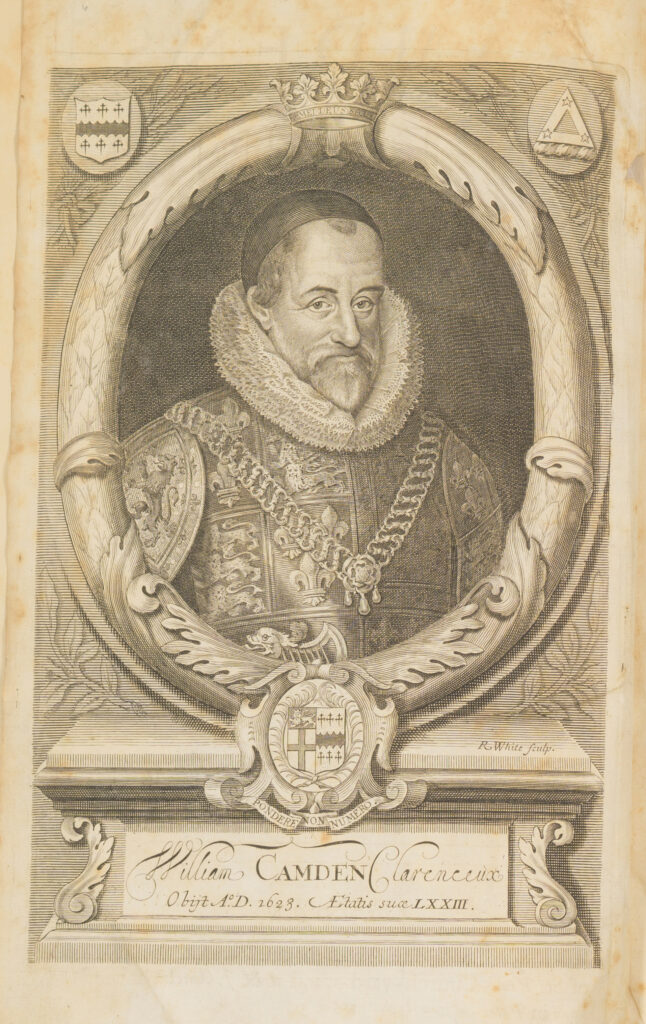
DID YOU KNOW?
Camden’s Britannia was originally published in Latin in 1586 as a geographical and historical history of Britain, particularly bringing its Roman history to light, which was not a focus of previous histories. It was a popular book at the time, and was republished in multiple Latin editions before being translated into English in the 17th century. Later editions were larger and contained more maps and illustrations. The 1695 edition in English includes histories of Britain and Ireland by county along with large fold-out maps and illustrations of ancient remains.
By Ella Jackson
I recently completed an internship with the University of Washington Preservation Department and Libraries Conservation Center where I had the opportunity to learn from the amazing staff and the many different aspects of their work. I was excited to learn more about treatments and practices that integrate chemistry, history, materials, and hand skills. The interdisciplinary nature of conservation work is something that initially drew me to this career, and seeing it in action was incredible.
I was excited to learn more about treatments and practices that integrate chemistry, history, materials, and hand skills. The interdisciplinary nature of conservation work is something that initially drew me to this career, and seeing it in action was incredible.
Over the course of ten weeks, I completed nine book and paper conservation projects under the mentorship of Senior Conservator for books and paper, Leith Calcote. These projects varied in complexity, each providing the opportunity to practice important conservation skills. I was especially able to expand my knowledge and develop these skills as I worked on a 1695 edition of Camden’s Britannia.
Camden’s Britannia came to the Conservation Center because it was too fragile for cataloguers to safely handle. The covers were detached from the text, the spine was cracked, and the sewing was broken. The text block was broken into multiple sections with some loose and torn pages.
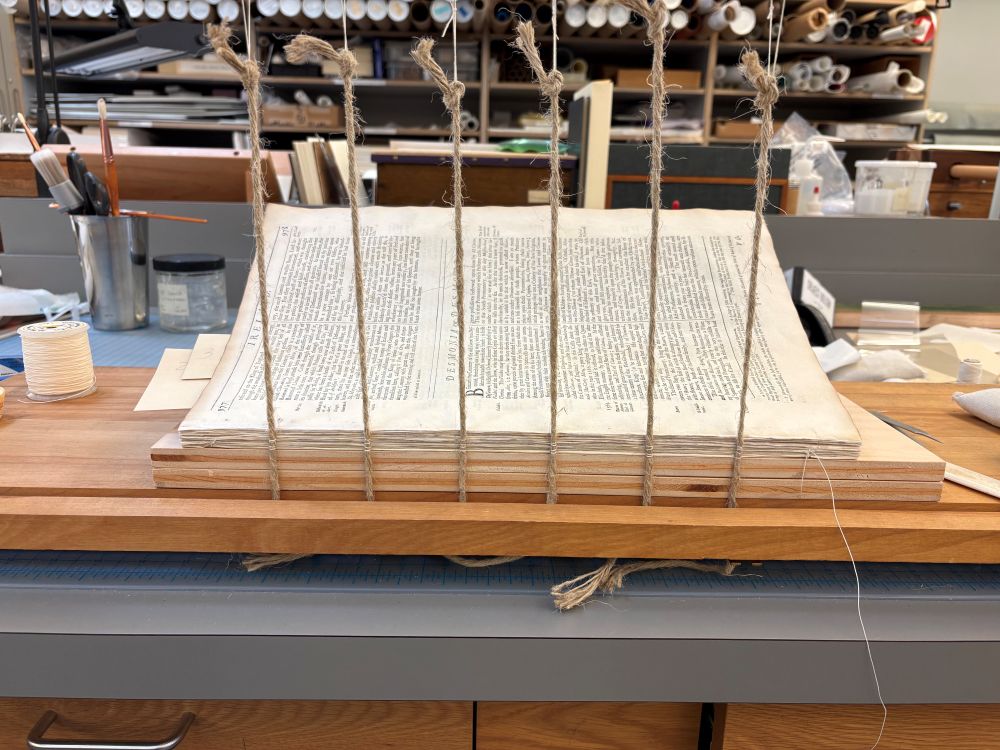
Before beginning our conservation work, Leith helped me develop a treatment to propose to the Rare Books Curator. This process emphasized to me the importance of looking closely and clear communication. With our plan approved, we treated the book by disbinding the text, repairing torn pages, and humidifying, flattening, and refolding maps. I used Japanese paper to guard damaged folds. With these repairs complete, I resewed the text block on cords to match the original binding and sewed new endbands. After consolidating the spine and lining it with paper and cloth, the book opened safely.
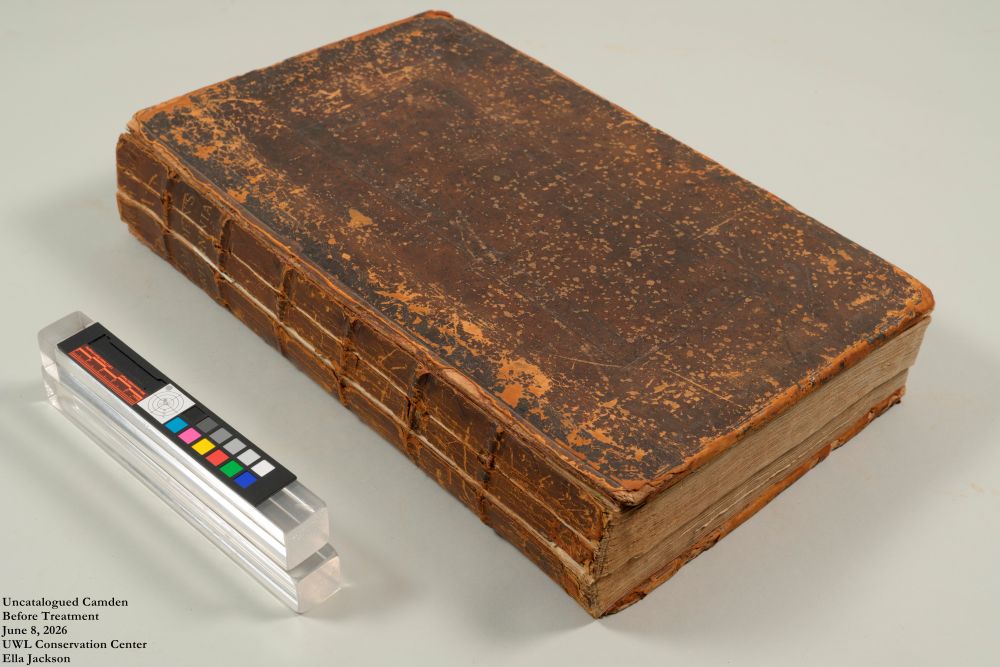
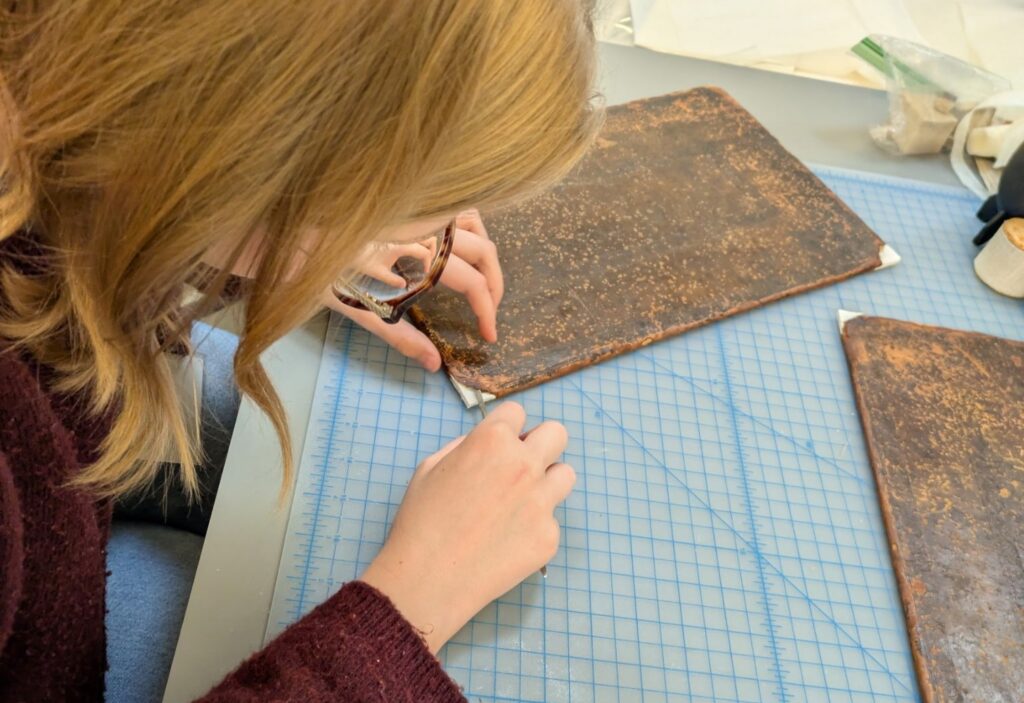
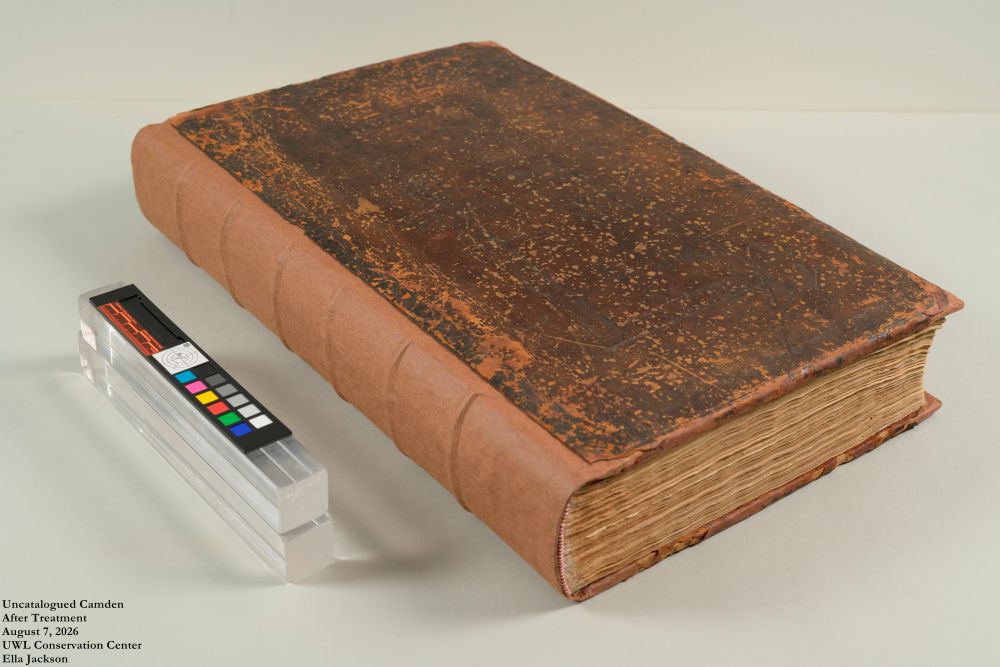
Images above left to right: 1) Camden’s Brittania before conservation, in a full-leather binding with covers detached, cracked spine, and damaged sewing. 2) Conservation Intern Ella Jackson adding material to the corners of Camden’s Brittania. 3) Camden’s Brittania after conservation treatment was completed with a new spine molded to preserve the appearance of raised cords.
This project was challenging, but it greatly expanded my conservation repertoire, as did the many other experiences I had at the Conservation Center. It reaffirmed my belief in the importance of conservation work, as it allows the written content and the historic structure of the book to contribute to our knowledge of cultural and technological developments. Conservation and preservation allow for valuable materials to be referenced for years to come. It is extremely satisfying to know that through our work, these books can provide information to future students and scholars.
For students interested in conservation, I would start with taking classes in art history, chemistry, or studio art. Another valuable resource is the American Institute for Conservation, which provides information about what conservation work entails. For students at the University of Washington, speaking with the conservators at the Conservation Center would be a great way to learn more!
I am incredibly grateful for this opportunity to work at the Conservation Center. As I continue in my studies, I look forward to learning more about conservation research, ethical philosophies, and spending more hands-on time with historic objects.
ABOUT THE AUTHOR
Ella Jackson is originally from Orlando, Florida and was introduced to bookbinding and conservation practices at her undergraduate institution’s library conservation laboratory. She graduated from Brigham Young University in 2026 with a BA in art history and curatorial studies, a minor in chemistry, and a French language certificate. Ella hopes to gain more practical conservation experience before applying to graduate-level art conservation programs.