
Suzzallo and Allen Libraries History
History, Architecture, and Design
Suzzallo Library
The University of Washington was founded in 1861, less than ten years after the creation of the Washington Territory and before the settler population had exceeded 350. The University moved to its current campus location in 1895. After 1909 the library was located in a building constructed for the Alaska-Yukon-Pacific Exposition and soon outgrew the space.
In 1915, when Henry Suzzallo was appointed President of the University, a new library building became one of his top priorities. When planning began in 1922, Suzzallo envisioned a library that was to be “the soul of the university.”
An example of the Collegiate Gothic style, the library was designed by Carl F. Gould, Sr. and Charles H. Bebb, Seattle architects of national stature who has also created the 1915 campus plan. Ground was broken for the new library in 1923.
Suzzallo Library, named for Henry Suzzallo, the fifteenth president of the University, opened in 1926. Soon after, President Suzzallo found himself involved in political rivalries and controversies that resulted in his dismissal from the University. The library, the crown jewel of his administration, was named for him following his death in 1933.
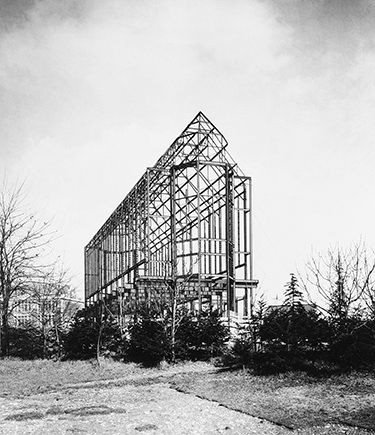
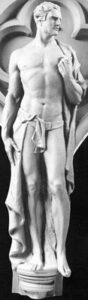 The exterior of Suzzallo Library is composed of sandstone, precast stone, terra-cotta and brick, with a slate roof. The windows are of leaded and stained glass.
Eighteen terra-cotta figures in niches atop buttresses were selected by the UW faculty in 1923 to symbolize contributions to learning and culture. Allan Clark, a young sculptor from Tacoma, was commissioned to create the figures, which include, from left to right, Moses, Louis Pasteur, Dante, Shakespeare, Plato, Benjamin Franklin, Justinian, Sir Isaac Newton, Leonardo da Vinci, Galileo, Goethe, Herodotus, Adam Smith, Homer, Gutenberg, Beethoven, Darwin and Grotius.
Just above the main doors stand figures of cast stone depicting “Mastery,” “Inspiration” and “Thought,” also sculpted by Clark.
A series of shields depicts coats of arms from universities around the world, including Toronto, Louvain, Virginia, California, Yale, Heidelberg, Bologna, Oxford, Paris, Harvard, Stanford, Michigan, Uppsala and Salamanca.
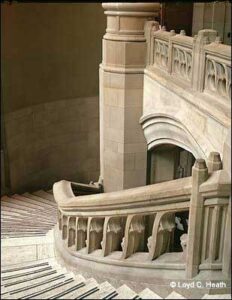 The Grand Staircase leads from the first to the third floors (The 1963 addition to Suzzallo added a floor between the first and second floors of the original building). Note the travertine treads worn by decades of students climbing the stairs.
At the top of the Grand Staircase is the Grand Stair Hall. In 1926, this area was a rotunda surrounded by stained glass windows.
The southeast wing was constructed in 1935. The original design called for an octagonal carillon tower over 300 feet high. Although it was never built, the shape is reflected in motif of the limestone floor.
The vaulted ceiling reveals a “batwing” – a system of steel reinforcing beams resembling the wing structure of a bat – one of the more visible features of a seismic renovation that Suzzallo underwent between 2000 and 2002, at a cost of $47 million.
The Grand Stair Hall also houses one of the world’s biggest books, a series of photographs of Bhutan by Michael Hawley. Protected by light-safe glass, the book’s pages are turned about once a month by Library staff.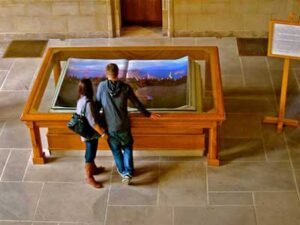
Part of the Book Arts Collections at the University of Washington…
One of the biggest books in the world compels attention in a country where records are something to strive for. Michael Hawley didn’t start out to make one of the world’s biggest books and while that might be what claimed headlines about Bhutan: A Visual Odyssey Across the Last Himalayan Kingdom, it isn’t the most significant. The project evolved into its 7 foot by 5 foot form as a result of Hawley’s research at the Massachusetts Institute of Technology working to capture photographically a visual record of field expeditions. Hawley led four separate expeditions to Bhutan where he and a team of MIT and Bhutanese students took photographs with state of the art digital and film equipment. Afterwards Hawley decided that making a giant book from the enormous archive of photographs would allow the reader to “step into” the world of Bhutan. UW faculty member Professor David Salesin, Computer Science and Engineering, was instrumental in taking many of the photographs and assisting in receiving a key grant from Microsoft.
Bhutan, a 2004 gift of an anonymous donor to the Libraries, joined the Book Arts Collection in the Special Collections Division. The Book Arts Collection is a group of 14,000 pieces, both historical and modern, of examples of book making of various forms. While it certainly held the record for size, there are many elements of Bhutan that fits it into a collection of equally stunning works. The lure of the book has long appealed to artists and size always has been a special challenge. Bhutan is reminiscent of the large antiphonaries of the medieval period, books of song meant to be sung from by a large group and big enough for everyone to see. There are huge 18th Century engravings by Giovanni Battista Piranesi so large they had to be folded to be bound into books. Similarly large atlases had maps folded when bound so that pages could be turned by a single reader and be part of a private library.
Bhutan tops a list of “big books”: John James Audubon’s Birds of America, David Roberts’ Egypt and Nubia, Thomas McKenney and James Hall’s History of the Indian tribes of North America-three 19th Century tour-de-force examples that pushed the technology of printing and binding, stand out in the history of book making because they were so uncommon. But, as with Bhutan, size was only part of their appeal. Both Audubon and Roberts were looking for way to capture the physical scale of their subjects. Audubon and McKenney and Hall featured rich hand colored illustrations. These books documented time and place and people, holding on to treasures in the changing world. Audubon has images of birds now extinct-Roberts gives us views of the Middle East worn away by sand and war-McKenney and Hall provide a vision of the American Native in his glory in the 1830’s. Hopefully Bhutan the country will hold on to the beauty of its natural environment and cultural richness so that Bhutan will not be the repository for the bones of a society over run by golden arches and the magic kingdom.
Everything about Bhutan is extraordinary: it is printed with a gallon of ink on a roll of paper longer than a football field. The printing process takes an entire 24 hours for each copy. It weighs 133 pounds making it the heaviest book in Special Collections as well as the biggest. The technical challenges of printing and binding a book of this size and weight are as enormous as the book. As much care went into displaying the book as into creating it. The Libraries commissioned a custom designed exhibition case so that Bhutan could be safely put on display in Suzzallo Library in a way that will not endanger the heavy binding. The case was made on campus, designed by Ed McKinley and fabricated by Carmine Ruggiero. Danette Rogers did the case finishing work.
But beyond the sheer amazement at the size and weight, the book warrants superlatives. To see Bhutan as simply a former Guinness Book of World’s Record holder is to sell the book short. The size contributes to its impact but without the photographs, the book would be a large 30 second sound bite. The book is cinematic. The views from the huge window the book creates are breathtaking-expansive in a way few other books have ever been. Floods of color fill your entire field of vision and portraits are almost human size. Without question the continuously printed images are spectacular. Turning the huge pages is a contemplative experience. Bhutan is a treasured addition to a nationally significant Collection. The book is now on permanent display outside of the Reading Room in Suzzallo Library. Pages are turned once a month. The small trade version is available in Odegaard Undergraduate Library and in Special Collections.
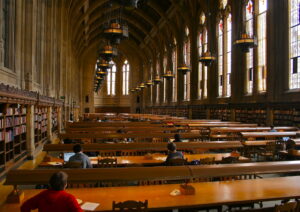 The Suzzallo Reading Room measures 65 feet high, 52 feet wide, and 250 feet long.
The Suzzallo Reading Room features a vaulted ceiling with vibrantly colored and gilded details. A 1927 article in The Pacific Builder and Engineer stated that “This room has been pronounced by experts to be the most beautiful on the continent and is ranked among the most beautiful in the world.”
Oak bookcases along the walls are topped with hand-carved friezes representing native plants of Washington State, including salal, Douglas fir, scrub oak, grape, dogwood, mountain ash, rhododendron, pear, trillium, salmon berry, wild rose, apple, marigold, cantaloupe, tulip and cherry.
Leaded-glass windows incorporate medallions representing 28 Renaissance watermarks from a book purchased by the University Library in 1923, Les Filigranes: Dictionnaire Historique des Marques du Papier, a four-volume set by C.M. Briquet.
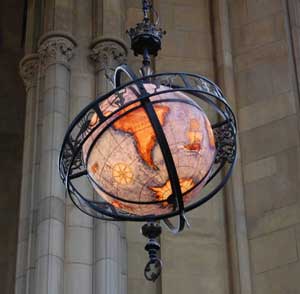 At each end of the reading room, hangs a hand-painted world globe, each of which bear names of explorers. In the south apse, Leif Ericson, Marco Polo, Columbus, Amerigo Vespucci, Magellan, Henry Hudson, Vasco da Gama and Juan Rodriguez Cabrillo. In the north apse, Ponce de Léon, Hernando Cortez, Capt. John Smith, Sir Walter Raleigh, Fray Junípero Serra, Vasco Núñez de Balboa, Francisco Pizarro, John Cabot, Jacques Cartier and Fernando de Soto.
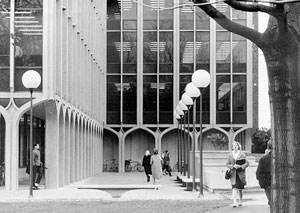 As you exit the Reading Room through the Grand Stair Hall, a transition in the floor from sandstone to linoleum marks the 1961-1963 addition of 125,000 square feet. Architects Bindon and Wright departed radically from Bebb and Gould’s original plans for the library with modern architecture designed to harmonize with the gothic elements in the original building, as well as with those in surrounding campus buildings.
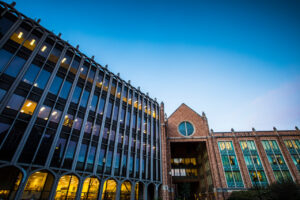 The Allen Library was completed in 1990, proving shelving for over a million volumes as well as ultraviolet filtering for lights and windows.
In 1988, the Washington State Legislature approved funding for the construction of the Allen library, designed by Edward Larrabee Barnes Associates of New York. The brick and terra-cotta facade by Daniel Casey ties the building to existing campus architectural styles.
The library was named for Kenneth S. Allen, Associate Director of Libraries from 1960 to 1982, in recognition of his years of service to the Libraries, and in appreciation of a generous gift from his son, Paul G. Allen, co-founder of Microsoft.
 In 1994, artists Carl T. Chew, Mare Blocker, J. T. Stewart, and Ron Hilbert installed their collaborative artwork, Raven Brings Light to This House of Stories in the Allen Library as part of the Washington State Art in Public Places Program.
In Pacific Northwest Native American lore, the raven is the being who went east to bring the light to the West. 40 ravens and crows are suspended from the ceiling and carry symbols from cultures around the world. The title is displayed above the windows in the Lushootseed and English languages. Additional artworks in the immediate area include poems, a hand-made book, and a study table.
A Native American, Pacific Northwest Coast story tells how once it was so dark here that the People sent Raven and Mink to bring back light. Artworks by Mare Blocker, Carl Chew, Ron Hilbert Coy, and J.T. Stewart located throughout the Kenneth S. Allen Library are parts of a contemporary retelling of this story. In this retelling, light symbolizes the Library’s collected knowledge.
Raven Brings Light to this House of Stories is a project of the Washington State Arts Commission, Art in Public Places Program in partnership with the University of Washington. The title of the work can be found written along the southeast wall in the Ground Floor Lobby, Allen North. It is in Lushootseed and English. Lushootseed speaking people are the Native Americans ancestral to where Seattle is today.
|
Title of the exhibit |
Phonetic representations of sounds in Lushootseed |
|---|---|
Raven brings light
|
|

The installation includes:
- Ravens and Crows
By the artist team. In the Lobby and throughout the Library. - Table of Knowledge
A cedar table by Ron Hilbert Coy celebrating the passage of knowledge from one generation to the next. In the Lobby. - Presentations from the International Symposium of Light
A book by the artists, printed and bound by Mare Blocker. In the Lobby on the Table of Knowledge. - Broadsides
Poems by J.T. Stewart, printed by Mare Blocker. In the Lobby, and 2nd Floor Bridge between Allen North and South Wings. - Study Desks
Two Cawpets by Carl Chew. Balcony 1st Floor Allen North, and 3rd Floor Allen South. - Things the Crows Left
Special Collections.
Mare Blocker is an artist book maker and publisher from Jerome, Arizona.
Rug designer and manufacturer Carl Chew, artist, carver, and story teller Ron Hilbert Coy, and literary artist and instructor J.T. Stewart reside in Seattle.
More about this exhibit and related information:
- Lushootseed dictionary / Dawn Bates, Thom Hess, Vi Hilbert; edited by Dawn Bates.
Seattle : University of Washington Press, c1994. - Northwest coast texts : [stealing light] edited by Barry F. Carlson.
University of Chicago Press, 1997. - Whulshootseed Language
- Contact Special Collections
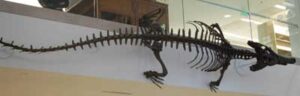 In the south wing of the Allen Library is a cast of a 28 foot fossil crocodile, Tomistoma machikanense, from the late Pleistocene, thanks to a special arrangement with the Burke Museum at the University of Washington.