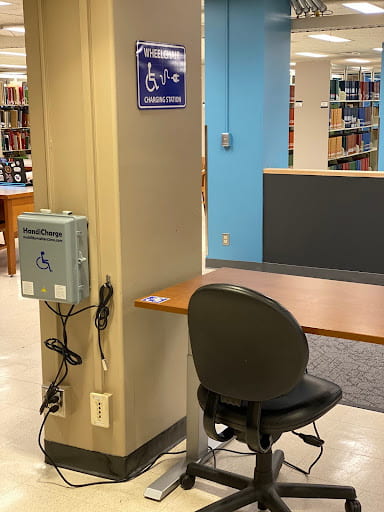
one of the new charging station in Suzzallo Library, one of four new stations in libraries across the Seattle campus
The UW Libraries have added four wheelchair charging stations, located in the Odegaard Undergraduate Library, the Open Scholarship Commons in Suzzallo Library, the Research Commons in the Allen Library, and the Foster Business Library. These charging stations were able to be purchased thanks to the UW’s Student Technology Fee (STF). The charging stations are from the Clearview Disability Resource Center and have 24 volt five-amp chargers, as well as a dual USB charging port. They are available to all library visitors. The Libraries have long had STF-funded stations equipped for charging small devices such as phones and tablets, and are excited to now have the necessary infrastructure for ensuring people using powered wheelchairs can recharge on campus.
Before the Libraries added these four charging stations to the Seattle campus, the only existing public spot for charging wheelchairs was in the Hans Rosling Center.
“Having multiple recharging options on campus will be beneficial to powerchair users. For instance, commuting between the main campus and the South Campus can be incredibly draining on the batteries. Having chargers across campus offers increased flexibility to do whatever you need to do while on campus and not having to worry if the battery has enough power to get home,” said Andy Andrews, Assistant Director of Academic Services at Disability Resources for Students.
More charging stations are also expected to be added on campus in the future. One group working on adding charging capability to the campus is UW’s Engineers Without Borders Accessibility group, who are working on “Project Mobility” to improve the affordability of this endeavor.
Enhancing equitable environments for teaching, learning and research is one of the UW Libraries main strategic priorities. To put those values into practice, we prioritized improving access to library spaces and resources by adding more wheelchair charging stations. We hope that these stations will improve the campus experience for wheelchair users, with the ability to recharge their devices as needed without having to cart around unwieldy cords or return home.
A full list of our accessible spaces and resources can be found on the Libraries Accessibility page. If you have any questions about the study room or would like to suggest potential areas of improvement related to Libraries’ accessibility, please contact us at [email protected].
###
Stories
The Secret Life of UW Libraries Catalogers and Metadata Specialists
January 22, 2024
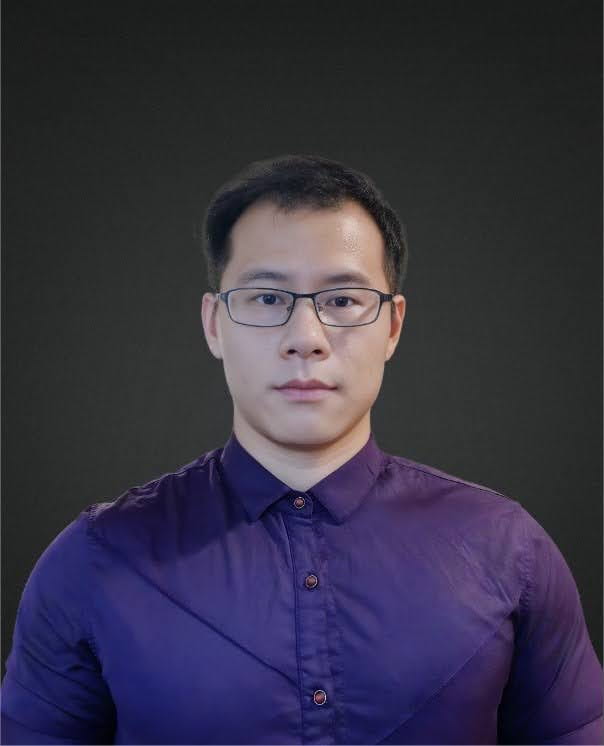
Student Spotlight: Zhuo Pan
Zhuo Pan says, “My time as a student employee at UW Libraries gave me both a solid foundation and a forward-thinking approach that have served me well in launching my career in library tech services.”
You may be surprised to hear that before you can access a library resource when you need it, a lot of work must be done to get that resource into the UW Libraries catalog. A whole department of librarians, staff, and students are quietly working away behind the scenes to get new resources into the catalog and to find innovative ways to enhance the Libraries’ metadata. This series of blog posts will highlight our brilliant student employees and the work they do to make your tasks of searching, identifying, selecting, and obtaining library resources easier and more effective.
Zhuo Pan came to the University of Washington iSchool’s MLIS program after earning a Bachelor’s in Library Science from Wuhan University. Given his prior study and experience, the UW Libraries’ Linked Data Team (an informal group focused on linked data projects) was thrilled to bring Zhuo on board as a student Library Data Specialist in February 2022.
What is linked data? We’re glad you asked. You might be familiar with standard web technologies such as HTTP, which uses hypertext links to serve up web pages for human readers to interpret. Machines cannot make much sense of web pages or their often-complex relationships to one another when they are in document form. Linked data builds on standard web technologies such as HTTP in a way that makes the information on the internet automatically readable for computers as well as humans. It also interlinks data with other data on the web using languages called ontologies that express specific types of relationships, so it becomes more useful through semantic queries. You may also hear people refer to linked data as the Semantic Web.
What is RDA?
RDA is an international set of cataloging standards which the UW Libraries follows in describing library resources. RDA publishes a linked data ontology alongside its cataloging rules so that libraries, museums, and galleries may express their descriptions as linked data.
Libraries are very interested in linked data because it has the potential to connect our users with information outside our collections from all over the web, enriching the user experience and enabling researchers to access more information than ever before.
The Linked Data Team at the University of Washington Libraries has been pursuing a linked data implementation of Resource Description and Access (RDA), an international library resource description standard already in use by library catalogers across the world, for a number of years because it is a more granular (and we think, more useful) ontology than others used to express library data as linked data. The UW Libraries has been a leader in this work, which you can learn more about through the UW Libraries Semantic Web Blog.
Zhuo exceeded the Linked Data Team’s high expectations with his work ethic, productivity, self-motivation and strategic thinking during his work on several projects at the Libraries. Zhuo began contributing to the MARC21 to LRM/RDA/RDF Mapping and Transformation Project, supervised by Theo Gerontakos and managed by Crystal Yragui, at the start of his employment. His deep theoretical knowledge of the Resource Description & Access (RDA) rules and ontology made him a respected colleague on an international team of world-recognized experts.
RDA is an international set of cataloging standards which the UW Libraries follows in describing library resources. RDA publishes a linked data ontology alongside its cataloging rules so that libraries, museums, and galleries may express their descriptions as linked data.
…Currently, libraries around the world are preparing to move from the existing non-linked-data format to linked data.
Currently, libraries around the world are preparing to move from MARC21 (the record-based, non-linked-data format we are used to seeing when we search the UW Libraries for resources) to linked data. In order to do this, libraries need to transform their MARC21 data to linked data formats, and create editing environments for new resource descriptions to be recorded. Zhuo made significant contributions to discussions, ontology mapping work, and the transformation code accompanying the ontology mapping. Zhuo’s work on this project will aid the international RDA user community in transforming their legacy MARC21 data to the RDA linked data format.
Zhuo’s MLIS Capstone project, Sinopia MAPs, worked toward the related goal of enabling the creation of new RDA metadata descriptions using RDA’s ontology through a set of templates. The direct creation of resource descriptions as linked data rather than as records which need to be converted to linked data using complex mappings and transformation processes avoids the losses of specificity that come along with transforming data from MARC. Supervised by Benjamin Riesenberg, Zhuo drafted a set of templates for describing print books, demonstrating a deep, professional-level knowledge of the RDA data model and numerous other sources of internationally-adopted documentation and instructions. He documented his template design well, and showed outstanding skill in the types of coding needed to get the job done. Templates for other types of resources will be created based on the print books templates Zhuo drafted, eventually allowing metadata professionals to describe all library resources in a similar way.
“My time as a student employee at UW Libraries gave me both a solid foundation and a forward-thinking approach that have served me well in launching my career in library tech services.” – Zhuo Pan
All of the work Zhuo has done on these two projects will help the University of Washington Libraries convert the existing catalog to linked data and change cataloging practices to linked data in the future. This will translate to high-quality linked data that guides users toward the information they need within the UW Libraries collections and across the Semantic Web.
Zhuo graduated with his MLIS in Spring 2023, and began his career as a Resource Description Resident Librarian at Duke University Libraries after a celebratory farewell lunch with the Linked Data Team. We hope to continue working with Zhuo on international library metadata projects, and are proud of his success.
###
Stories
January Update 2024
January 3, 2024
Happy New Year, Huskies! Here’s wishing you a great start to winter quarter and 2024! This month’s update features some incredible new stories including an insightful essay by The Boys in the Boat author, Daniel James Brown as well as features on our work to preserve Seattle’s music history, and student-centered scholarship documenting UW student sports experiences (Go Dawgs!) . Speaking of articles, all UW users now have faster, more direct access to journal articles (read our story on LibKey below) and access to the Atlantic magazine (see details below). As always, be sure to check out all of the free workshops, exhibits and events happening this month – for learning and for fun – including journal creation and info sessions on the very popular Data Science for Social Good summer program!
Pop-Up Exhibit:
Racing Toward the 1936 Olympics
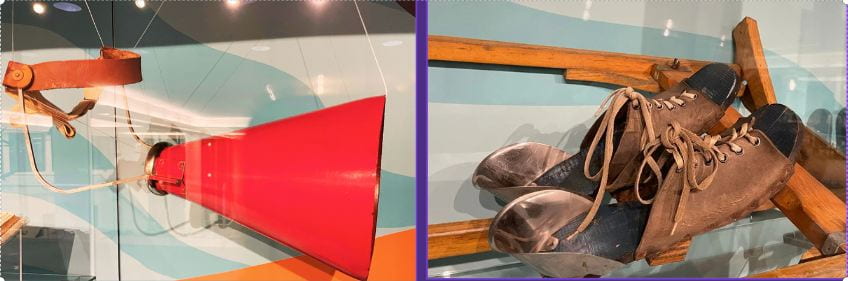
Don’t miss UW Libraries Special Collections’ pop-up exhibit Racing Toward the 1936 Olympics. The exhibit features a timeline of the events leading up to the Olympics beginning in 1931 and period rowing equipment courtesy of Pocock rowing historian Al Mackenzie, who also served as a rowing consultant for the film. The exhibit will be on display in the first-floor exhibit case in Allen Library North, through Friday, February 2, 2023.
Images: (left) A coxswain megaphone used by George Pocock, and (right) a sliding seat, rigger and foot stretcher from boats used by the team.
News and Stories
“The Boys in the Boat happened only because of the vast collection of carefully preserved documents and artifacts I was able to unearth at Suzzallo.”
In our most recent blog, Daniel James Brown shares his UW research journey writing the acclaimed book, The Boys in the Boat, now a major motion picture. Read the essay, stop by the exhibit ‘Racing Toward the 1936 Olympics” (see right) and check out UW Libraries new digital collection, UW 1936 Rowing Team!
Student Stories of Campus Sport Experiences: A Case of Engaged Learning– A recently published article in the theSports Innovation Journal highlights the Libraries role in supporting digital scholarship and open pedagogy practices, in particular through the use of Pressbooks. Co-authored by Lauren Ray, Open Education and Psychology Librarian with Jennifer Hoffman, Assoc. Professor in the Center for Leadership in Athletics at the UW College of Education and Regena Pauketat, doctoral candidate in the College of Education.
Community /Events
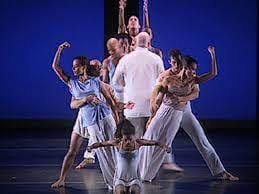
January 11- Film Screening: Bill T. Jones: Still/HereBill T. Jones: Still/Here follows dancer and choreographer Bill T. Jones as he develops his acclaimed “Still/Here” dance production based on his workshops inviting people battling serious illness to express their angst, hopes and fears through original gestures, which he incorporates into dance moments for his piece. This film screening accompanies the exhibit Someday This Will be Over: AIDS Remembered, in the Allen Library Lobby through January 15, 2024. Learn more.
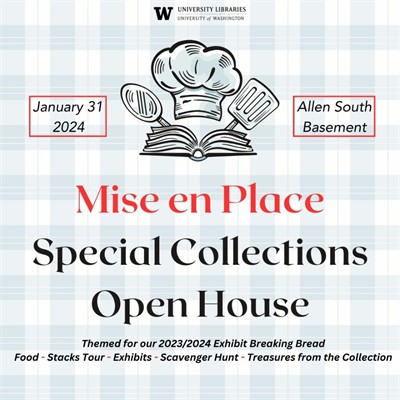
January 31-Mise en Place: Special Collections Open House A rare opportunity to go behind the scenes — tour and learn more about special collections and current exhibits. Enjoy food, a scavenger hunt, insights from the curators, and get “hands on” access to many treasures from the collections, including items from our current exhibits: Breaking Bread: Foodways and Cuisine in Print AND Magick and Mystery: Exploring the Supernatural.! OPEN TO ALL! Learn more.
NEW Resources!
The Atlantic online:UW users now have online access to The Atlantic! From the log-in page click “Sign in through your institution,” find the University of Washington, then create an account with your UW email. Get access
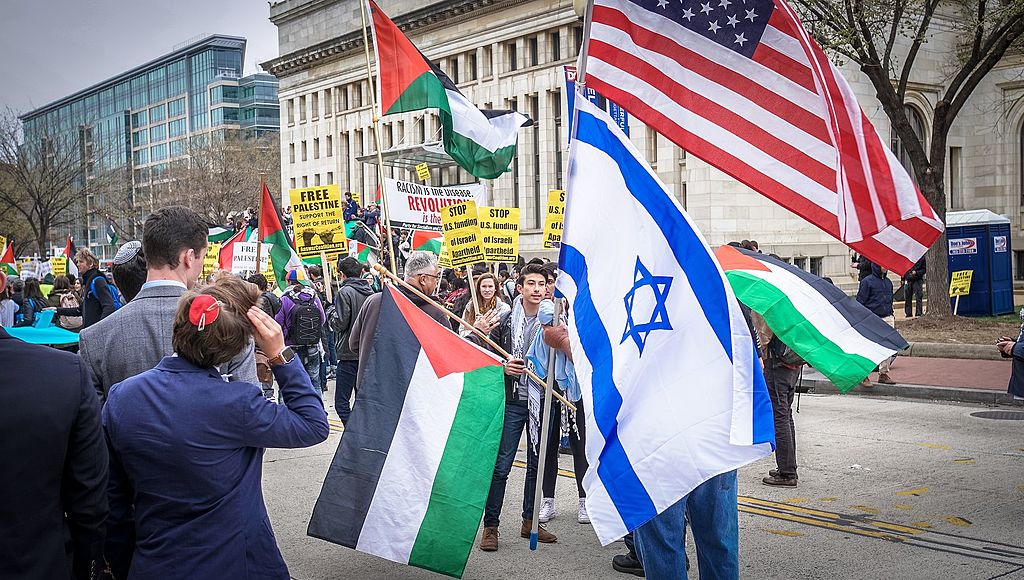
Israel-Hamas War Research Guide: This new research guide provides access to tools and sources for learning about the Israel-Hamas war, representing a variety of academic and political perspectives.
Special Programs/Upcoming Application Deadlines
January 24- Information Session for Data Science for Social Good (DSSG)-online and in-person sessions. The Data Science for Social Good (DSSG) is a 10-week summer program that brings together students, stakeholders, and data and domain researchers to work on focused, collaborative projects for societal benefit. Up to 16 UW DSSG Student Fellows are selected annually. Applications will be accepted from Jan. 3 – Feb. 12, 2024Learn more.
February 4th-UW Libraries Fellowship in Research Communication and Equity: This unique fellowship program is aimed at Black, Indigenous, and People of Color (BIPOC) graduate students who want to share their research or other academic work. Fellows will create a physical artifact that visually communicates their research and receive a $500 award. Applications due February 4th. Learn more.
Learning Workshops
January 15th- Metadata Support for UW Libraries Digital Scholarship Platforms. High-quality, descriptive metadata can make your work more findable and meaningful for users, but platform requirements and standards aren’t always easy to understand. UW Libraries can help!
January 23- Student Journals Hack the Academy -online and in-person sessions. Hear from representatives of five UW student journals about the importance of student-produced scholarship and how student journals “hack the academy” by pushing the boundaries of traditional scholarship and publishing! See also our “So you want to start a journal?” workshop on January 31st!
January 23- Textual Studies & Digital Humanities Minor Open House. Learn more about studies relevant to careers in libraries and archives, publishing and editing, and fields dedicated to preserving and making accessible cultural materials and documents! You don’t have to know your career plan to explore the many opportunities in these fields and how these UW courses can support your exploration.
Digital Scholarship Project Help Office Hours- Tuesdays: Learn about getting started with digital projects at UW. We offer consultations for research and course related projects. Examples include support for digital publishing, building digital exhibits, and more! We can help you find the right tools, resources and instruction whether you’re just getting started or are working on an on-going project. Learn more
Exhibits
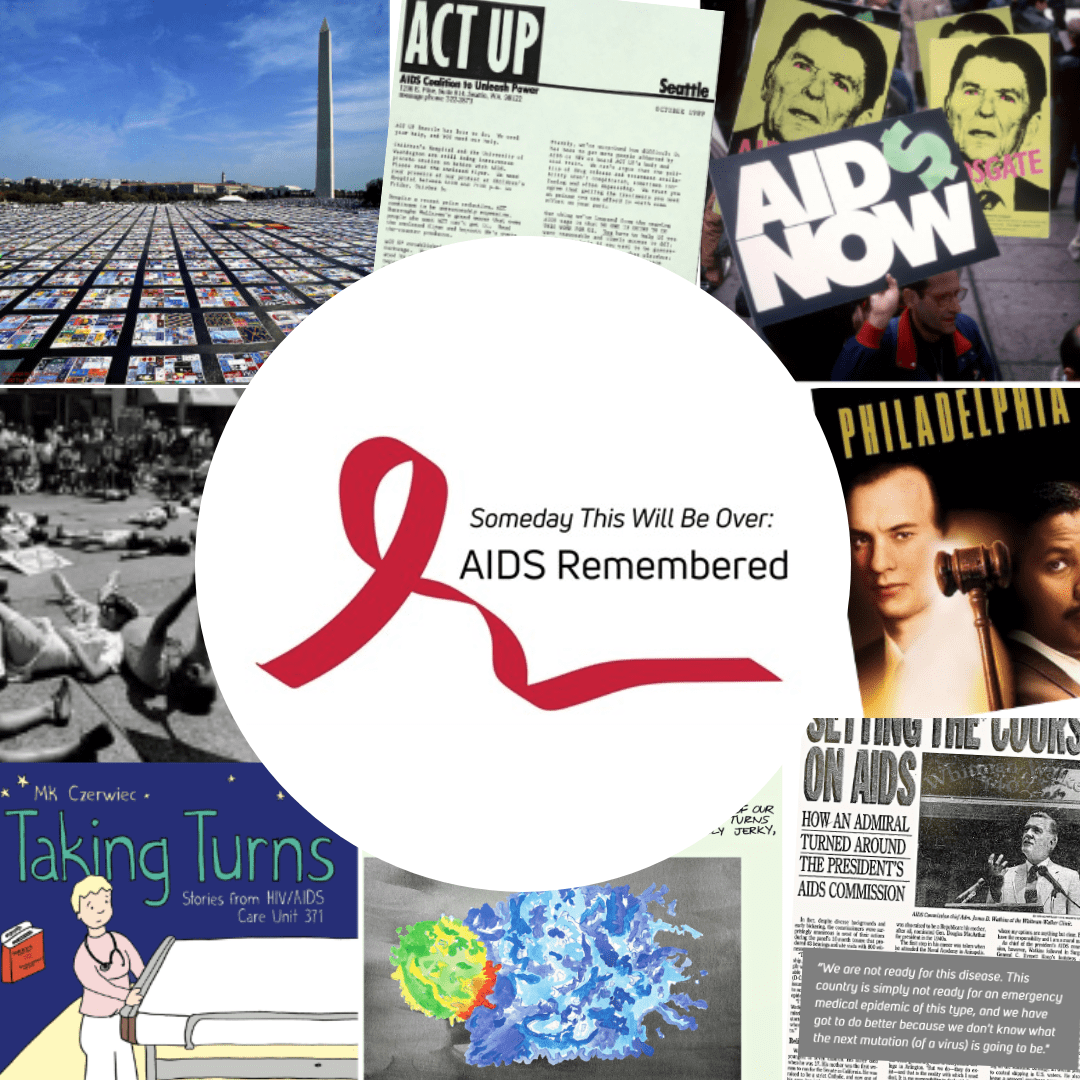
Someday This Will Be Over: AIDS Remembered – On the 35th anniversary of World AIDS Day, this exhibit highlights the history of the HIV/AIDS pandemic with a focus on the political, social, and cultural impacts in the United States and Seattle. The exhibit will also feature film viewings in Allen Auditorium. Now-January 15th. Learn more.
Breaking Bread: Foodways and Cuisine in Print – opening September 26 For the 2023-24 academic year, Special Collections is featuring items in our collections that connect to a multitude of different foodways and food cultures. With four rotations at the end of each quarter, the items from Special Collections demonstrate complex systems of cultural celebration, continuance, and suppression that are wrapped up in food systems. Learn more.
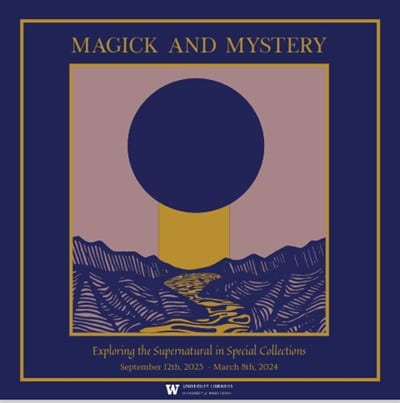
Magick and Mystery: Exploring the Supernatural in Special Collections – Opens September 12. Explore the supernatural in this exhibit featuring all manner of magic and mischief. Opening in Fall 2023 and running until the end of Winter Quarter 2024, Magick and Mystery will feature items from Special Collections, in the UW Libraries, on topics ranging from local folklore and mysteries to 19th-century spiritualism, and even TikTok tarot trends.Learn more.
###
Stories
Fiat Lux – By Daniel James Brown
December 12, 2023
Daniel Brown, author of The Boys in the Boat
The following is a version of a keynote speech given by author Daniel James Brown at the 2014 UW Libraries’ Literary Voices fundraising event that has been edited for length in this context.
PREFACE: Daniel Brown’s love of libraries began decades ago when, as a struggling high school student, he was instructed to complete correspondence courses while working out of Doe Memorial Library at Cal Berkeley—to earn his high school diploma. The experience was foundational. Speaking at a UW Libraries event, Brown reflected about this pivotal time and his early career as an English professor, where “university libraries were always my places of refuge, my sanctuaries—Doe and the Bancroft at Berkeley, Powell at UCLA, Clark at San Jose State, Green at Stanford. They were the places where I could most fully become who I was, who I am today.”
I have to confess that although I lived just across the lake in Redmond, I seldom had occasion to visit the University of Washington Libraries. But then, in 2008, I met my neighbor, an old man named Joe Rantz. When I first sat down with Joe and he began to tell me how he had come to row crew at the University of Washington and how he and his crewmates had won a gold medal in Berlin in 1936, rowing against a German boat in front of Hitler, I was mesmerized immediately.
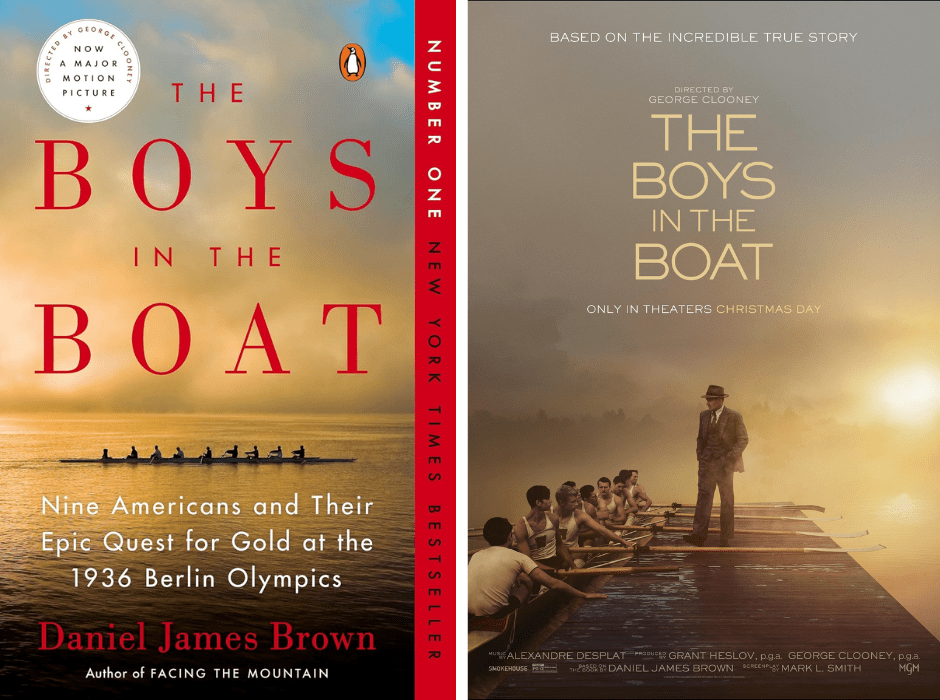
LEFT: The book cover for The Boys in the Boat; RIGHT: a promotional poster for the film, opening December 25, 2023.
And as Joe talked that first day, I couldn’t help but notice that from time-to-time he was tearing up. At first, I thought he was crying for the loss of his crewmates, most of whom had passed away in the preceding few years. But as we talked more I began to see that there was a kind of joy coming through Joe’s tears, a large measure of pride and love. And as we talked more, I began to understand that Joe was crying not so much for the loss of his crewmates as for the sheer beauty of what had happened seventy-five years before in Berlin. Toward the end of the conversation, I asked Joe if I could write a book about his life. He thought for a moment and then shook his head and said slowly, “No…I don’t want you to write a book about my life. But you can write a book about the boat.”
At first, I didn’t know what he meant—I thought he meant the physical boat in which he and his mates had rowed. But we talked a little more, and I gradually came to understand that by “the boat” Joe meant the other boys who had rowed with him. And then, finally, I came to understand that he meant more even than that. He meant the perfect thing that he and those eight other good-hearted boys had become together—a living thing, an almost mystical thing, an exquisitely unified and balanced thing, a team in the very deepest possible meaning of that word.
And so I set out, the very next day, with Joe’s permission, to write a book about the boys in the boat.
It didn’t take me long, though, to discover that the story was really about even more than just than those nine boys and a gold medal and the beauty of that moment in Berlin. It was about the mechanics of rowing, the physiology of pain, and the psychology of endurance. It was about humility and trust, about loss and redemption. It was about the Great Depression and the Dust Bowl and Nazi Germany and boat building and an Olympic boycott and a German filmmaker named Leni Riefenstahl and many, many other things about which I knew next to nothing.
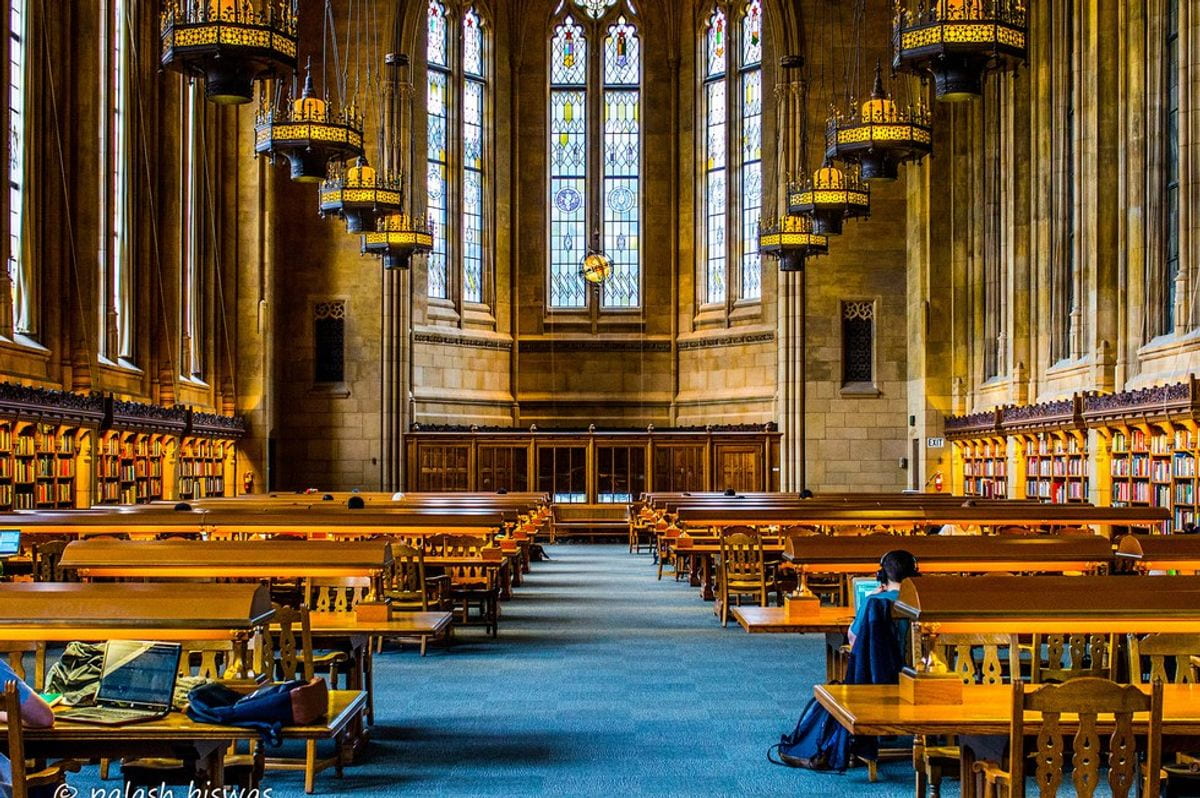
The Reading Room in Suzzallo Library
But I did know where to go. And when I walked into Suzzallo Library at the University of Washington, I knew immediately that I was home again.
There were the old familiar smells, the ornate entrances and marble staircases, the murmuring of students, a great, cathedral-like reading room, and stacks and stacks of books.
Over the next several years, that first conversation I had with Joe Rantz became a book called The Boys in the Boat. But that happened only because of the vast collection of carefully preserved documents and artifacts I was able to unearth at Suzzallo.
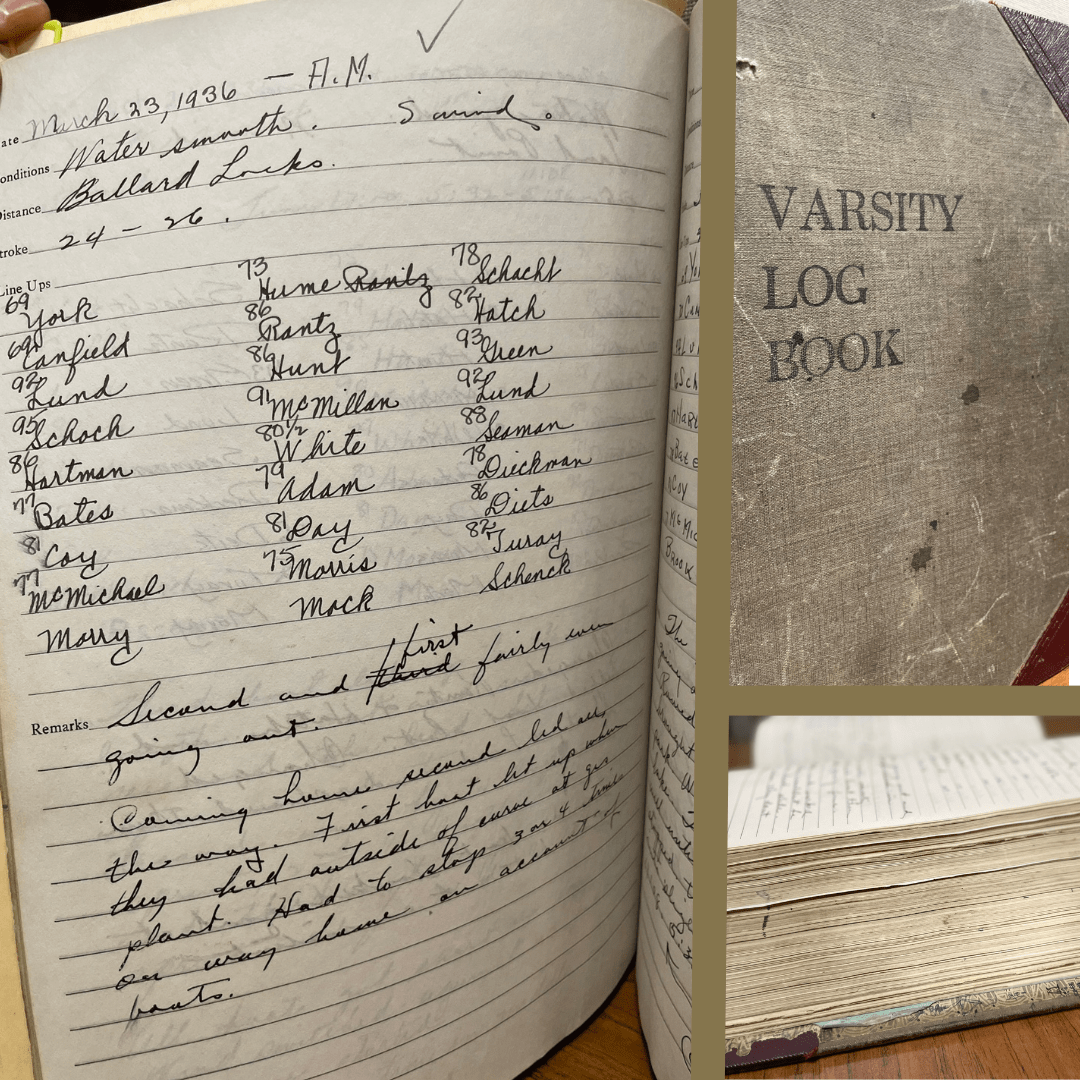
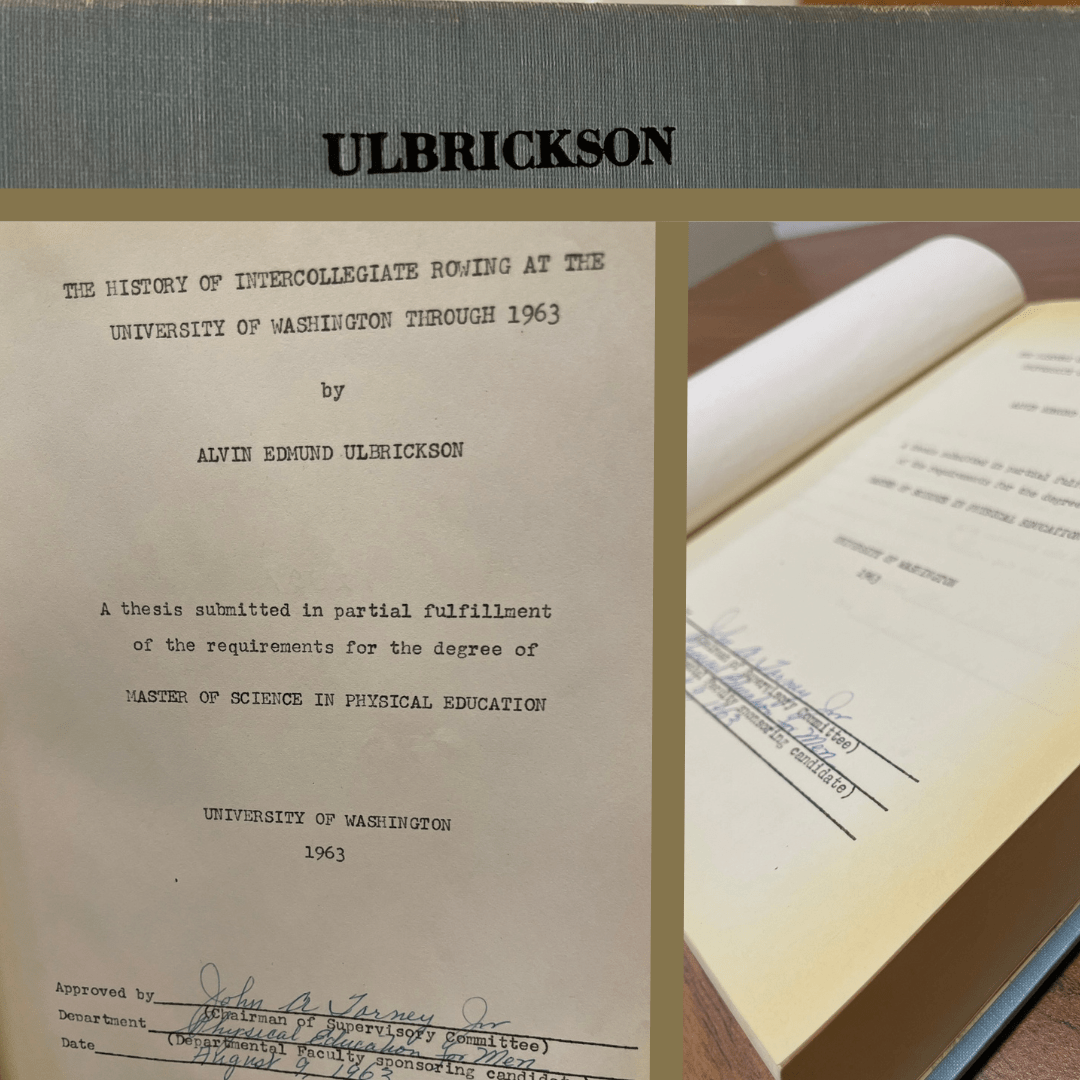
Images: A page from one of Coach Al Ulbrickson’s log books, March, 1936. From the Alvin Edmund Ulbrickson papers, University of Washington Libraries, Special Collections, accession number 2941-001Images: Cover page and spine of the bound edition of Al Ulbrickson Jr.’s Master’s thesis on the history of Washington rowing. Special Collections, Thesis 12997
I found hundreds of relevant articles from The Seattle Times, the P-I, and UW’s Daily on microfilm. I found the daily logbooks of Coach Al Ulbrickson, some of them kept in old lab notebooks stained with mysterious chemicals but carefully conserved in Special Collections. I found a bound edition of his son, Al Junior’s, Master’s thesis on the history of Washington rowing. I found a trove of books on German history, sports psychology, the Depression, Riefenstahl, and dozens of other topics of interest—really pretty much everything I needed to get a firm grip on any angle of the larger story. There were hundreds of photographs—not just those that appear in the book—but scores more that gave me small but crucial insights into daily life in Seattle in the mid-1930s, many of them conveniently digitized.
I don’t think it is an overstatement to say that The Boys in the Boat would never have happened but for the resources housed in this one library.
These kinds of materials are the stuff from which new books are sometimes made—not just mine, but thousands of the new books that appear in the marketplace every year. I think too often we think of libraries only as repositories of old stories and old books; but in fact they are also very often the wellspring of new stories and new books.
Now we are here tonight, of course, because we have decided to join in a cause, to raise funds for the library. And that brings to mind an incident from The Boys in the Boat. The boys from Washington won the right to represent the United States at the 1936 Berlin Olympics in a qualifying race at Princeton on a sweltering hot day in June of 1936. But just a few hours after that victory—after they had realized the goal toward which they had striven for three years—an official from the Olympic Rowing Committee, a man named Henry Penn Burke from Pennsylvania, came to Coach Ulbrickson and informed him that the boys, or the university, would have to pay their own way to Berlin. And, Burke went on, if Washington couldn’t afford to go, the Pennsylvania boys had plenty of money. They had come in second. They would be happy to go in Washington’s place. Ulbrickson was flabbergasted, and furious. No one had ever suggested that the boys would need to pay their own way. This was the depths of the Depression and none of them had two nickels to rub together, nor for that matter did the University. Burke left the meeting with Ulbrickson under the impression that Washington could not afford to go. Ulbrickson left the room with the same impression.
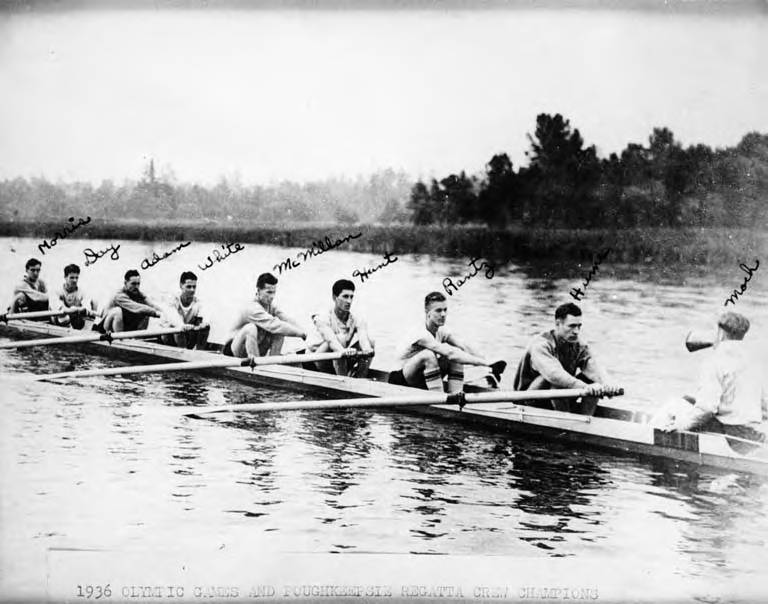
Image: 1936 Olympic Games and Poughkeepsie Regatta Crew Champions (Joe Rantz is the second rower from the front), University of Washington Libraries, Special Collections, UW37275. See also many of the iconic historical photos in a new UW Libraries digital collection: UW 1936 Olympic Rowing Team
But that night, phones began to ring all over Seattle. Ulbrickson and the Washington press contingent—Royal Brougham of the Post-Intelligencer and George Varnell of TheSeattle Times—began placing calls back home and composing headlines for the morning editions of their papers. By the next morning, committees had been formed. By that afternoon hundreds of students and citizens were on the streets of Seattle selling paper badges for 50 cents apiece. Donations began to come in from businesses and individuals: $1.00 from a donor who wished to remain anonymous, $5.00 from the Hide-Away-Beer Parlor, a hefty $500 from The SeattleTimes. By the time another twenty-four hours had passed, the citizens of Seattle had raised $5,000 and the boys were good to go to Germany. But only because the citizens of Seattle stood up and said, “Yes they will go.” It was, as someone pointed out to me recently, an example of Seattle’s 12th man before there was even a professional football team in the city.
It tells a story. It tells how—aided by the spectacular generosity of the citizens of Seattle in a very tough time—those nine young men showed us all what we can do when we climb in a boat and pull together as one.
The boys went on to win Olympic gold in spectacular fashion in Berlin. But they did more than win gold. They created a great legacy. If you have never done so, I urge you to go down to Conibear Shellhouse and take a look at the Husky Clipper, the beautiful shell in which the boys rowed their way to glory in 1936. It hangs gorgeously above the dining commons. It has been lovingly restored, preserved, and displayed. Its burnished red cedar hull and yellow spruce trim glow under the spotlights in the room. But more than a beautiful object, the Husky Clipper is important because it is a symbol. It stands for something far beyond winning a race. It embodies the boys’ legacy. It tells a story. It tells how—aided by the spectacular generosity of the citizens of Seattle in a very tough time—those nine young men showed us all what we can do when we climb in a boat and pull together as one.
And that’s just exactly what we are doing here this evening, climbing in a boat and pulling together as one toward a common goal—
providing for the restoration, conservation, and preservation of the library materials that remind us who we are, the materials that past generations have left us as their legacies, to tell us their stories, and to engender new stories.
And so the library—particularly the university library—remains the ultimate sanctuary of knowledge. And it is truly a sanctuary, a temple in which we keep the flame of knowledge lit. And we must defend it. It is up to us individually—but more importantly collectively, as a team, joining together as one, just like that 1936 crew—to keep that flame blazing brightly. As the motto over the portal of Doe Library down in Berkeley reminds every uncertain young man or woman who passes under it, generation after generation, Fiat Lux, let there be light.
Books make a great gift! Use code WINTER23 and get FREE domestic shipping through January 5th! SHOP NOW.
Here’s wishing everyone a successful finals week, holiday season and relaxing winter break ahead. When you are done with finals, or need a study break, stop by our current exhibits, take advantage of our wide selection of streaming media or browse University Press’ amazing catalog for a gift that is uniquely “UW”!
Winter Break Boredom Buster: UW Libraries Streaming Media! From popular recent movies to artistic performances, cult classics, documentaries, foreign films, TED talks, vintage advertising and so much more, UW Libraries streaming media collections have you covered!
Operations Updates:
Odegaard offers extended hours for end of quarter and Finals Week: Evening and weekend hours will be extended for Odegaard Library December 6 – Thursday December 16. See all hours.
Odegaard Undergraduate Library Access Update: UW Alumni Association Members and Cascadia College members are now included as part of the UW-only access policy for Odegaard. To enter, users must have a current library account and present their UWAA card (physical card, or digital card in UWAA app) or Cascadia Card PLUS a current, valid photo ID.
NEWS and STORIES
Missing Women Authors: Unheard Songs of Indian Devotional Poetry Read the story
‘The world is magic’: ‘Magick and Mystery’ Exhibit at Special Collections Read the Story
Community Events
NEW EXHIBIT: Someday This Will Be Over: AIDS Remembered On the 35th anniversary of World AIDS Day, this exhibit highlights the history of the HIV/AIDS pandemic with a focus on the political, social, and cultural impacts in the United States and Seattle. The exhibit will also feature film viewings in Allen Auditorium. Now-January 15th. Learn more.
UW Libraries Social Justice Book Groups: Winter break is a great time to discover and read books for your own personal enjoyment. It’s also a great time to learn about Community Reads and RealLit, two community-based book groups hosted by UW Tacoma and UW Bothell Libraries that bring UW students and community members together across campuses to delve into compelling stories while sharing ideas and personal expression. Learn more.
FREE Workshops
Partner Events: The UW Libraries Open Scholarship Commons is committed to sharing the work of UW partners like the eScience Institute who are engaged in open scholarship work across disciplines:
12/7: AWS Cloud Security Workshop: UW’s Amazon Web Services (AWS) team cordially invites you to attend a monthly workshop hosted at the eScience Institute. These workshops will consist of a technical component introducing cloud computing concepts, discussing best practices, and an open Q&A session to discuss projects you are working on or issues you are running into. Learn more.
Office Hours / Drop-In Help
12/5: Open Source GIS Tools Office Hours: Stop by and learn about open source GIS and mapping tools (ex. StorymapJS, QGIS). Learn more.
The Graduate Funding Information Service (GFIS) is hosting drop in hours virtually on Wednesdays from 1:00-2:00p. Open to all current and admitted UW graduate students, this service helps students learn the skills and tools to find funding for graduate school. Learn more.
12/13 Data Visualization Office Hours: Drop by office hours to get help with data visualization! We can help you choose the right tools, find resources and discuss how to prepare your data for visualization. Feel free to attend whether you’re just thinking about getting started or are already working on a project. Learn more.
Digital Scholarship Project Help Office Hours- Tuesdays: Learn about getting started with digital projects at UW. We offer consultations for research and course related projects. Examples include support for digital publishing, building digital exhibits, and more! We can help you find the right tools, resources and instruction whether you’re just getting started or are working on an on-going project. Learn more
12/18- Metadata Support for UW Libraries Digital Scholarship Platforms: Metadata support office hours at the OSC are a place to ask questions about describing your digital project and get support for integrating metadata effectively into your work in Libraries-supported platforms. Learn more.
12/21- Data Management & Stewardship Office Hours: Learn about tips and tools to better help you manage your research data and preserve it for long-term use. We can help with data management plans, help identify campus data resources and experts, and provide information on data sharing, including the UW’s data repository, Dryad. Learn more.
Health Sciences REDCAP Trainings
Provided by the Institute of Translational Health Sciences and UW Health Sciences Library.
REDCap 101- Introduction to REDCap- Dec 5: Geared towards new or novice users of the REDCap system, this class goes through the entire lifecycle of a REDCap project – from initial setup to data entry and finally exporting your data. Learn more here
REDCap 203 – Longitudinal Studies- Dec 12: Learn how to setup complex longitudinal projects and how to utilize the repeatable instruments/events feature. Take this class if you are planning a complex or longer term project in REDCap. Learn more here.
EXHIBITS
Magick and Mystery: Exploring the Supernatural in Special Collections – Through Winter Quarter. Explore the supernatural in this exhibit featuring all manner of magic and mischief with items from Special Collections on topics ranging from local folklore and mysteries to 19th-century spiritualism, and even TikTok tarot trends.Learn more.
Breaking Bread: Foodways and Cuisine in Print – For the 2023-24 academic year, Special Collections is featuring items in our collections that connect to a multitude of different foodways and food cultures. With four rotations at the end of each quarter, the items from Special Collections demonstrate complex systems of cultural celebration, continuance, and suppression that are wrapped up in food systems. Learn more.
###
Stories
November Update
November 3, 2023
Holiday Meals: Vintage Inspiration
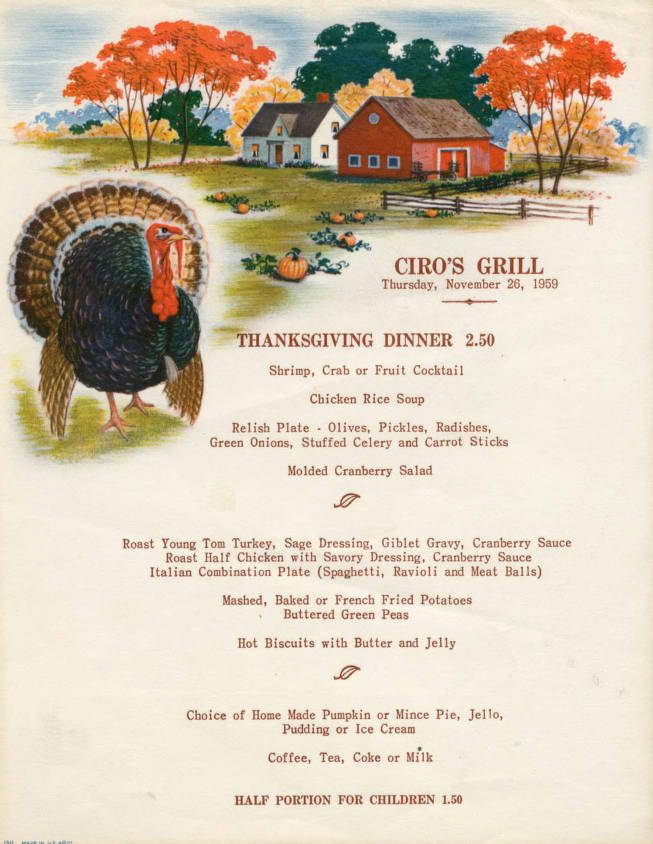
Even if you’re not on turkey and/or Tofurkey “duty”, you’ll be amused by the variety of holiday offerings (and prices!) from different eras in the UW Libraries Special Collections Historical Menu Collection! Molded cranberries anyone??
image: Ciro’s Grill Thanksgiving dinner menu, November 26, 1959. University of Washington Libraries Special Collections
It is hard to believe that we are about halfway through the first quarter! Finals may seem far off, but it’s never too early to start thinking about connecting with UW Libraries to help you prepare, stress less and succeed. Not sure where to start? Check out our drop-in help sessions and resource reminders in this post! Grad students: check out the Community Fellows Series (a paid fellowship), Scholar’s Studio and weekly office hours for the Graduate Funding Information Service to help guide you through the process of identifying and applying for grad school funding. Starbucks has reopened in Suzzallo (YAY!)– after you grab a coffee, be sure to peruse the amazing new exhibits on display in Allen Library on your way to class, only during the month of November!
Missing Women Authors: Songs from the Kishangarh Zenana:Display case on Allen Library North Balcony, First Floor: Men (often of privilege) dominate the pages of the canon of Indian devotional literature, but what about women authors? This exhibit presents the case of the talented women surrounding the prolific Nagaridas, alias of Savant Singh, crown-prince of Kishangarh (Rajasthan) in the first half of the eighteenth century. Learn more.
Unveiling Myanmar: Allen Library North Lobby
A month of movie screenings, an exhibit and book talk to learn about #whatshappeninginmyanmar. The multifaceted exhibit explores recent political events in Myanmar (Burma), featuring historical and cultural artifacts and information, and introduces UW Libraries research resources on Myanmar. Film screenings are Wednesdays at 4PM in the Allen Library Auditorium. Learn more.
Tateuchi East Asia Library
Faculty Showcase: See this impressive collection of recent publications by your UW East Asia studies faculty now on display in the newly-renovated Tateuchi East Asia Library! Learn more.
Kuroshio Odyssey: Maritime Memories, Culture, and Landscape: Through November 28, 2023, the Taiwan Studies Arts & Culture Program welcomes you to the Kuroshio Odyssey: Maritime Memories, Culture, and Landscapes—a serial program that focuses on the diverse Indigenous communities of eastern Taiwan and their stunning natural world. The program features a series of in-person displays, online exhibits, crafting workshops, film screenings, and scholarly roundtables across the UW-Seattle. Events hosted in the Tateuchi East Asia Library include:
November 14- Scholars’ Studio for Graduate Students
Nervous about presenting your thesis or dissertation? Watch your peers and hear feedback from the UW research community that can help you prepare for your own presentation. Scholars’ Studio is a fun, informal virtual event that features 10 rapid-fire ignite-style presentations (5 minutes each) given by graduate students and postdocs doing research on topics related to an interdisciplinary theme. Hosted by the UW Libraries Research Commons and The Graduate School Core Programs, Scholars’ Studio gives students the opportunity to share their research across disciplines, make connections and build presentation skills. Open to any research, practice, or teaching topic in any discipline. RSVP Required. Learn more.
11/17 1-4PM: Karaoke Fridays: Come to enjoy FREE Karaoke at the Tateuchi East Asia Library! Songs of East Asian languages and more are available. No reservation required – first come first serve! Learn more
Learning Workshops
11/7: Introduction to Accessibility & Data Visualization Workshop (online): Data visualization best practices and tools do not always discuss accessibility, which can exclude many groups of people. This workshop will review ways to make your visualizations more accessible. We will work through a visualization together and add features to make it more accessible.
11/16 ORCID Workshop for Researchers: Funding organizations, publishers, and research institutions are increasingly requiring or asking for ORCID iDs from researchers. Getting and using your free ORCID iD and ORCID record can help you save time and get credit for your work in funding, publishing, and research reporting workflows. Led by the UW ORCID CommunityLearn more.
11/20: Metadata Support for UW Libraries Digital Scholarship Platform: High-quality descriptive metadata can make your work more findable and meaningful for users, but platform requirements and related standards aren’t always easy to understand. Ask questions and get support for integrating metadata effectively into your work.
11/8 Data Visualization Office Hours: Drop by office hours to get help with data visualization! We can help you choose the right tools, find resources and discuss how to prepare your data for visualization. Feel free to attend whether you’re just thinking about getting started or are already working on a project. Learn more.
11/16- Data Management & Stewardship Office Hours: Learn about tips and tools to better help you manage your research data and preserve it for long-term use. We can help with data management plans, help identify campus data resources and experts, and provide information on data sharing, including the UW’s data repository, Dryad. Learn More.
Digital Scholarship Project Help Office Hours- Thursdays: Learn about getting started with digital projects at UW. We offer consultations for research and course related projects. Examples include support for digital publishing, building digital exhibits, and more! We can help you find the right tools, resources and instruction whether you’re just getting started or are working on an on-going project. Learn more
Health Sciences REDCAP Trainings
Provided by the Institute of Translational Health Sciences and UW Health Sciences Library.
REDCap 101- Introduction to REDCap- Nov 7: Geared towards new or novice users of the REDCap system, this class goes through the entire lifecycle of a REDCap project – from initial setup to data entry and finally exporting your data. Learn more.
Don’t Miss It…
Don’t miss these ongoing exhibits in Special Collections throughout the year:
EXHIBIT: Magick and Mystery: Exploring the Supernatural in Special Collections – Explore the supernatural in this exhibit featuring all manner of magic and mischief. Running until the end of Winter Quarter 2024, Magick and Mystery will feature items from Special Collections, in the UW Libraries, on topics ranging from local folklore and mysteries to 19th-century spiritualism, and even TikTok tarot trends.Learn more.
EXHIBIT: Breaking Bread: Foodways and Cuisine in Print – opening September 26 For the 2023-24 academic year, Special Collections is featuring items in our collections that connect to a multitude of different foodways and food cultures. With four rotations at the end of each quarter, the items from Special Collections demonstrate complex systems of cultural celebration, continuance, and suppression that are wrapped up in food systems. Learn more.
###
Stories
Accessible Study Room In Suzzallo – Now More Accessible!
November 3, 2023
By UW Libraries Accessibility Working Group
It is important to provide equitable environments that allow all students to feel comfortable studying at the Libraries. To that end, in the last few years we have improved accessibility in several ways around the Libraries: audited our physical spaces and electronic resources for accessibility; posted accessibility information on our website to aid in trip planning; created accessibility kits available for check out; and most recently, opened an accessible study room for use by everyone.
see highlighted area of room 327 – near the reading room on the third floor of Suzzallo.
The room is located at Suzzallo 327 on the third floor near the Suzzallo Reading Room.
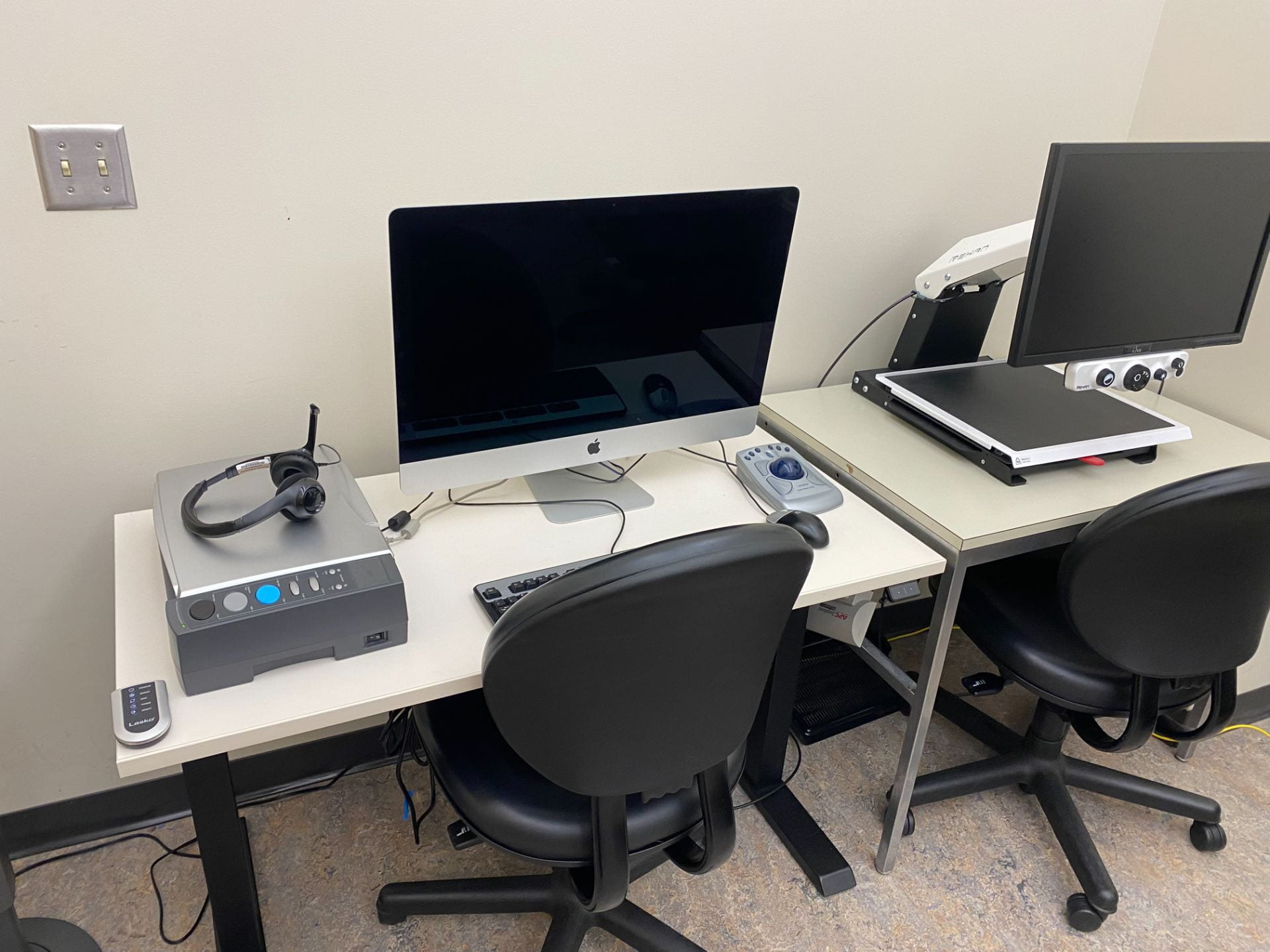
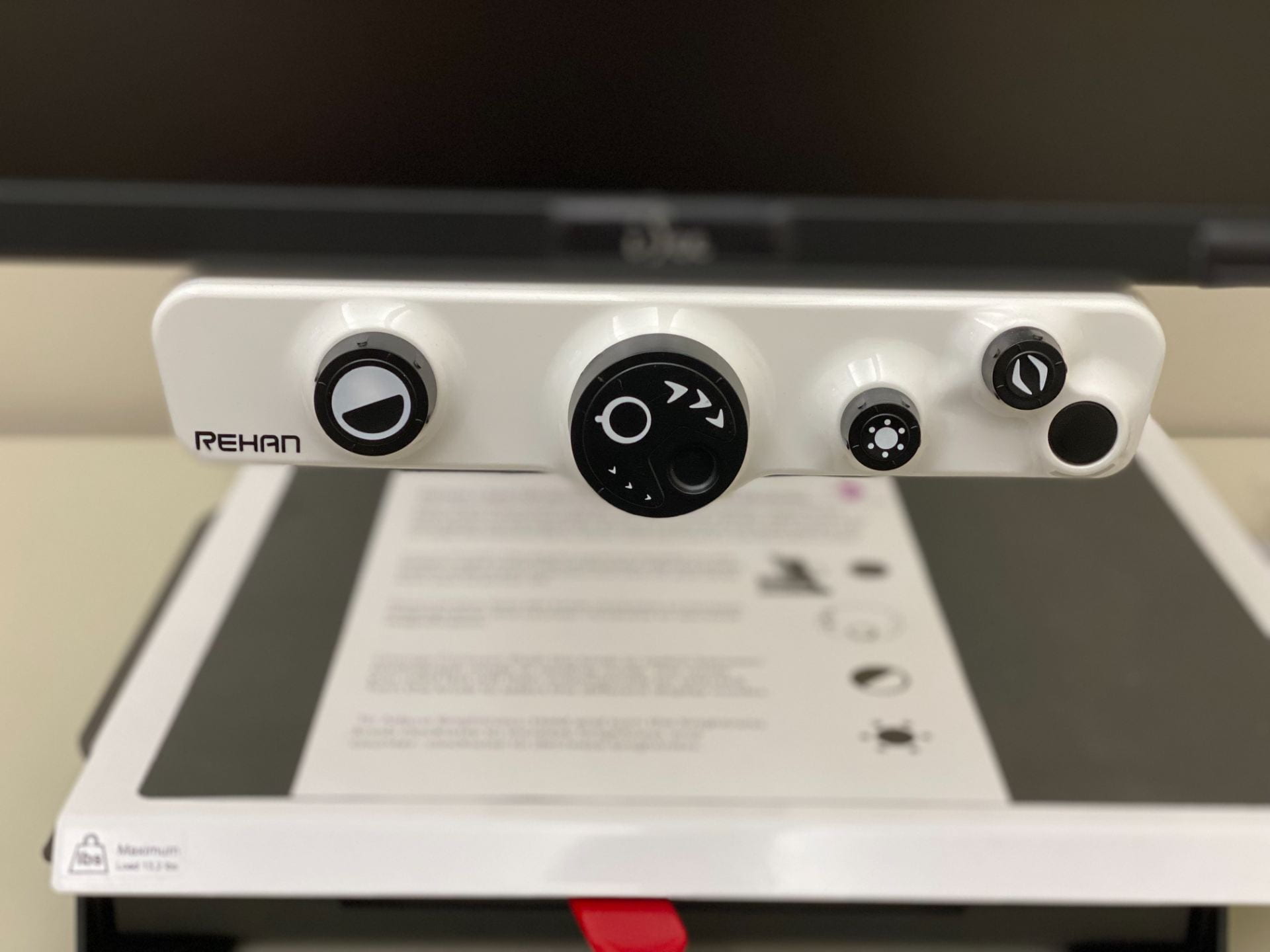
The room is close to elevators and accessible bathrooms. This accessible study room is equipped with two accessible workstations provided by Access Technology Services (ATS) with software and hardware tools such as those found in theAccess Technology Center. The room has a video magnifier and speech to text tools. The room also provides additional privacy for students with disabilities needing to make noise during their work, such as while using speech to text. While this room is open to the public, priority is given to students with disabilities. This information is also posted on theAccessibility at the Libraries page.
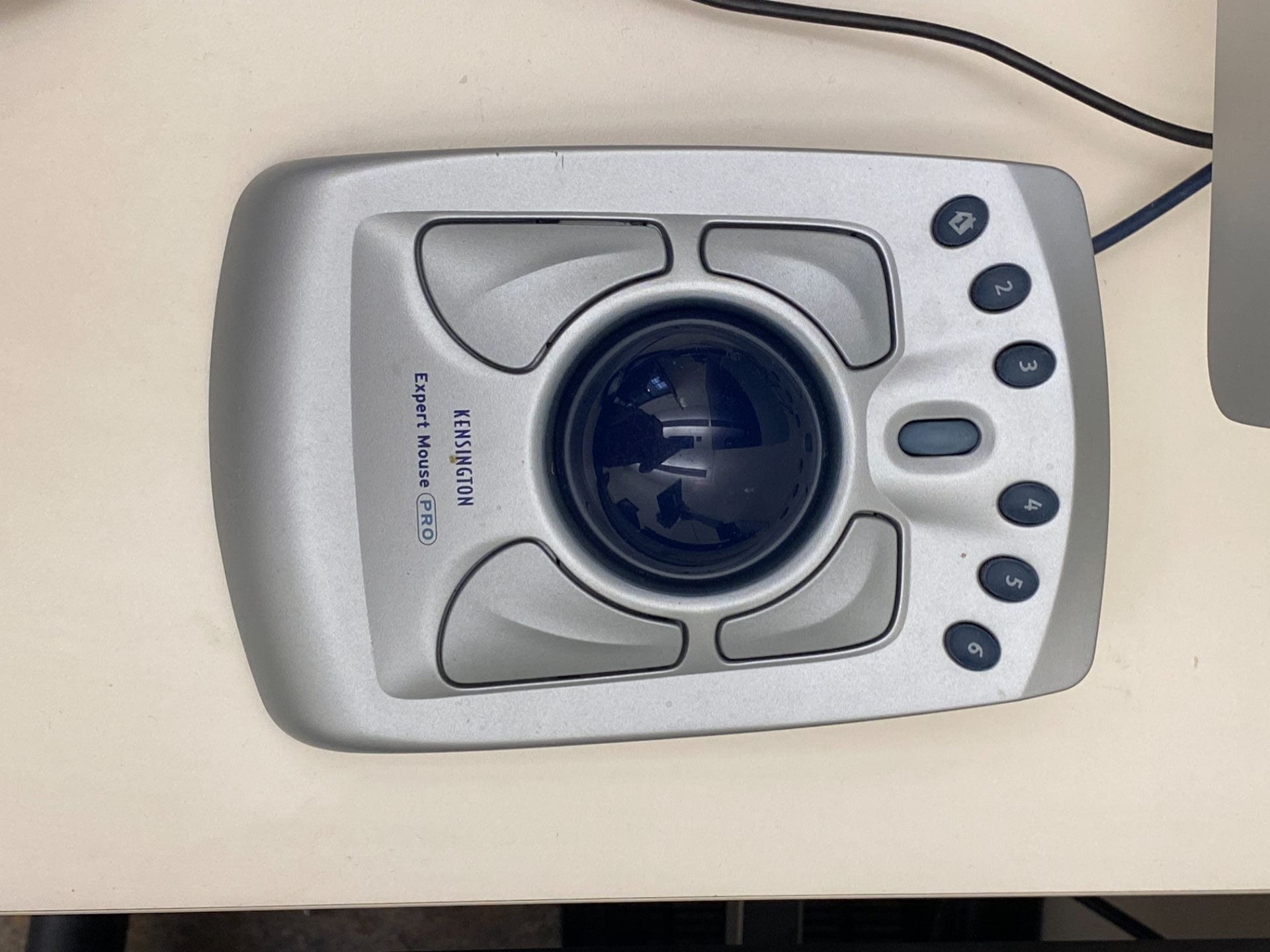
A workstation with accessible technologyA computer mouse with a trackball and ambidextrous designAn electronic magnifier
Suzzallo Library has hosted an accessible study room for many years; however, access was previously managed by Disability Resources for Students (DRS) and was limited to students registered through that program. Following conversations, DRS, ATS, and members of the UW Libraries Accessibility Working Group agreed that the room would be better utilized and benefit more people if it was opened to the public. The room is now open and unlocked during all Suzzallo Library operating hours.
For now, the accessible study room will not be added to the study room reservation system. As time goes on and we learn more about how often the room is used, we will adjust this as needed. For example, if demand is high enough, we will consider adding it to the reservations system. Currently, signage in the room states that students with disabilities have priority use of the room.
Enhancing equitable environments for teaching, learning and research is one of the UW Libraries main strategic priorities. To put those values into practice, we prioritized improving access to library spaces and resources by opening up our accessible study room.
A full list of our accessible spaces and resources can be found on the Libraries Accessibility page. If you have any questions about the study room or would like to suggest potential areas of improvement related to Libraries’ accessibility, please contact us at [email protected].
###
Stories
The Secret Life of UW Libraries Catalogers and Metadata Specialists
You may be surprised to hear that before you can access a library resource when you need it, a lot of work must be done to get that resource into the UW Libraries catalog. A whole department of librarians, staff, and students are quietly working away behind the scenes to get new resources into the catalog and to find innovative ways to enhance the Libraries’ metadata. This series of blog posts will highlight our brilliant student employees and the work they do to make your tasks of searching, identifying, selecting, and obtaining library resources easier and more effective.
Student Spotlight #1: Melissa Morgan
When Melissa Morgan was accepted into the MLIS program at the University of Washington Information School, she expressed interest in volunteering with the University of Washington Libraries. Melissa’s undergraduate work at the UW demonstrated that she was an exceptional student, having earned a Bachelor’s of History with honors and won the UW Libraries’ Library Research Award Grand Prize in 2018. In April 2019, she joined the University of Washington Libraries Linked Data Team, an informal group within the Cataloging and Metadata Services Department (CAMS) focused on semantic web projects, with the aim of gaining some linked data experience. Linked data (or semantic web data, or RDF (Resource Description Framework)) is structured data which is interlinked with other data so it becomes more useful through semantic queries.
Linked data is exciting for libraries because it makes relationships between things described on the web computer-readable and more shareable and discoverable across information repositories through integration with the open web. Once she joined the Linked Data Team, Melissa hit the ground running. She began participating in the Libraries’ Linked Data for Production (LD4P2) Mellon Foundation subgrant project and familiarizing herself with linked data analysis, application profile development, and collaboration using GitHub.
Melissa’s remarkable ability to learn new skills quickly and on-the-fly earned her a paid student position as a Linked Data Specialist for the duration of her MLIS study. Under the supervision of Theo Gerontakos and Benjamin Riesenberg, Melissa proactively took responsibility for several areas of highly technical work, much of which involved designing innovative workflows using programming languages she was not yet familiar with. She quickly became one of the most technically skilled members of the Linked Data Team and began contributing at a professional level. One example of Melissa’s outstanding work was a large-scale data conversion project, described below by Benjamin Riesenberg, Metadata Librarian:
“Melissa wrote thousands of lines of Python code to implement ontology mappings and convert data, developing expertise in the mapping language specification and communicating directly with developers to improve the open source specification. Another of her significant contributions to this project was the creation of Python code for parsing human-readable mappings and converting these to RML syntax.”
Melissa collaborated with the Linked Data Team on several such projects, picking up programming languages and learning linked data ontologies quickly in order to solve practical problems in creative ways. Melissa showed herself to be a capable workflow designer and project leader during her time as a student employee.
What is ontology mapping and linked data conversion?
Ontology mapping and linked data conversion sound technical, but they bear resemblance to processes most people are already familiar with. Linked data is expressed in RDF (Resource Description Framework) using well-defined vocabularies called ontologies. These ontologies can be thought of as similar to languages. Humans use languages to communicate information. In a less-sophisticated but similar way, the semantic web uses linked data ontologies to express information in a way that computers and software applications can understand. There are several ontologies currently being used to describe library resources. Two important ones are the Resource Description and Access ontology and the BIBFRAME ontology. In order for computers (and users) to understand data from multiple sources which use different ontologies, these ontologies must be mapped to one another and large batches of data must be machine-converted from one ontology to another. This work is complex, and in a human language context resembles the act of translating a work of literature from one language into another.
After assessing project goals, identifying and learning the skills required to solve problems, and learning them quickly, Melissa designed effective workflows and patiently taught new skills and workflows to other Linked Data Team members. She is a skilled writer, and wrote a blog post on her RML project that helped us explain the work to colleagues in non-technical positions. Melissa’s work as a student employee was so helpful to the Linked Data Team that the Libraries kept her on as a temporary library technician after her graduation from the MLIS program. During that time, Melissa continued her linked data work and also studied traditional cataloging with Crystal Yragui, a science cataloger in CAMS. Melissa learned to create catalog records using national cataloging standards and controlled vocabularies.
As with Melissa’s other work, her cataloging was superb. The experience and skills developed as a student employee were foundational to forging her career in the field of librarianship. She is now the full-time Cataloging & Metadata Specialist at Pacific Lutheran University. We are proud of Melissa and grateful for the time she spent at the UW Libraries! Join Us!
International Open Access Week, observed each October since 2008, is an opportunity to learn about and celebrate our collective momentum in building a more open and equitable system for sharing knowledge.
The theme for this year’s Open Access Week (October 23–27) is “Community over Commercialization.” Rooted in ongoing professional and public concerns about consolidation within the scholarly publishing industry and publishers’ continued efforts to monetize scholarly outputs by extending their control of all aspects of the scholarly publishing ecosystem, the theme “encourages a candid conversation about which approaches to open scholarship prioritize the best interests of the public and the academic community—and which do not.”
Open Scholarship
What is “Open Scholarship?” Also referred to as “Open Science,” “Open Research,” and “Digital Scholarship,” Open Scholarship is an expansive worldwide, interdisciplinary, and inclusive movement among researchers, scholars, learners, universities, libraries, and funders intended to ensure that research results and scholarly works of all kinds are shared openly as soon as possible for the benefit of the public good.
On the one hand it encompasses rapid, unrestricted, and open access to scholarly works in all formats, open research data, the ability to reproduce and verify research results, and encourages an open infrastructure that values community over commercialization.
Open Scholarship also integrates traditional scholarly methods with new and emerging technologies to question and investigate traditional scholarly paradigms and utilize new methods of working. Examples of this aspect of Open Scholarship include open publishing, community-engaged research, text analysis, data mining, visualization, modeling and simulation, geospatial analysis and mapping, multi-modal storytelling, network analysis, and mark-up.
Open Scholarship at UW
“These changes in federal policy will require federally funded authors to share their research articles and supporting research data freely and publicly upon publication. This will be especially important for a research-intensive institution like UW, which in FY23 was awarded$1.52 billion in federal funding. The work funded by the grants, in turn, resulted in thousands of peer-reviewed articles and underlying data sets.”
The University of Washington community has long embraced and exemplified the principles of Open Scholarship. In 2018 the faculty of the University of Washington adopted anOpen Access Policy intended to make their peer-reviewed scholarly articles freely and widely available to the people of Washington and the broader research community. In the fall of 2022 the University joined a growing body of peers in the Higher Education Initiative for Open Scholarship (HELIOS), a coordinated effort to align higher education practices with open scholarship values. This strategic decision not only aligns with local institutional values and open initiatives, but also helps position the University to respond to upcoming federal research funding policy changes requiring immediate public access to published research results and the data supporting them, especially those from the National Institutes for Health and the Office of Science, Technology, and Policy. These changes in federal policy will require federally funded authors to share their research articles and supporting research data freely and publicly upon publication. This will be especially important for a research-intensive institution like UW, which in FY23 was awarded$1.52 billion in federal funding. The work funded by the grants, in turn, resulted in thousands of peer-reviewed articles and underlying data sets.
The Libraries’ 2023-2026Strategic Plan affirms that “UW research attains its greatest impact on our most pressing global challenges when we advocate for open, public and emerging forms of scholarship.” The UW Libraries has centered and integrated the importance of Open Scholarship as a guiding principle into our strategic thinking and practice, helping to influence and shape our programs and initiatives over the past decade.
Open Scholarship Commons
OSC Tech and Work Spaces:
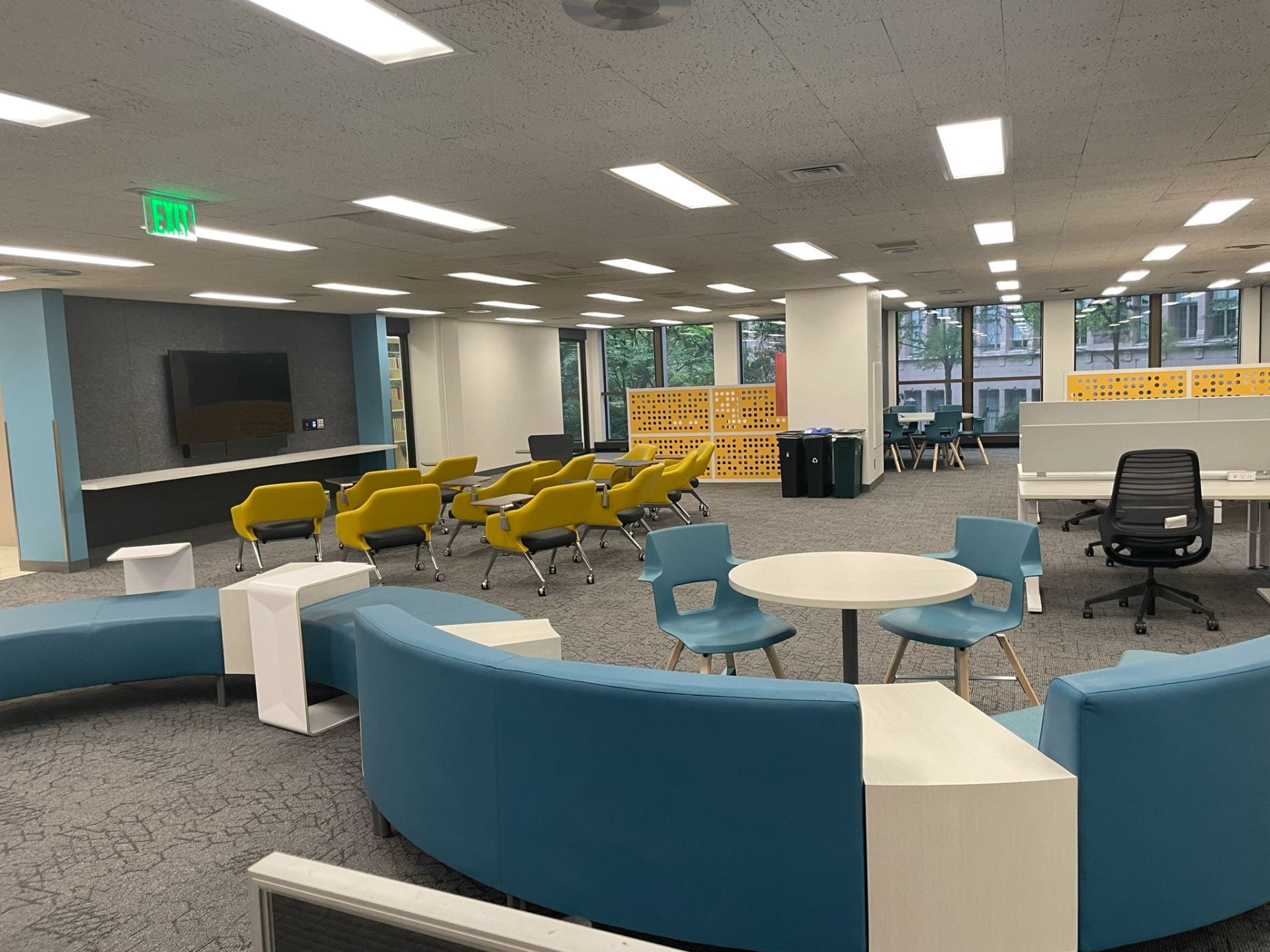
multiple group work spaces with large screens and seating for 5-9 with laptop hook-ups and reservable speakers, cameras and microphones
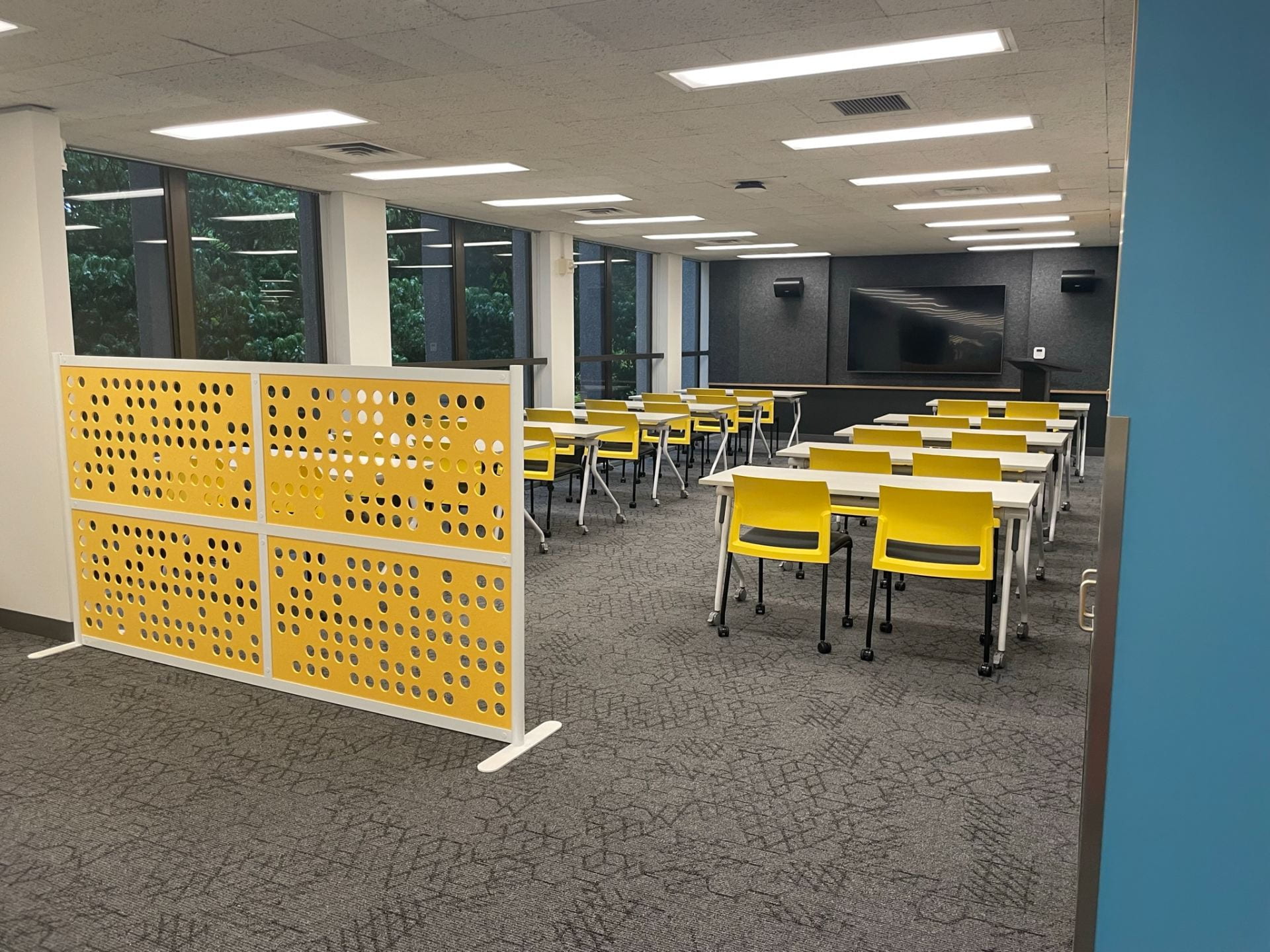
presentation spaces with movable tables and seating for up to 24 – available via reservation.
mobile laptop cart with 25 Windows laptops
mobile whiteboards
8 tables for individual study, including 2 adjustable height tables
counter and café style tables and soft seating for individual or group work
The OSC’s mission is to be “an interdisciplinary set of spaces and services intended to advance open, public, and emerging forms of scholarship. It provides opportunities for scholars, creators, and learners from diverse backgrounds to learn from each other and build the skills necessary to co-create, share, translate, and make the impact of their research visible to the world.” One of its primary goals is to serve as a campus hub to help build community and capacity. In its first year, nearly 1,000 people attended OSC events that explored trends and perspectives around different aspects of open scholarship and its importance to sharing research for the public good.
Initially begun as a virtual space and service in the fall of 2020, this past summer the Libraries was able to create a physical space to complement our online presence with the help of funding from UW’s Programmatic Renewal Fund and the Libraries Catalyst Fund for Innovation.
Located on the first floor of Suzzallo Library, the Open Scholarship Commons is an attractive and interdisciplinary set of spaces and hybrid services dedicated to knowledge creation and digital and open scholarship. The OSC offers a wide range of in-person and online workshops, events, and consultation services to build skills and inspire our UW community to co-create, share, translate, and make the impact of UW scholarship visible to the world.
We’re very excited to welcome new students, faculty, and staff into the space this fall!
Open Access Week at UW
We invite everyone to join us during the week of October 23-29 to celebrate Open Access Week and Open Scholarship. You can find a schedule of UW Libraries events with descriptions and registration information on the newly redesigned Open Scholarship Commons webpage.
Here’s a preview of what we have planned:
Hacking the Academy: The Adoption of Open Monday, October 23, 2023 10-11am Online
UW Theses and Dissertations Tuesday, October 24 2-3pm Online
Open Education Resources 101: Find and Create Affordable Course Materials Wednesday, October 25, 2023 2-3:00pm Online
Reading the Fine Print: a Workshop + Hackathon on Privacy and Terms of Service for Common Research and Classroom Tools Thursday, October 26, 2023 1-2:30pm Hybrid – OSC and Online
Seattle Research Software Engineer Meetup Thursday, October 26, 2023 3-5:00pm Hybrid – OSC Space and Online
Creative Commons Workshop Friday, October 27, 2023 10-11:00am Online
###
Stories
Exploring Library Careers: Conservation
September 26, 2023
UW Libraries Welcomes New Senior Conservator
Did you know?
Each year, Conservation staff repair, bind or make enclosures for an estimated 10,000 items in the UW Libraries. This care helps to preserve, stabilize or restore the usability of book, paper, and photograph materials.
Are you interested in art, history, science and working in a library or museum? You may want to explore a career in conservation, just like Leith Calcote, the newest member of UW Libraries Conservation Center team.
What is a conservation?
In a library or museum setting, conservation includes all the actions taken to preserve library or museum collections.
What is a conservator?
A conservator has the skills and training to provide conservation support. This includes the treatment or repair of individual library or museum materials. It also includes preventive care or reducing damage to collections through careful handling, storage, emergency planning, and collection management.
Conservators focus on a specific type of material or “specialty” during their training such as books and paper, photographic materials, electronic media, objects, or textiles. Most conservators have a background in studio art, art history, science, or other related fields. This allows them to have a thorough understanding of the materials in their care, the context in which they were made, and their scientific make-up to help prevent deterioration. You can learn more about becoming a conservator from the American Institute for Conservation.
Leith Calcote joined the Conservation Center team as Senior Conservator for Books & Paper on August 28, 2023. They worked most recently as the Collections Conservator at The Newberry Library in Chicago.
Leith’s work focuses primarily on planning and performing complex conservation treatment for rare books. This involves a wide variety of skills to repair and restore delicate and aging materialsin order to preserve as much of the original structure and materials as possible while making the items safe to handle. This requires a knowledge of historical bookbinding techniques and how the original and new components interact chemically.
One of the things that attracted Leith to the UW Libraries was the breadth of collections. “I am excited to work with the diversity of the UW Libraries’ collections from early printed books and manuscripts to modern artist books and everything in between.”
“I am looking forward to introducing students to the conservation field and helping them move towards applying to graduate school,” says Calcote. The summer conservation internship is typically posted in early winter on the UW Library Jobs page.
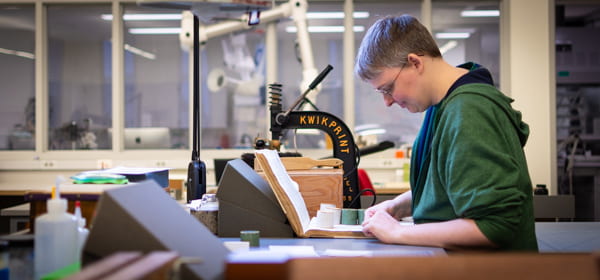
Photo: Leith conserving a rare music score.
Leith is currently working on mending torn pages in some newly cataloged rare 19th century music scores and reattaching a partially detached board for a popular travel book by author Anne Newport Royall. The book is an interesting example of a temporary binding that ended up being not so temporary. Leith says, “It was common during this period for printers or publishers to sell books in temporary bindings, or without any binding, so the owner could bind it to match other books in their library. These temporary bindings rarely survive so long, making it important to preserve the binding as evidence of practices at that time.”
“I am looking forward to introducing students to the conservation field and helping them move towards applying to graduate school,” says Calcote. The summer conservation internship is typically posted in early winter on the UW Library Jobs page.
Prior to working at The Newberry Library, Leith held professional and intern positions at The Boston Athenaeum, University of Michigan, and Iowa State University. They completed a Master of Arts and Certificate of Advanced Study in Art Conservation at Buffalo State College and a Bachelor of Arts in Chemistry at Carleton College. Leith also received a Certificate in Bookbinding from North Bennet Street School in Boston, MA.
To hone their practice, Leith also enjoys creating historical bookbinding structures in their own time. These sometimes evolve into more creative work. One of Leith’s pieces,Araneus liberius, was chosen for the Guild of Book Workers exhibition, WILD/LIFE. This very diminutive piece is a traditional leather binding sewn on raised cords, but the traditional structure is used as a base to create a book in the form of a spider.
Created in 2012 with support from the Andrew W. Mellon Foundation and many Friends of the Libraries, the Senior Conservator position has dramatically increased the Libraries capacity to care for the fragile rare books and manuscripts in our special collections by allowing the Libraries to perform more complicated conservation treatments in-house.

 January 11-
  January 31-
 The Atlantic online:
  Israel-Hamas War Research Guide
 Someday This Will Be Over: AIDS Remembered – On the 35th anniversary of World AIDS Day, this exhibit highlights the history of the HIV/AIDS pandemic with a focus on the political, social, and cultural impacts in the United States and Seattle. The exhibit will also feature film viewings in Allen Auditorium. Now-January 15th.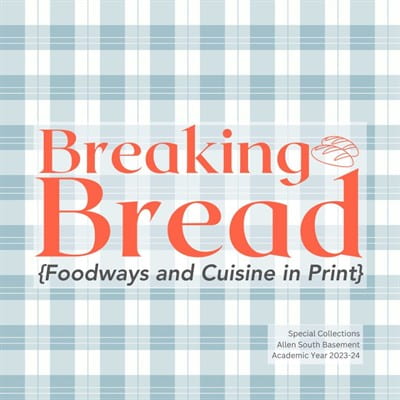
 Magick and Mystery: Exploring the Supernatural in Special Collections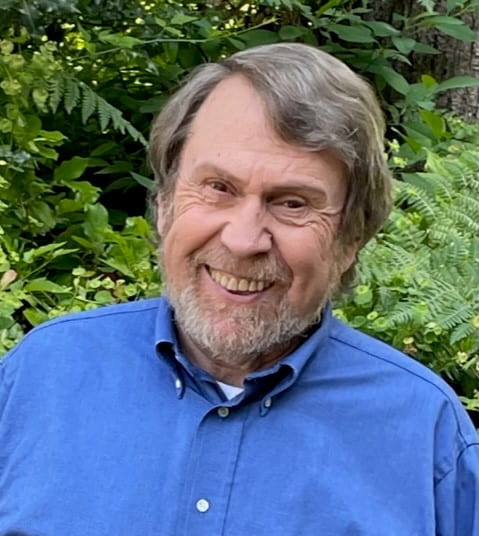
 The boys went on to win Olympic gold in spectacular fashion in Berlin. But they did more than win gold. They created a great legacy. If you have never done so, I urge you to go down to Conibear Shellhouse and take a look at the Husky Clipper, the beautiful shell in which the boys rowed their way to glory in 1936. It hangs gorgeously above the dining commons. It has been lovingly restored, preserved, and displayed. Its burnished red cedar hull and yellow spruce trim glow under the spotlights in the room. But more than a beautiful object, the Husky Clipper is important because it is a symbol. It stands for something far beyond winning a race. It embodies the boys’ legacy. It tells a story. It tells how—aided by the spectacular generosity of the citizens of Seattle in a very tough time—those nine young men showed us all what we can do when we climb in a boat and pull together as one.

 Odegaard Undergraduate Library Access Update: UW Alumni Association Members and Cascadia College members are now included as part of the UW-only access policy for Odegaard. To enter, users must have a current library account and present their UWAA card (physical card, or digital card in UWAA app) or Cascadia Card PLUS a current, valid photo ID.
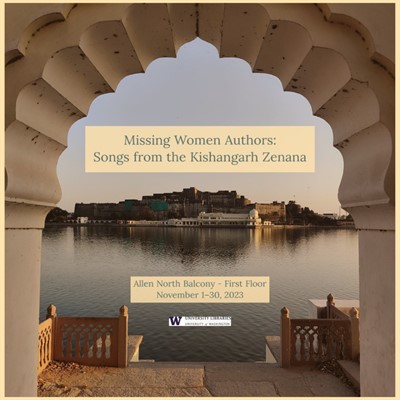 Missing Women Authors: Songs from the Kishangarh Zenana: Display case on Allen Library North Balcony, First Floor:
 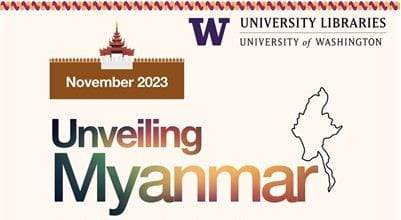 Unveiling Myanmar: Allen Library North Lobby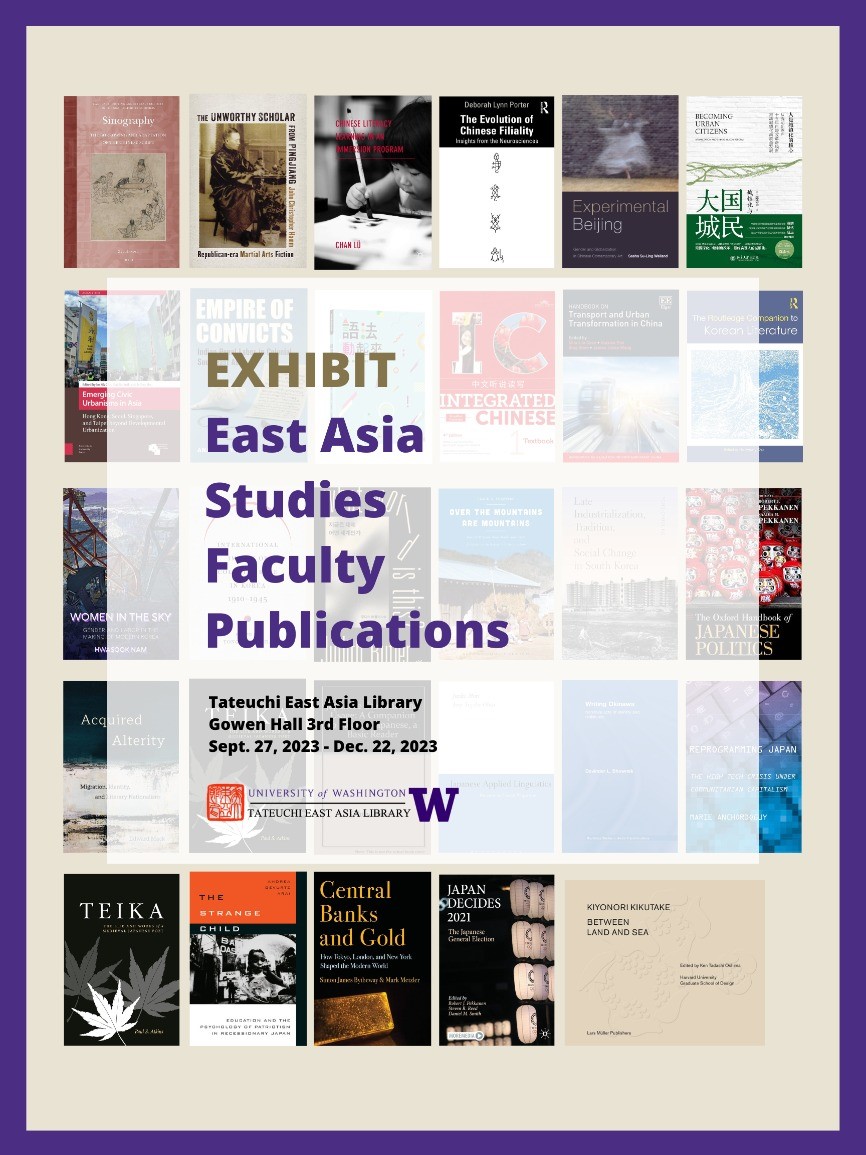
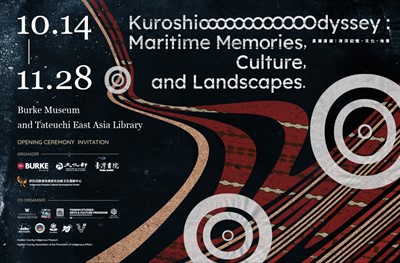
 November 14- Scholars’ Studio for Graduate Students
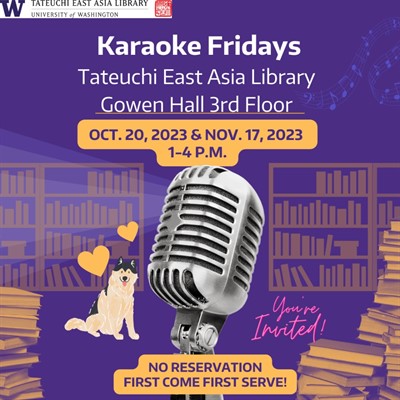 11/17 1-4PM: Karaoke Fridays:
 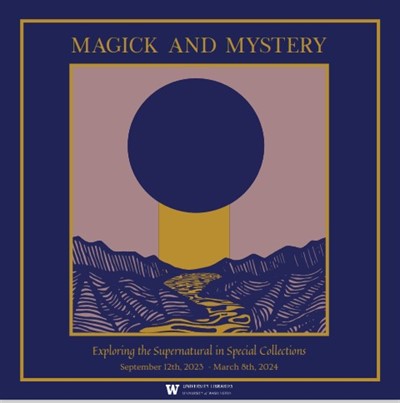 EXHIBIT: Magick and Mystery: Exploring the Supernatural in Special Collections
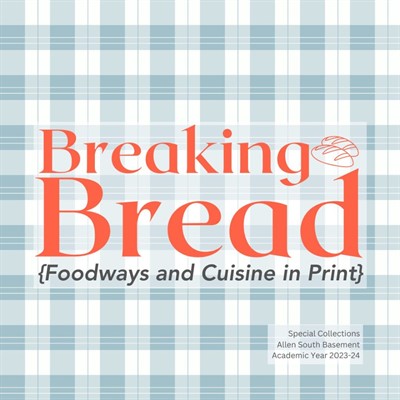 EXHIBIT: Breaking Bread: Foodways and Cuisine in Print – opening September 26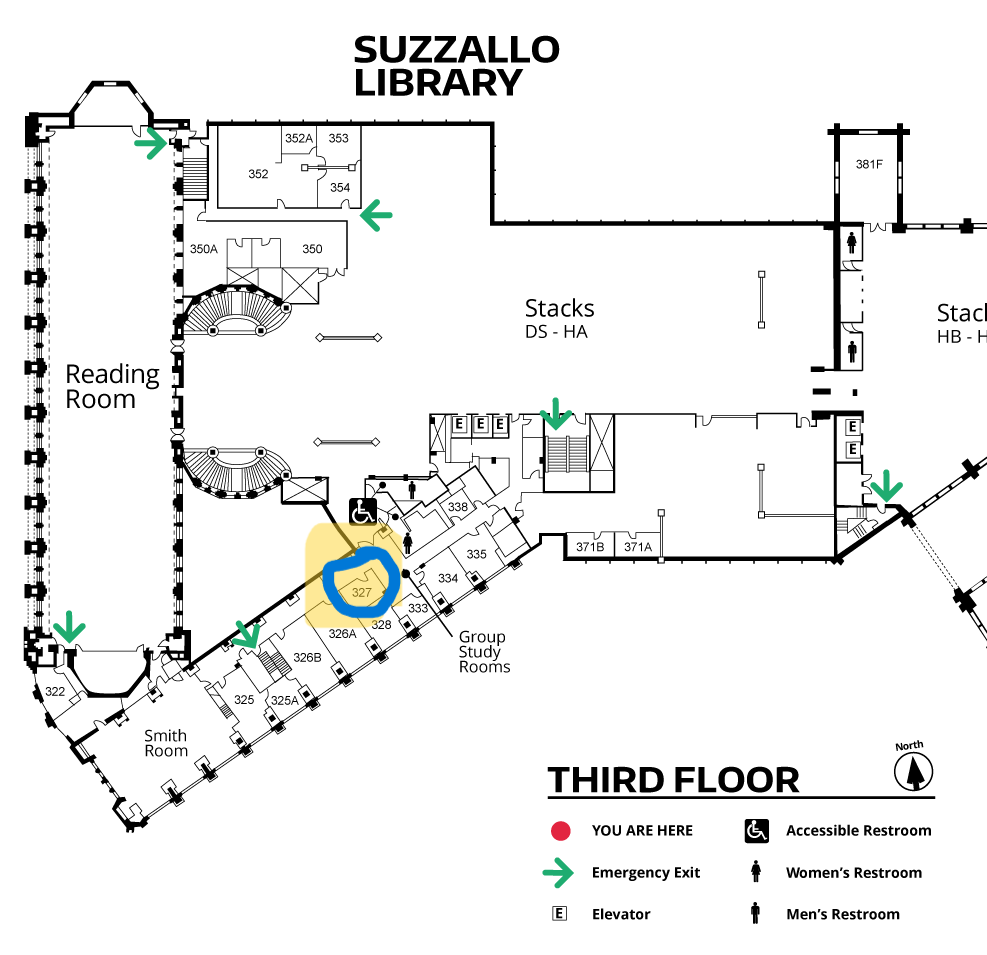
 Melissa’s remarkable ability to learn new skills quickly and on-the-fly earned her a paid student position as a Linked Data Specialist for the duration of her MLIS study. Under the supervision of Theo Gerontakos and Benjamin Riesenberg, Melissa proactively took responsibility for several areas of highly technical work, much of which involved designing innovative workflows using programming languages she was not yet familiar with. She quickly became one of the most technically skilled members of the Linked Data Team and began contributing at a professional level. One example of Melissa’s outstanding work was a large-scale data conversion project, described below by Benjamin Riesenberg, Metadata Librarian: