Skip to content
Stories

We Love Our Student Employees!

Celebrating 2024 Student Scholarship Recipients

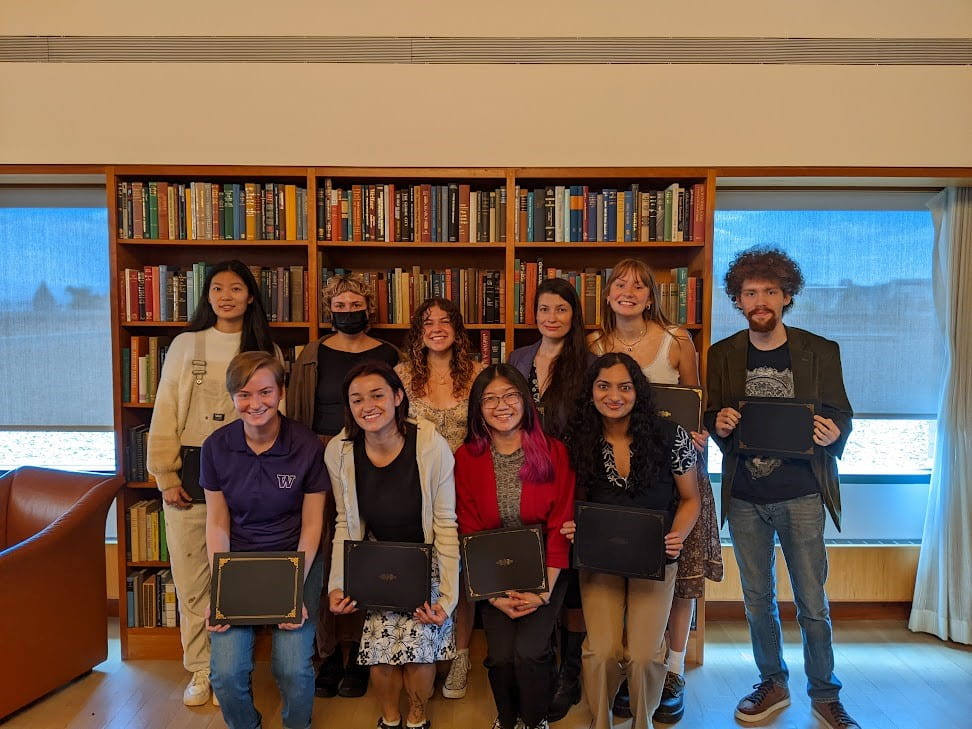
UW Libraries recognizes the achievements of our outstanding student employees through our Student Employee Appreciation Week, and an annual scholarship award, generously sponsored by UW Libraries donors.  On February 29, we celebrated this year’s 50 new scholarship recipients in person with a reception honoring their amazing contributions.

group photo of 2024 scholarship recipients
2024 Scholarship Recipients

Library student workers represent undergraduates and graduate students from all areas of study working across all three UW campuses, including UW Press!  As one of the largest employers of student workers on campus, our student employees are essential to Libraries’ operations – while they literally keep the doors open, lights on and books on shelves,  they are also peer mentors, writers, designers, marketers, technicians and instructors! We LOVE our student employees, and this year’s scholarship class exemplifies the dedication, creativity and work ethic that our students bring to their jobs every day. But don’t take our word for it; see what our students have to say about their experience working with the Libraries in these selected quotes from  2024 scholarship recipient essays:

But don’t take our word for it; see what our students have to say about their experience working with the Libraries in these selected quotes from  2024 scholarship recipient essays:

“As a Web Services & UX Assistant at ITSDS at UW Libraries, my journey has been transformative, echoing not just professional development, but a profound personal evolution. At UW Libraries, under the guidance of supportive supervisors, I found an environment that not only respected my ideas but also encouraged me to voice them. UW Libraries provided more than just a job; it offered a community where I found friends, mentors, and a sense of belonging. It has nurtured my professional skills, yes, but more importantly, it has allowed me to find my voice and vision. I have learned to embrace challenges with confidence and curiosity, qualities that I will carry forward in my journey both within and beyond the realms of librarianship.” – Sabrina

“…I’ve found a place where I belong at UW libraries, and it’s turned me into a version of myself that freshman me probably wouldn’t recognize but would be grateful to have grown into.”

“I am very happy to be a part of (the library). Everybody working at the campus library is very collaborative and supportive, their willingness to listen to my ideas and questions fostered an environment that allowed me to flourish both personally and professionally with confidence.” – Anmei

“Beyond the practical skills gained, working in the Health Sciences Library has provided me with in-depth exposure to various health science topics, crucial for my future graduate school decision.” – Xiaoyu

“my experience working at the UW Libraries has been transformative for my personal, academic, and professional growth…

“Learning how information transmits through libraries encouraged my academic goal of pursuing informatics. My interaction with various information technologies at the library sparked a deep interest in how technology can enhance information accessibility.” – Yuanxi

“Overall, my experience working at the UW Libraries has been transformative for my personal, academic, and professional growth, impacting my past activities, current skill set, and future prospects for my transition into the modern workplace.”- Braedyn

“Connecting people with the resources and  knowledge they desire is the most meaningful part of my job…”

“My time at the library has made me a better worker– one who understands that above all else, my role in the library is to facilitate community.” – Clara

“I have consistently continued to learn new things and gain new skills through the projects I have worked on. I learned that my work was valued, including the time I needed to learn and the questions I needed to ask; and that this was a place where I could communicate my needs and be met where I was, with understanding and encouragement, by people who were excited to help me grow and learn.” – Cyprus

“I have consistently continued to learn new things and gain new skills…

“I never would have imagined that I would find a job that combines so many of my interests: helping other people, designing user interfaces, reading, learning, tackling new challenges, and creating seamless experiences for people.” – Doan

“In my studies as a history and psychology double major, my work at the library has supplemented my education in multiple ways. Learning the history of UW and Suzzallo and Allen has been immensely valuable, and spreading this knowledge to patrons from all over the world gives me a unique connection to my university. Connecting people with the resources and  knowledge they desire is the most meaningful part of my job, and it has solidified my commitment to service-oriented work in the future.” – Dominic

“I feel extremely fortunate and grateful to be working in a space where diversity is celebrated and welcomed, and in turn, I aim to project that same sentiment to all those who choose to visit the library.” – Ileana

I feel extremely fortunate and grateful to be working in a space where diversity is celebrated and welcomed

“I am confident that I am getting more out of my MLIS program because of the real world experience I’m gaining at Foster Business Library. I’m very grateful for the last year and a half at Foster  because I know I will be more confident in my job search later this year because of this experience.” – Giselle

“Working at the UW Libraries has shaped me into a better person, one who can connect better with others. My personal growth from the RC Desk is something I will value for life as I will utilize these skills in every possible situation. I’ve appreciated the opportunities and challenges the help desk has presented, and I will continue to grow and improve throughout my time here.” – Jordan

“…coming to work soon became the best part of my week, as it made me feel so connected to the academic community. In addition to enriching my sense of community on campus, working at the library, especially in and around the older collections held offsite and in Special Collections, made me even more enthusiastic about my academic studies.” – Leila

“I am intertwined in a community of supervisors who provide me opportunities to grow, technicians who collaborate with student staff in various projects, and student staff members who I feel comfortable talking about anything with. I’ve found a place where I belong at UW libraries, and it’s turned me into a version of myself that freshman me probably wouldn’t recognize but would be grateful to have grown into.”  – Maggie

2024 UW Libraries Student Scholarship Recipients Essays

Stories

February Update

Come celebrate with us: student performances, guest speakers, tours and light refreshments!

While there are many free learning workshops and drop-in help sessions as always (including Podcasting as Research and our LOVE DATA WEEK events!), don’t forget to make room for the fun and fascinating this February — from the launch of the 2024 Student Video Contest, our new board game collection, a unique Valentine’s Day event in Special Collections, Tateuchi East Asia Library’s grand re-opening celebration and Karaoke Fridays, book events, and Scholar’s Studio, there’s plenty of opportunity to take a break and explore. And when you do need a quiet space to join that remote study session, be sure to check out the new Zoom pods in Suzzallo

News and Stories

UW student video contest graphicUW Libraries annual Student Video Contest is here! Since 2018, this annual student video contest has produced some amazing videos to highlight all there is to LOVE about UW Libraries! Put your creative talents to work, show some “LOVE” for the Libraries AND win some well-deserved cash prizes! Learn more.


New from UW Press

New Book of the WeekTreaty Justice

Treaty Justice: The Northwest Tribes, the Boldt Decision, and the Recognition of Fishing Rights by Charles Wilkinson. Coinciding with the 50th anniversary of the landmark 1974 Boldt Decision, which affirmed the fishing rights and tribal sovereignty of Native nations in Washington State, Charles Wilkinson’s expert and compelling book weaves personalities and local detail into the definitive account of one of the twentieth century’s most important civil rights cases.

UW Press in the News

Read an excerpt from Treaty Justice in the Seattle Times Pacific NW Magazine.

Shaun Scott, author of Heartbreak City: Seattle Sports and the Unmet Promise of Urban Progress was on KUOW Soundside. Listen to the interview online.

Featured Event

Join UW Press for an event to commemorate the 50th anniversary of the Boldt Decision on February 12, 2024, at 7:30 p.m. at Town Hall. Centered around Charles Wilkinson’s posthumously acclaimed book, Treaty Justice, a panel will discuss the significance of the Boldt Decision and its enduring impact on the tribal sovereignty movement in the Pacific Northwest and beyond. Learn more and

photo of a group of board gamesBoard Game Collection Debuts at Odegaard: Odegaard’s newest collection of 65 board, card, and TTRPG games has hit the shelves! Games circulate for 14 days, checkouts are limited to 2 per person, holds can be placed on them, and the first game got checked out even before they were all shelved. Stop by Odegaard on your way home today to check out the collection (located to the left just inside the entry doors) for yourselves! See the Odegaard Game Collection Guide.

The Secret Life of UW Libraries Catalogers and Metadata Specialists: In this second installment of our student spotlight series, learn how one student’s work is helping to increase the global visibility of research. Read the story.

UW Research: A Year of Open Data with Dryad: See the top 10 UW data sets by views, downloads and journal, and learn more about the impact of our one-year-old membership with the data repository, DryadRead the story.

Questions about scholarly publishing? See answers to our most frequently asked questions in the updated Faculty and Instructor Guide.

Suzzallo Zoom Pods are Here! Building on the success of the Odegaard Zoom Pods, we have added four new Zoom pods in Suzzallo Library! Each pod provides a private, sound-dampened environment with outlets, individually-controlled lighting, and ventilation. Pods are available on a first-come, first-served basis and cannot be reserved, and use is limited to 60 minutes. Zoom Zoom! 

accessibility iconAccessibility Update: New Wheelchair Charging Stations and more! We’ve added four wheelchair charging stations, located in the Odegaard Undergraduate Library, the Open Scholarship Commons in Suzzallo Library, the Research Commons in the Allen Library, and the Foster Business Library. Over the winter break, Odegaard Library made significant updates to 14 group study rooms, installing accessible door levers, removing automatic closers and removing a wall to create an expanded space in Room 324 to better accommodate mobility devices.

UW Librarian received international honor: Michael Biggins, Slavic, Baltic and East European studies librarian, was recently honored by the University of Ljubljana (Slovenia) with the title of Honorary Senator of the University of Ljubljana. The title is awarded for exceptional contributions to advancing the international mission of the University of Ljubljana, the flagship research university of the Republic of Slovenia, with over 40,000 students and a disciplinary profile comparable to UW’s. Since joining UW in 1994, Michael has served continuously on the UW-University of Ljubljana Scholars Exchange Committee, becoming its Chair in 2011, and has built a permanent UW endowment to support the Exchange and other Slovenia-related programs at UW. Congratulations, Michael!

Featured Resources

Black History Month – Explore New Resources: two new databases available through UW Libraries

Exploring Race in Society: this research database offers essential content covering important issues related to race in society today. Essays, articles, reports and other reliable sources provide an in-depth look at the history of race and provide critical context for learning more about topics associated with race, ethnicity, diversity and inclusiveness. In addition to proprietary essays, photographs, graphs and charts, Exploring Race in Society includes: thousands of full-text articles from academic journals; government agency reports and more.

Slavery and Anti-Slavery: A Transnational Archive: this database is devoted to the study and understanding of the history of slavery in America and the rest of the world from the 17th century to the late 19th century.

Image (Left): Portrait of Dred Scott (1795-1858) by an unknown artist. Dred Scott was a slave who sued for his and his family’s freedom after having lived with their owner in several free states in the 1830s. The U.S. Supreme Court ruled against Scott, claiming that as a slave, he was not a citizen of the United States and therefore his case could not be heard before a federal court. Source: Appellate Case File No. 3230, Dred Scott v. Sandford, 60 US 393 (19 Howard 393), Decided March 6, 1857, and Related Records, available through the database,  Slavery and Anti-Slavery: A Transnational Archive.

Community /Events

Karaoke FridaysKaraoke Fridays are Back!:Come to enjoy FREE Karaoke at Tateuchi East Asia Library. Songs of East Asian languages and more are available. No reservation required – first come first serve!

Cover ArtFebruary 6- Community Reads: For our winter quarter event, Community Reads will be hosting a discussion of the short story “Tidings,” from the book Afterglow: Climate Fiction for Future Ancestors. Join us for snacks, a discussion of the story, and a conversation about climate fiction and new ways of visioning the world and our relationship to it. Whether you’ve read some, all, or none of the story, you are welcome! Attend in person (room LB1-205) or on Zoom. Learn more. 

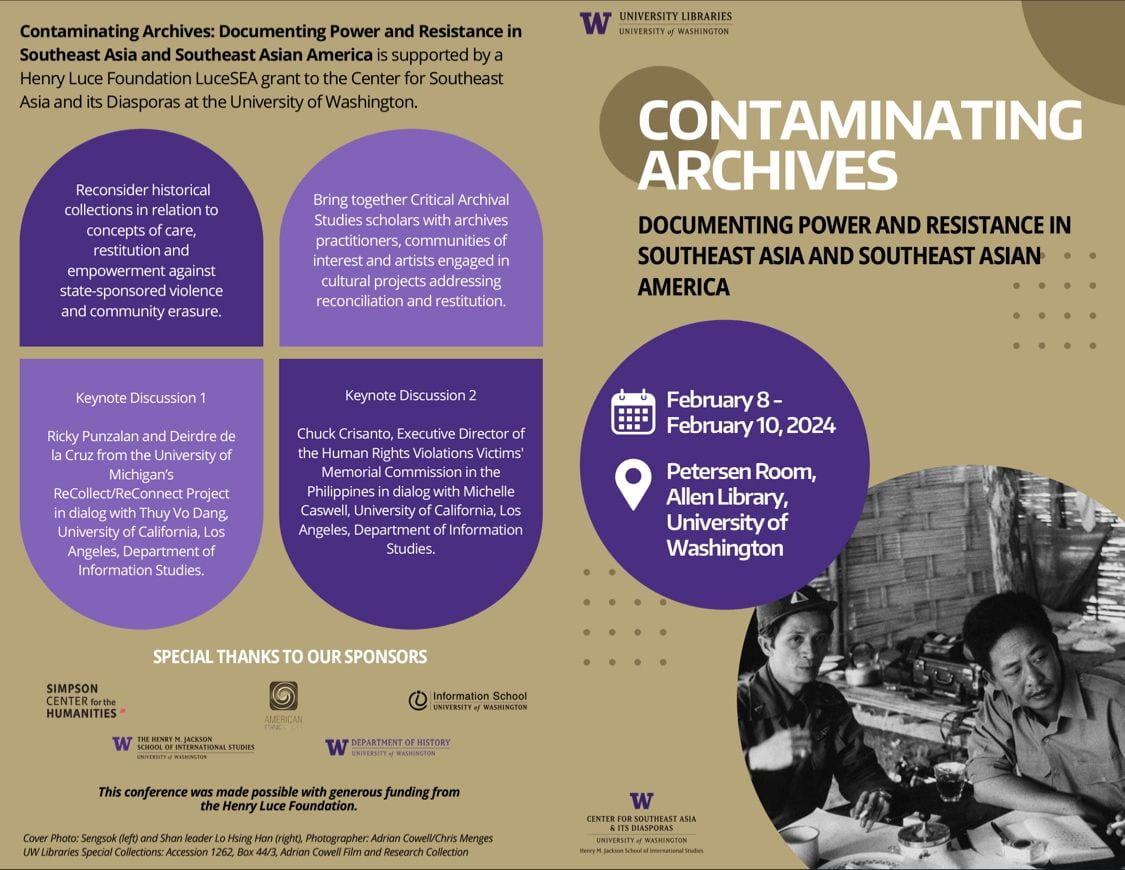
Feb 8-10: Contaminating Archives: Documenting Power and Resistance in Southeast Asia and Southeast Asian America. A conference to bring together Critical Archival Studies scholars with archives practitioners, communities of interest and artists engaged in cultural projects addressing reconciliation and restitution. Learn more. 

Feb 12Town Hall Seattle Presents Boldt at 50: Reflecting on Treaty Justice and Tribal Sovereignty (see side bar for details)

Feb 14- Tarot for Friends and Lovers: Join Abigail Vasquez, one of the best tarot readers in the Pacific Northwest, for a special Valentine’s Day event learning to read tarot cards for relationships AND enjoy the current exhibit in Special Collections Magick and Mystery: Exploring the Supernatural. Space is limited, so registration is required. RSVP and learn more.

Feb 21-Tateuchi East Asia Library Grand Reopening Celebration. Enjoy a festive program celebrating rich East Asian cultures, our special collections and support for East Asian scholarship. The event is open to all, so please feel free to share with your colleagues, friends, and family. RSVP appreciated!

  • February 29th- Scholars’ Studio: Scholars’ Studio is a fun, informal event that features 10 rapid-fire ignite-style presentations (5 minutes each) given by graduate students and postdocs doing research on topics related to an interdisciplinary theme.

Learning Workshops

  • February 12th- UW Libraries Hacking the Academy: Podcasting as Research and as a Way to Communicate Research: In this installment, a faculty member, two graduate students, and a program manager will share how they’ve made podcasts a part of their research and also in order to communicate about research, issues, and emerging things in their fields. This event will be a great look at how podcasting is being done at the UW, and attendees should come away with some practical next steps for starting their own podcasts.

Love Data Week EventsLove Data Week graphic

    • February 15th- Love Data Week: Finding Datasets: This workshop will cover where to find open and proprietary datasets, as well as considerations for using them. 

  • February 16th- Creative Commons Workshop: Join us to learn how the CC works and where to find and share media freely and easily.

February 23rd- Fair Use Workshop: Join us to explore how the doctrine of fair use facilitates commentary, scholarship, and innovation. 

March 1- Scholars Studio is a fun, informal event that features 10 rapid-fire ignite-style presentations (5 minutes each) given by graduate students and postdocs doing research on topics related to an interdisciplinary theme.  Hosted by the UW Libraries Research Commons and The Graduate School Core Programs, Scholars’ Studio gives students the opportunity to share their research across disciplines, make connections and build presentation skills. The winter 2024 Scholars’ Studio event will be a hybrid (in-person and virtual attendance options) event open to any research, practice, or teaching topic in any discipline. Learn more.

March 4- Introduction to Open Pedagogy: In conjunction with International Open Access Week, join colleagues in an interactive exploration of the benefits, challenges and transformative potential of open pedagogy assignments. Led by Lauren Ray, Open Education Librarian, UW Libraries!

Office Hours / Drop-In Help

Digital Scholarship Project Help Office Hours- Tuesdays: Learn about getting started with digital projects at UW. We offer consultations for research and course related projects. Examples include support for digital publishing, building digital exhibits, and more! We can help you find the right tools, resources and instruction whether you’re just getting started or are working on an on-going project. Learn more

Citation Tools Cafe- Rotating: Drop in and connect with the UW Libraries Research Commons citation management tools experts at a variety of cafes around campus! Learn more

Data Visualization Office Hours- Wednesday : Drop by office hours to get help with data visualization! We can help you choose the right tools, find resources, and discuss how to prepare your data for visualization. Learn more.

Graduate Funding Information Service Office Hours: The Graduate Funding Information Service (GFIS) works with current and admitted UW graduate students.  Learn more.

Missed It?

Check out this great story on the recent digitization of iconic Seattle music magazine, The Rocket:


EXHIBITS

EXHIBIT: Magick and Mystery: Exploring the Supernatural in Special Collections – Opens September 12. Explore the supernatural in this exhibit featuring all manner of magic and mischief. Opening in Fall 2023 and running until the end of Winter Quarter 2024, Magick and Mystery will feature items from Special Collections, in the UW Libraries, on topics ranging from local folklore and mysteries to 19th-century spiritualism, and even TikTok tarot trends. Learn more.

EXHIBIT: Breaking Bread: Foodways and Cuisine in Print – opening September 26 For the 2023-24 academic year, Special Collections is featuring items in our collections that connect to a multitude of different foodways and food cultures. With four rotations at the end of each quarter, the items from Special Collections demonstrate complex systems of cultural celebration, continuance, and suppression that are wrapped up in food systems. Learn more. 

Stories

UW Research: A Year of Open Data with Dryad

UW Libraries is happy to announce the one-year anniversary of its membership with the data repository Dryad! Our initial year saw both many deposits (see charts below) from UW researchers, as well as downloads from the research community at UW and beyond. We thought it would be fun to share some stats from this first year.

UW data deposits in Dryad had more than 8,064 downloads and 15,980 views! The charts below show the top 10 data sets by view, download and journal.

chart showing top downloads in Dryad

“I submitted my grant on Monday and just wanted to thank you again for providing these resources. The knowledge that UW is subscribing to Dryad, the info that Dryad provides in their Q&A, and the DMPTool were especially invaluable. So thank you so much again! You saved me so much time!” – Julie Crudele, Ph.D Acting Assistant Professor of Neurology 

Dryad is the first open data publishing platform available to UW users. As a generalist repository, Dryad accepts data regardless of data type, format, content, or disciplinary focus.

The UW Libraries implementation of Dryad aligns with the increasing advocacy of public research universities to provide for the open sharing of research data and outputs. This announcement also comes on the heels of the National Institutes of Health’s new data management and sharing policy which went into effect January 23rd.  Dryad is one of the Generalist Repositories recommended by the National Institutes of Health. 

Did You Know?

For more information on how UW researchers can get started with the service, see our guide. 

For more information, contact the Libraries Data Services Team, [email protected].

###


Stories

New Wheelchair Charging Stations Are Here!

one of the new charging station in Suzzallo Library, one of four new stations in libraries across the Seattle campus

The UW Libraries have added four wheelchair charging stations, located in the Odegaard Undergraduate Library, the Open Scholarship Commons in Suzzallo Library, the Research Commons in the Allen Library, and the Foster Business Library. These charging stations were able to be purchased thanks to the UW’s Student Technology Fee (STF). The charging stations are from the Clearview Disability Resource Center and have 24 volt five-amp chargers, as well as a dual USB charging port. They are available to all library visitors. The Libraries have long had STF-funded stations equipped for charging small devices such as phones and tablets, and are excited to now have the necessary infrastructure for ensuring people using powered wheelchairs can recharge on campus. 

Before the Libraries added these four charging stations to the Seattle campus, the only existing public spot for charging wheelchairs was in the Hans Rosling Center.

“Having multiple recharging options on campus will be beneficial to powerchair users. For instance, commuting between the main campus and the South Campus can be incredibly draining on the batteries. Having chargers across campus offers increased flexibility to do whatever you need to do while on campus and not having to worry if the battery has enough power to get home,” said Andy Andrews, Assistant Director of Academic Services at Disability Resources for Students.

More charging stations are also expected to be added on campus in the future. One group working on adding charging capability to the campus is UW’s Engineers Without Borders Accessibility group, who are working on “Project Mobility” to improve the affordability of this endeavor. 

Enhancing equitable environments for teaching, learning and research is one of the UW Libraries main strategic priorities. To put those values into practice, we prioritized improving access to library spaces and resources by adding more wheelchair charging stations. We hope that these stations will improve the campus experience for wheelchair users, with the ability to recharge their devices as needed without having to cart around unwieldy cords or return home.

A full list of our accessible spaces and resources can be found on the Libraries Accessibility page. If you have any questions about the study room or would like to suggest potential areas of improvement related to Libraries’ accessibility, please contact us at [email protected].


###

Stories

The Secret Life of UW Libraries Catalogers and Metadata Specialists

Student Spotlight: Zhuo Pan

Zhuo Pan says, “My time as a student employee at UW Libraries gave me both a solid foundation and a forward-thinking approach that have served me well in launching my career in library tech services.”

You may be surprised to hear that before you can access a library resource when you need it, a lot of work must be done to get that resource into the UW Libraries catalog. A whole department of librarians, staff, and students are quietly working away behind the scenes to get new resources into the catalog and to find innovative ways to enhance the Libraries’ metadata. This series of blog posts will highlight our brilliant student employees and the work they do to make your tasks of searching, identifying, selecting, and obtaining library resources easier and more effective.  

Zhuo Pan came to the University of Washington iSchool’s MLIS program after earning a Bachelor’s in Library Science from Wuhan University. Given his prior study and experience, the UW Libraries’ Linked Data Team (an informal group focused on linked data projects) was thrilled to bring Zhuo on board as a student Library Data Specialist in February 2022. 

What is linked data? We’re glad you asked. You might be familiar with standard web technologies such as HTTP, which uses hypertext links to serve up web pages for human readers to interpret. Machines cannot make much sense of web pages or their often-complex relationships to one another when they are in document form. Linked data builds on standard web technologies such as HTTP in a way that makes the information on the internet automatically readable for computers as well as humans. It also interlinks data with other data on the web using languages called ontologies that express specific types of relationships, so it becomes more useful through semantic queries. You may also hear people refer to linked data as the Semantic Web.  

What is RDA?

RDA is an international set of cataloging standards which the UW Libraries follows in describing library resources. RDA publishes a linked data ontology alongside its cataloging rules so that libraries, museums, and galleries may express their descriptions as linked data

Libraries are very interested in linked data because it has the potential to connect our users with information outside our collections from all over the web, enriching the user experience and enabling researchers to access more information than ever before.

The Linked Data Team at the University of Washington Libraries has been pursuing a linked data implementation of Resource Description and Access (RDA), an international library resource description standard already in use by library catalogers across the world, for a number of years because it is a more granular (and we think, more useful) ontology than others used to express library data as linked data. The UW Libraries has been a leader in this work, which you can learn more about through the UW Libraries Semantic Web Blog.

Zhuo exceeded the Linked Data Team’s high expectations with his work ethic, productivity, self-motivation and strategic thinking during his work on several projects at the Libraries. Zhuo began contributing to the MARC21 to LRM/RDA/RDF Mapping and Transformation Project, supervised by Theo Gerontakos and managed by Crystal Yragui, at the start of his employment. His deep theoretical knowledge of the Resource Description & Access (RDA) rules and ontology made him a respected colleague on an international team of world-recognized experts. 

RDA is an international set of cataloging standards which the UW Libraries follows in describing library resources. RDA publishes a linked data ontology alongside its cataloging rules so that libraries, museums, and galleries may express their descriptions as linked data

…Currently, libraries around the world are preparing to move from the existing  non-linked-data format to linked data. 

Currently, libraries around the world are preparing to move from MARC21 (the record-based, non-linked-data format we are used to seeing when we search the UW Libraries for resources) to linked data. In order to do this, libraries need to transform their MARC21 data to linked data formats, and create editing environments for new resource descriptions to be recorded. Zhuo made significant contributions to discussions, ontology mapping work, and the transformation code accompanying the ontology mapping. Zhuo’s work on this project will aid the international RDA user community in transforming their legacy MARC21 data to the RDA linked data format. 

Zhuo’s MLIS Capstone project, Sinopia MAPs, worked toward the related goal of enabling the creation of new RDA metadata descriptions using RDA’s ontology through a set of templates. The direct creation of resource descriptions as linked data rather than as records which need to be converted to linked data using complex mappings and transformation processes avoids the losses of specificity that come along with transforming data from MARC. Supervised by Benjamin Riesenberg, Zhuo drafted a set of templates for describing print books, demonstrating a deep, professional-level knowledge of the RDA data model and numerous other sources of internationally-adopted documentation and instructions. He documented his template design well, and showed outstanding skill in the types of coding needed to get the job done. Templates for other types of resources will be created based on the print books templates Zhuo drafted, eventually allowing metadata professionals to describe all library resources in a similar way.

“My time as a student employee at UW Libraries gave me both a solid foundation and a forward-thinking approach that have served me well in launching my career in library tech services.” – Zhuo Pan

All of the work Zhuo has done on these two projects will help the University of Washington Libraries convert the existing catalog to linked data and change cataloging practices to linked data in the future. This will translate to high-quality linked data that guides users toward the information they need within the UW Libraries collections and across the Semantic Web.

Zhuo graduated with his MLIS in Spring 2023, and began his career as a Resource Description Resident Librarian at Duke University Libraries after a celebratory farewell lunch with the Linked Data Team. We hope to continue working with Zhuo on international library metadata projects, and are proud of his success.

###


Stories

January Update 2024

Happy New Year, Huskies! Here’s wishing you a great start to winter quarter and 2024!  This month’s update features some incredible new stories including an insightful essay by The Boys in the Boat author, Daniel James Brown as well as features on our work to preserve Seattle’s music history, and student-centered scholarship documenting UW student sports experiences (Go Dawgs!) .  Speaking of  articles, all UW users now have faster, more direct access to journal articles (read our story on LibKey below) and access to the Atlantic magazine (see details below).   As always, be sure to check out all of the free workshops, exhibits and events happening this month – for learning and for fun – including journal creation and info sessions on the very popular Data Science for Social Good summer program!  

Pop-Up Exhibit:

Racing Toward the 1936 Olympics

Don’t miss UW Libraries Special Collections’ pop-up exhibit Racing Toward the 1936 Olympics. The exhibit features a timeline of the events leading up to the Olympics beginning in 1931 and period rowing equipment courtesy of Pocock rowing historian Al Mackenzie, who also served as a rowing consultant for the film. The exhibit will be on display in the first-floor exhibit case in Allen Library North, through Friday, February 2, 2023.

Images: (left) A coxswain megaphone used by George Pocock, and (right) a sliding seat, rigger and foot stretcher from boats used by the team.

News and Stories

“The Boys in the Boat happened only because of the vast collection of carefully preserved documents and artifacts I was able to unearth at Suzzallo.” 

In our most recent blog, Daniel James Brown shares his UW research journey writing the acclaimed book, The Boys in the Boat, now a major motion picture. Read the essay, stop by the exhibit ‘Racing Toward the 1936 Olympics” (see right) and check out UW Libraries new digital collection, UW 1936 Rowing Team!

UW Libraries Launches LibKey – new service behind Libraries Search will significantly improve efficiencies in accessing academic journal articles. Read the announcement.

Archives of The Rocket, influential Seattle music magazine, go digitalfeaturing UW curator of the UW Ethnomusicology Archives, John Vallier and Jessica Albano, head of UW Libraries’ government publications, maps, microforms and newspapers.

Student Stories of Campus Sport Experiences: A Case of Engaged Learning – A recently published article in the  the Sports Innovation Journal highlights the Libraries role in supporting digital scholarship and open pedagogy practices, in particular through the use of Pressbooks. Co-authored by Lauren Ray, Open Education and Psychology Librarian with Jennifer Hoffman, Assoc. Professor in the Center for Leadership in Athletics at the UW College of Education and Regena Pauketat, doctoral candidate in the College of Education.

Community /Events

January 11- Film Screening: Bill T. Jones: Still/Here Bill T. Jones: Still/Here follows dancer and choreographer Bill T. Jones as he develops his acclaimed “Still/Here” dance production based on his workshops inviting people battling serious illness to express their angst, hopes and fears through original gestures, which he incorporates into dance moments for his piece. This film screening accompanies the exhibit Someday This Will be Over: AIDS Remembered, in the Allen Library Lobby through January 15, 2024. Learn more.

Mise en Place: Special Collections Open HouseJanuary 31- Mise en Place: Special Collections Open House A rare opportunity to go behind the scenes — tour and learn more about special collections and current exhibits.  Enjoy food, a scavenger hunt, insights from the curators, and get “hands on” access to many treasures from the collections, including items from our current exhibits: Breaking Bread: Foodways and Cuisine in Print AND Magick and Mystery: Exploring the Supernatural.! OPEN TO ALL! Learn more.

NEW Resources!

The Atlantic online: UW users now have online access to The Atlantic! From the log-in page click “Sign in through your institution,” find the University of Washington, then create an account with your UW email. Get access  


Israel-Hamas War Research Guide: This new research guide provides access to tools and sources for learning about the Israel-Hamas war, representing a variety of academic and political perspectives.


Special Programs/Upcoming Application Deadlines

  • February 4th- UW Libraries Fellowship in Research Communication and Equity:  This unique fellowship program is aimed at Black, Indigenous, and People of Color (BIPOC) graduate students who want to share their research or other academic work. Fellows will create a physical artifact that visually communicates their research and receive a $500 award. Applications due February 4th. Learn more.

Learning Workshops

  • January 23- Student Journals Hack the Academy -online and in-person sessions. Hear from representatives of five UW student journals about the importance of student-produced scholarship and how student journals “hack the academy” by pushing the boundaries of traditional scholarship and publishing! See also our “So you want to start a journal?” workshop on January 31st!
  • January 23- Textual Studies & Digital Humanities Minor Open House. Learn more about studies relevant to careers in libraries and archives, publishing and editing, and fields dedicated to preserving and making accessible cultural materials and documents! You don’t have to know your career plan to explore the many opportunities in these fields and how these UW courses can support your exploration.

Office Hours / Drop-In Help

Digital Scholarship Project Help Office Hours- Tuesdays: Learn about getting started with digital projects at UW. We offer consultations for research and course related projects. Examples include support for digital publishing, building digital exhibits, and more! We can help you find the right tools, resources and instruction whether you’re just getting started or are working on an on-going project. Learn more

Exhibits

Someday This Will Be Over: AIDS RememberedOn the 35th anniversary of World AIDS Day, this exhibit highlights the history of the HIV/AIDS pandemic with a focus on the political, social, and cultural impacts in the United States and Seattle. The exhibit will also feature film viewings in Allen Auditorium. Now-January 15th.  Learn more. 


Breaking Bread: Foodways and Cuisine in Print – opening September 26 For the 2023-24 academic year, Special Collections is featuring items in our collections that connect to a multitude of different foodways and food cultures. With four rotations at the end of each quarter, the items from Special Collections demonstrate complex systems of cultural celebration, continuance, and suppression that are wrapped up in food systems. Learn more.

Magick and Mystery: Exploring the Supernatural in Special Collections – Opens September 12. Explore the supernatural in this exhibit featuring all manner of magic and mischief. Opening in Fall 2023 and running until the end of Winter Quarter 2024, Magick and Mystery will feature items from Special Collections, in the UW Libraries, on topics ranging from local folklore and mysteries to 19th-century spiritualism, and even TikTok tarot trends. Learn more.

###

Stories

Fiat Lux – By Daniel James Brown

Daniel Brown, author of The Boys in the Boat

The following is a version of a keynote speech given by author Daniel James Brown at the 2014 UW Libraries’ Literary Voices fundraising event that has been edited for length in this context.

PREFACE: Daniel Brown’s love of libraries began decades ago when, as a struggling high school student, he was instructed to complete correspondence courses while working out of Doe Memorial Library at Cal Berkeley—to earn his high school diploma. The experience was foundational. Speaking at a UW Libraries event, Brown reflected about this pivotal time and his early career as an English professor, where “university libraries were always my places of refuge, my sanctuaries—Doe and the Bancroft at Berkeley, Powell at UCLA, Clark at San Jose State, Green at Stanford. They were the places where I could most fully become who I was, who I am today.”


I have to confess that although I lived just across the lake in Redmond, I seldom had occasion to visit the University of Washington Libraries. But then, in 2008, I met my neighbor, an old man named Joe Rantz. When I first sat down with Joe and he began to tell me how he had come to row crew at the University of Washington and how he and his crewmates had won a gold medal in Berlin in 1936, rowing against a German boat in front of Hitler, I was mesmerized immediately.

LEFT: The book cover for The Boys in the Boat; RIGHT: a promotional poster for the film, opening December 25, 2023.

And as Joe talked that first day, I couldn’t help but notice that from time-to-time he was tearing up. At first, I thought he was crying for the loss of his crewmates, most of whom had passed away in the preceding few years. But as we talked more I began to see that there was a kind of joy coming through Joe’s tears, a large measure of pride and love. And as we talked more, I began to understand that Joe was crying not so much for the loss of his crewmates as for the sheer beauty of what had happened seventy-five years before in Berlin. Toward the end of the conversation, I asked Joe if I could write a book about his life. He thought for a moment and then shook his head and said slowly, “No…I don’t want you to write a book about my life. But you can write a book about the boat.”

At first, I didn’t know what he meant—I thought he meant the physical boat in which he and his mates had rowed. But we talked a little more, and I gradually came to understand that by “the boat” Joe meant the other boys who had rowed with him. And then, finally, I came to understand that he meant more even than that. He meant the perfect thing that he and those eight other good-hearted boys had become together—a living thing, an almost mystical thing, an exquisitely unified and balanced thing, a team in the very deepest possible meaning of that word.

And so I set out, the very next day, with Joe’s permission, to write a book about the boys in the boat.

It didn’t take me long, though, to discover that the story was really about even more than just than those nine boys and a gold medal and the beauty of that moment in Berlin. It was about the mechanics of rowing, the physiology of pain, and the psychology of endurance. It was about humility and trust, about loss and redemption. It was about the Great Depression and the Dust Bowl and Nazi Germany and boat building and an Olympic boycott and a German filmmaker named Leni Riefenstahl and many, many other things about which I knew next to nothing.

The Reading Room in Suzzallo Library

But I did know where to go. And when I walked into Suzzallo Library at the University of Washington, I knew immediately that I was home again.

There were the old familiar smells, the ornate entrances and marble staircases, the murmuring of students, a great, cathedral-like reading room, and stacks and stacks of books.

Over the next several years, that first conversation I had with Joe Rantz became a book called The Boys in the Boat. But that happened only because of the vast collection of carefully preserved documents and artifacts I was able to unearth at Suzzallo.

Images: A page from one of Coach Al Ulbrickson’s log books, March, 1936. From the Alvin Edmund Ulbrickson papers, University of Washington Libraries, Special Collections, accession number 2941-001
Images: Cover page and spine of the bound edition of Al Ulbrickson Jr.’s Master’s thesis on the history of Washington rowing. Special Collections, Thesis 12997

I found hundreds of relevant articles from The Seattle Times, the P-I, and UW’s Daily on microfilm. I found the daily logbooks of Coach Al Ulbrickson, some of them kept in old lab notebooks stained with mysterious chemicals but carefully conserved in Special Collections. I found a bound edition of his son, Al Junior’s, Master’s thesis on the history of Washington rowing. I found a trove of books on German history, sports psychology, the Depression, Riefenstahl, and dozens of other topics of interest—really pretty much everything I needed to get a firm grip on any angle of the larger story. There were hundreds of photographs—not just those that appear in the book—but scores more that gave me small but crucial insights into daily life in Seattle in the mid-1930s, many of them conveniently digitized.

I don’t think it is an overstatement to say that The Boys in the Boat would never have happened but for the resources housed in this one library.

These kinds of materials are the stuff from which new books are sometimes made—not just mine, but thousands of the new books that appear in the marketplace every year. I think too often we think of libraries only as repositories of old stories and old books; but in fact they are also very often the wellspring of new stories and new books.

Now we are here tonight, of course, because we have decided to join in a cause, to raise funds for the library. And that brings to mind an incident from The Boys in the Boat. The boys from Washington won the right to represent the United States at the 1936 Berlin Olympics in a qualifying race at Princeton on a sweltering hot day in June of 1936.  But just a few hours after that victory—after they had realized the goal toward which they had striven for three years—an official from the Olympic Rowing Committee, a man named Henry Penn Burke from Pennsylvania, came to Coach Ulbrickson and informed him that the boys, or the university, would have to pay their own way to Berlin. And, Burke went on, if Washington couldn’t afford to go, the Pennsylvania boys had plenty of money. They had come in second. They would be happy to go in Washington’s place. Ulbrickson was flabbergasted, and furious. No one had ever suggested that the boys would need to pay their own way. This was the depths of the Depression and none of them had two nickels to rub together, nor for that matter did the University. Burke left the meeting with Ulbrickson under the impression that Washington could not afford to go. Ulbrickson left the room with the same impression.

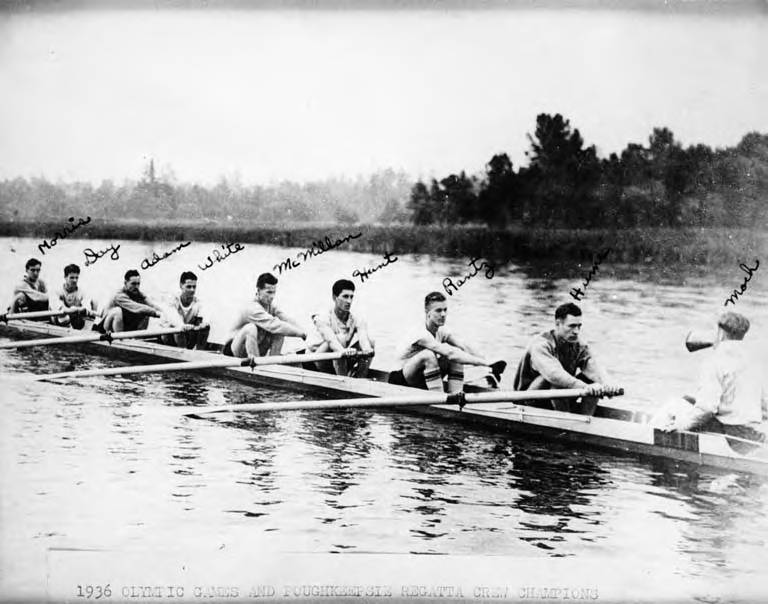
University of Washington rowing team from the 1936 Olympics
Image: 1936 Olympic Games and Poughkeepsie Regatta Crew Champions (Joe Rantz is the second rower from the front), University of Washington Libraries, Special Collections, UW37275. See also  many of the iconic historical photos in a new UW Libraries digital collection: UW 1936 Olympic Rowing Team

But that night, phones began to ring all over Seattle. Ulbrickson and the Washington press contingent—Royal Brougham of the Post-Intelligencer and George Varnell of The Seattle Times—began placing calls back home and composing headlines for the morning editions of their papers. By the next morning, committees had been formed. By that afternoon hundreds of students and citizens were on the streets of Seattle selling paper badges for 50 cents apiece. Donations began to come in from businesses and individuals: $1.00 from a donor who wished to remain anonymous, $5.00 from the Hide-Away-Beer Parlor, a hefty $500 from The Seattle Times. By the time another twenty-four hours had passed, the citizens of Seattle had raised $5,000 and the boys were good to go to Germany. But only because the citizens of Seattle stood up and said, “Yes they will go.”  It was, as someone pointed out to me recently, an example of Seattle’s 12th man before there was even a professional football team in the city.

It tells a story. It tells how—aided by the spectacular generosity of the citizens of Seattle in a very tough time—those nine young men showed us all what we can do when we climb in a boat and pull together as one.

description and photos of library exhibitThe boys went on to win Olympic gold in spectacular fashion in Berlin. But they did more than win gold. They created a great legacy.  If you have never done so, I urge you to go down to Conibear Shellhouse and take a look at the Husky Clipper, the beautiful shell in which the boys rowed their way to glory in 1936. It hangs gorgeously above the dining commons. It has been lovingly restored, preserved, and displayed. Its burnished red cedar hull and yellow spruce trim glow under the spotlights in the room. But more than a beautiful object, the Husky Clipper is important because it is a symbol. It stands for something far beyond winning a race. It embodies the boys’ legacy. It tells a story. It tells how—aided by the spectacular generosity of the citizens of Seattle in a very tough time—those nine young men showed us all what we can do when we climb in a boat and pull together as one.

And that’s just exactly what we are doing here this evening, climbing in a boat and pulling together as one toward a common goal—

providing for the restoration, conservation, and preservation of the library materials that remind us who we are, the materials that past generations have left us as their legacies, to tell us their stories, and to engender new stories.

And so the library—particularly the university library—remains the ultimate sanctuary of knowledge.  And it is truly a sanctuary, a temple in which we keep the flame of knowledge lit. And we must defend it. It is up to us individually—but more importantly collectively, as a team, joining together as one, just like that 1936 crew—to keep that flame blazing brightly. As the motto over the portal of Doe Library down in Berkeley reminds every uncertain young man or woman who passes under it, generation after generation, Fiat Lux, let there be light.

###

Learn more about how you can support UW Libraries.


Stories

December Update

Books make a great gift! Use code WINTER23 and get FREE domestic shipping through January 5th! SHOP NOW.

Here’s wishing everyone a successful finals week, holiday season and relaxing winter break ahead. When you are done with finals, or need a study break, stop by our current exhibits, take advantage of our wide selection of streaming media or browse University Press’ amazing catalog for a gift that is uniquely “UW”!

Resource Reminders

Finals Week Tips from UW Libraries 

Winter Break Boredom Buster: UW Libraries Streaming Media! From popular recent movies to artistic performances, cult classics, documentaries, foreign films, TED talks, vintage advertising and so much more, UW Libraries streaming media collections have you covered!

Operations Updates:

Odegaard offers extended hours for end of quarter and Finals Week: Evening and weekend hours will be extended for Odegaard Library December 6 – Thursday December 16. See all hours.

Odegaard Undergraduate Library Access Update: UW Alumni Association Members and Cascadia College members are now included as part of the UW-only access policy for Odegaard. To enter, users must have a current library account and present their UWAA card (physical card, or digital card in UWAA app) or Cascadia Card PLUS a current, valid photo ID.

NEWS and STORIES

  • Missing Women Authors: Unheard Songs of Indian Devotional Poetry Read the story
  • ‘The world is magic’: ‘Magick and Mystery’ Exhibit at Special Collections Read the Story

Community Events

NEW EXHIBIT: Someday This Will Be Over: AIDS Remembered On the 35th anniversary of World AIDS Day, this exhibit highlights the history of the HIV/AIDS pandemic with a focus on the political, social, and cultural impacts in the United States and Seattle. The exhibit will also feature film viewings in Allen Auditorium. Now-January 15th.  Learn more.


UW Libraries Social Justice Book Groups: Winter break is a great time to discover and read books for your own personal enjoyment. It’s also a great time to learn about Community Reads and RealLit, two community-based book groups hosted by UW Tacoma and UW Bothell Libraries that bring UW students and community members together across campuses to delve into compelling stories while sharing  ideas and personal expression. Learn more.

FREE Workshops

Partner Events: The UW Libraries Open Scholarship Commons is committed to sharing the work of UW partners like the eScience Institute who are engaged in open scholarship work across disciplines:

  • 12/7: AWS Cloud Security Workshop: UW’s Amazon Web Services (AWS) team cordially invites you to attend a monthly workshop hosted at the eScience Institute. These workshops will consist of a technical component introducing cloud computing concepts, discussing best practices, and an open Q&A session to discuss projects you are working on or issues you are running into. Learn more.

Office Hours / Drop-In Help

12/5: Open Source GIS Tools Office Hours: Stop by and learn about open source GIS and mapping tools (ex. StorymapJS, QGIS). Learn more.

The Graduate Funding Information Service (GFIS) is hosting drop in hours virtually on Wednesdays from 1:00-2:00p. Open to all current and admitted UW graduate students, this service helps students learn the skills and tools to find funding for graduate school. Learn more.

12/13 Data Visualization Office Hours: Drop by office hours to get help with data visualization! We can help you choose the right tools, find resources and discuss how to prepare your data for visualization. Feel free to attend whether you’re just thinking about getting started or are already working on a project. Learn more.

Digital Scholarship Project Help Office Hours- Tuesdays: Learn about getting started with digital projects at UW. We offer consultations for research and course related projects. Examples include support for digital publishing, building digital exhibits, and more! We can help you find the right tools, resources and instruction whether you’re just getting started or are working on an on-going project. Learn more

12/18- Metadata Support for UW Libraries Digital Scholarship Platforms: Metadata support office hours at the OSC are a place to ask questions about describing your digital project and get support for integrating metadata effectively into your work in Libraries-supported platforms. Learn more.

12/21- Data Management & Stewardship Office Hours: Learn about tips and tools to better help you manage your research data and preserve it for long-term use. We can help with data management plans, help identify campus data resources and experts, and provide information on data sharing, including the UW’s data repository, Dryad. Learn more. 

Health Sciences REDCAP Trainings

 Provided by the Institute of Translational Health Sciences and UW Health Sciences Library.

  • REDCap 101- Introduction to REDCap- Dec 5: Geared towards new or novice users of the REDCap system, this class goes through the entire lifecycle of a REDCap project – from initial setup to data entry and finally exporting your data. Learn more here
  • REDCap 203 – Longitudinal Studies- Dec 12: Learn how to setup complex longitudinal projects and how to utilize the repeatable instruments/events feature. Take this class if you are planning a complex or longer term project in REDCap.  Learn more here.

EXHIBITS

Magick and Mystery: Exploring the Supernatural in Special Collections – Through Winter Quarter. Explore the supernatural in this exhibit featuring all manner of magic and mischief with items from Special Collections on topics ranging from local folklore and mysteries to 19th-century spiritualism, and even TikTok tarot trends. Learn more.


Breaking Bread: Foodways and Cuisine in Print – For the 2023-24 academic year, Special Collections is featuring items in our collections that connect to a multitude of different foodways and food cultures. With four rotations at the end of each quarter, the items from Special Collections demonstrate complex systems of cultural celebration, continuance, and suppression that are wrapped up in food systems. Learn more. 

###

Stories

November Update

It is hard to believe that we are about halfway through the first quarter! Finals may seem far off, but it’s never too early to start thinking about connecting with UW Libraries to help you prepare, stress less and succeed. Not sure where to start? Check out our drop-in help sessions and resource reminders in this post!  Grad students: check out the Community Fellows Series (a paid fellowship), Scholar’s Studio and weekly office hours for the Graduate Funding Information Service to help guide you through the process of identifying and applying for grad school funding. Starbucks has reopened in Suzzallo (YAY!)– after you grab a coffee, be sure to peruse the amazing new exhibits on display in Allen Library on your way to class, only during the month of November!  

Resource Reminders for Finals

NEWS and STORIES

Announcing the Community Fellows Workshop Series from the Open Scholarship Commons–  a paid fellowship opportunity, funded by the UW Diversity Council, aims to support the expertise and leadership of underrepresented students in the field of open scholarship,  creating opportunities for peer-to-peer learning. Learn more at the November 17th open house; applications due December 1st!

A conversation with the author of Bridgerton Julia Quinn A fascinating interview from The Daily covering the October 19th event hosted with the UW Eighteenth and Nineteenth Century Graduate Research Cluster.

Exploring Library Careers: UW Libraries Welcomes New Senior Conservator: Are you interested in art, history, science and working in a library or museum? Explore a career in conservation!

Accessible Study Room In Suzzallo – Now More Accessible!

The Secret Life of UW Libraries Catalogers and Metadata Specialists: Student Spotlight

New Exhibits

EXHIBIT: Missing Women Authors: Songs from the Kishangarh ZenanaMissing Women Authors: Songs from the Kishangarh Zenana: Display case on Allen Library North Balcony, First Floor: Men (often of privilege) dominate the pages of the canon of Indian devotional literature, but what about women authors? This exhibit presents the case of the talented women surrounding the prolific Nagaridas, alias of Savant Singh, crown-prince of Kishangarh (Rajasthan) in the first half of the eighteenth century. Learn more.


Unveiling Myanmar: Allen Library North Lobby

A month of movie screenings, an exhibit and book talk to learn about #whatshappeninginmyanmar. The multifaceted exhibit explores recent political events in Myanmar (Burma), featuring historical and cultural artifacts and information, and introduces UW Libraries research resources on Myanmar. Film screenings are Wednesdays at 4PM in the Allen Library Auditorium.  Learn more. 

Tateuchi East Asia Library

EXHIBIT: East Asia Studies Faculty PublicationsFaculty Showcase: See this impressive collection of recent publications by your UW East Asia studies faculty now on display in the newly-renovated Tateuchi East Asia Library! Learn more.

Kuroshio Odyssey: Maritime Memories, Culture, and Landscape: Through November 28, 2023, the Taiwan Studies Arts & Culture Program welcomes you to the Kuroshio Odyssey: Maritime Memories, Culture, and Landscapes—a serial program that focuses on the diverse Indigenous communities of eastern Taiwan and their stunning natural world. The program features a series of in-person displays, online exhibits, crafting workshops, film screenings, and scholarly roundtables across the UW-Seattle. Events hosted in the Tateuchi East Asia Library include:

EXHIBIT: Kuroshio Odyssey: Maritime Memories, Culture, and Landscapes (黑潮漫遊:海洋記憶・文化・地景) Books & PhotosKuroshio Odyssey: Maritime Memories, Culture, and Landscapes (黑潮漫遊:海洋記憶・文化・地景) Books & Photos: In conjunction with the main exhibit  at the Burke museum, this display of books and photos  focuses on the diverse Indigenous communities of eastern Taiwan. On November 9th, join us for an in-person cultural exchange workshop!

11/9: Indigenous Cultures & Food Cultures Exchange with Sra Kacaw, Dumai Manaaki, and Sayang Anang

Community

Scholars' StudioNovember 14- Scholars’ Studio for Graduate Students

Nervous about presenting your thesis or dissertation?  Watch your peers and hear feedback from the UW research community that can help you prepare for your own presentation. Scholars’ Studio is a fun, informal virtual event that features 10 rapid-fire ignite-style presentations (5 minutes each) given by graduate students and postdocs doing research on topics related to an interdisciplinary theme.  Hosted by the UW Libraries Research Commons and The Graduate School Core Programs, Scholars’ Studio gives students the opportunity to share their research across disciplines, make connections and build presentation skills. Open to any research, practice, or teaching topic in any discipline. RSVP Required. Learn more.

Karaoke Fridays11/17 1-4PM: Karaoke Fridays: Come to enjoy FREE Karaoke at the Tateuchi East Asia Library! Songs of East Asian languages and more are available. No reservation required – first come first serve! Learn more

Learning Workshops

11/7: Introduction to Accessibility & Data Visualization Workshop (online): Data visualization best practices and tools do not always discuss accessibility, which can exclude many groups of people. This workshop will review ways to make your visualizations more accessible. We will work through a visualization together and add features to make it more accessible. 

11/16 ORCID Workshop for Researchers: Funding organizations, publishers, and research institutions are increasingly requiring or asking for ORCID iDs from researchers. Getting and using your free ORCID iD and ORCID record can help you save time and get credit for your work in funding, publishing, and research reporting workflows. Led by the UW ORCID Community Learn more.

11/27: Create the World’s Fastest Book: Manifold Workshop: A mix of lecture and hands-on time that you’ll spend learning to build a digital book of your own Learn more. 

11/20: Metadata Support for UW Libraries Digital Scholarship Platform: High-quality descriptive metadata can make your work more findable and meaningful for users, but platform requirements and related standards aren’t always easy to understand. Ask questions and get support for integrating metadata effectively into your work.

Office Hours / Drop-In Help

The Graduate Funding Information Service (GFIS) is hosting drop in hours virtually on Wednesdays from 1:00-2:00p. Open to all current and admitted UW graduate students, this service helps students learn the skills and tools to find funding for graduate school. Learn more.

11/8 Data Visualization Office Hours: Drop by office hours to get help with data visualization! We can help you choose the right tools, find resources and discuss how to prepare your data for visualization. Feel free to attend whether you’re just thinking about getting started or are already working on a project. Learn more.

11/16- Data Management & Stewardship Office Hours:  Learn about tips and tools to better help you manage your research data and preserve it for long-term use. We can help with data management plans, help identify campus data resources and experts, and provide information on data sharing, including the UW’s data repository, Dryad. Learn More.

Digital Scholarship Project Help Office Hours- Thursdays: Learn about getting started with digital projects at UW. We offer consultations for research and course related projects. Examples include support for digital publishing, building digital exhibits, and more! We can help you find the right tools, resources and instruction whether you’re just getting started or are working on an on-going project. Learn more

Health Sciences REDCAP Trainings

 Provided by the Institute of Translational Health Sciences and UW Health Sciences Library.

  • REDCap 101- Introduction to REDCap- Nov 7: Geared towards new or novice users of the REDCap system, this class goes through the entire lifecycle of a REDCap project – from initial setup to data entry and finally exporting your data. Learn more.

Don’t Miss It…

Don’t miss these ongoing exhibits in Special Collections throughout the year:

EXHIBIT: Magick and Mystery: Exploring the Supernatural in Special CollectionsEXHIBIT: Magick and Mystery: Exploring the Supernatural in Special CollectionsExplore the supernatural in this exhibit featuring all manner of magic and mischief. Running until the end of Winter Quarter 2024, Magick and Mystery will feature items from Special Collections, in the UW Libraries, on topics ranging from local folklore and mysteries to 19th-century spiritualism, and even TikTok tarot trends. Learn more. 


EXHIBIT: Breaking Bread: Foodways and Cuisine in PrintEXHIBIT: Breaking Bread: Foodways and Cuisine in Print – opening September 26 For the 2023-24 academic year, Special Collections is featuring items in our collections that connect to a multitude of different foodways and food cultures. With four rotations at the end of each quarter, the items from Special Collections demonstrate complex systems of cultural celebration, continuance, and suppression that are wrapped up in food systems. Learn more.

###

Stories

Accessible Study Room In Suzzallo – Now More Accessible!

By UW Libraries Accessibility Working Group

It is important to provide equitable environments that allow all students to feel comfortable studying at the Libraries. To that end, in the last few years we have improved accessibility in several ways around the Libraries: audited our physical spaces and electronic resources for accessibility; posted accessibility information on our website to aid in trip planning; created accessibility kits available for check out; and most recently, opened an accessible study room for use by everyone. 

see highlighted area of room 327 – near the reading room on the third floor of Suzzallo.

The room is located at Suzzallo 327 on the third floor near the Suzzallo Reading Room.

The room is close to elevators and accessible bathrooms. This accessible study room is equipped with two accessible workstations provided by Access Technology Services (ATS) with software and hardware tools such as those found in the Access Technology Center. The room has a video magnifier and speech to text tools. The room also provides additional privacy for students with disabilities needing to make noise during their work, such as while using speech to text. While this room is open to the public, priority is given to students with disabilities. This information is also posted on the Accessibility at the Libraries page.

A workstation with accessible technology
A computer mouse with a trackball and ambidextrous design
An electronic magnifier

Suzzallo Library has hosted an accessible study room for many years; however, access was previously managed by Disability Resources for Students (DRS) and was limited to students registered through that program. Following conversations, DRS, ATS, and members of the UW Libraries Accessibility Working Group agreed that the room would be better utilized and benefit more people if it was opened to the public. The room is now open and unlocked during all Suzzallo Library operating hours. 

For now, the accessible study room will not be added to the study room reservation system. As time goes on and we learn more about how often the room is used, we will adjust this as needed. For example, if demand is high enough, we will consider adding it to the reservations system. Currently, signage in the room states that students with disabilities have priority use of the room.

Enhancing equitable environments for teaching, learning and research is one of the UW Libraries main strategic priorities. To put those values into practice, we prioritized improving access to library spaces and resources by opening up our accessible study room.

A full list of our accessible spaces and resources can be found on the Libraries Accessibility page. If you have any questions about the study room or would like to suggest potential areas of improvement related to Libraries’ accessibility, please contact us at [email protected]

###