Skip to content
Stories

Spring Quarter Survival Tip: Get to Know Your Subject Librarian

Do you know YOUR subject librarian? Have you ever utilized the Libraries’ consultation services for help with your research?  While UW maintains remote learning, our UW Libraries staff will be here to help you, huskies!  Beyond helping users find the electronic books and resources they need, Librarians are talking with students and faculty on the phone, online and over email to offer a wide range of support.

Elliot Stevens

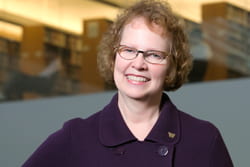
Elliott Stevens, UW’s English Studies and Research Commons Librarian, gave us some insight into how subject librarians work with students and faculty, what online consultations look like, and some of his most useful research tips.

What is a subject librarian?

There is a designated librarian for every department at UW and literally hundreds of subjects, providing years of expertise and interdisciplinary practice. Subjects are kind of a starting off point for working across disciplines. For example, on any given day, my expertise in English could lend itself to a class on gender, women and sexuality studies or French literature for comparative studies. Every day is different.

As a subject librarian for English, I track what is happening in the department and monitor our library catalog to keep up with relevant journals, new books and to see what people are writing about. I update our English LibGuides. Specializing allows us to build a knowledge base over time, to understand trends and be aware of new resources as they become available, which can often save someone hours of research time.

What is a research consultation? 

Research consultations typically connect a subject librarian with a student for personalized help with research–identifying or narrowing a topic and finding resources in the Libraries or online (databases, etc.).  However, UW Libraries staff and librarians offer all kinds of one-on-one consultations for help with things like writing, guidance on copyright, publishing, creating citations and more. Remote consultations are not new–even when the Libraries are open, many consultations happen online; this is a routine part of what we do.

What happens during a research consultation?

Typically, I start with a research interview to collect information, find out what the student is interested in and what they’ve already consulted.  This can be done over email or on the phone. Once I have a sense of their interests and goals, I do my own research before we meet or talk again to review what I have found, and to point them to other possible resources.

For example, today, I met with a student on ZOOM, who came to me for guidance on a major research paper for her English honors program this quarter.  We spent about an hour talking about what she’s done already, and what she’s thinking about, and then I tried to get a sense of how she uses the libraries. Then I shared some of the tips and best resources to help with her particular project.

What do students need to prepare before a consultation?

All you need is curiosity and a willingness to talk to your Librarian. You do not need to have a topic. You do not need to have an outline or anything prepared ahead of time, but coming with a sense of what you’re most interested in and want to learn about is always helpful.

What are some tips that you share with students during a consultation? 

My best advice is outlined in the blog “7 Essential Tips for Research”.

How do you work to support faculty?

During routine operations, I will often lesson plan with faculty in order to visit their classes and do research instruction with students. I also order the books, journals, and databases that they need for teaching and research. 

What do you love most about your job?

It’s endlessly educational. To constantly get close to human ingenuity and creativity and curiosity–it’s a very special thing to experience every day. 

It’s endlessly educational. To constantly get close to human ingenuity and creativity and curiosity–it’s a very special thing to experience every day.  Through research, people are adding to human knowledge, or critiquing human knowledge, and that’s a very noble, important pursuit. 

I hope that every undergraduate will graduate feeling like they can do the work of an analyst, that they can really delve deeply into things, be organized, be creative, and pull information together in a cohesive way. If I can help someone to gain confidence and advance their analytic skills, that it is very satisfying.

______

As this quarter of online learning continues, reach out to UW Libraries for a consultation with a subject librarian or other Libraries staff.  No matter your question or topic of research, a skillful member of the UW Libraries team is here to help– chat with us online, on the phone or over email!

About Elliott Stevens

In addition to being the English subject Librarian, Elliott Stevens supervises the Student Squad (the student workers in the Research Commons), teaches classes and collaborates on Libraries workshops and events with colleagues. He has an MFA in fiction writing from the University of Kansas and an MLIS from the University of Rhode Island. 

#YourLibrary



Stories

7 Essential Tips for Research: Advice From a UW Librarian

Whether you are a new undergraduate or a PhD student, navigating the Libraries vast resources can feel overwhelming, especially when you are working remotely. Fortunately, UW Librarians like me (Elliot Stevens, English Studies & Research Commons Librarian) are here to help.  My fellow Librarians and I regularly talk with students (over email, on the phone, or via ZOOM) to help them strategize their research process. To schedule a consultation, visit our remote resources page here. In the meantime, here are some of my best tips:

1. Start with a question and a conversation.  When you’re starting out, try to think beyond a topic alone. What interests you about the topic? What do you want to learn? THINK: really juicy, interesting, creative, spiky, audacious questions about your topic – open questions. Questions that scream for some kind of answer. Then, use Libraries resources to find a conversation on the topic–like an academic article, or in the media. Look at how others have approached similar topics and ask yourself:  What is my role in the conversation? Am I here to disagree? Am I here to critique? Am I here to amplify? Am I here to emphasize? Am I here to listen, to record or testify? Understanding how your research fits into the larger conversation can be a huge help in focusing your research.

2. Keep a research log. Create a “one stop shop” to document your research process. Use your research log not only to save your citations and relevant links, but also to write down your questions and ideas. Keeping everything in one place saves a lot of time when you want to revisit something or get stuck–you can always go back to past sources and thinking. At the same time, if you document as you go, you are building your citations and bibliography in real time, and this can help save a tremendous amount of time.

Many students do not realize that their UW accounts can be linked to Google Scholar.

3. Connect Google Scholar to your UW Library account. It’s very important to connect Google Scholar to your UW Library account to avoid having to pay for articles. Many students do not realize that their UW accounts can be linked to Google Scholar.  At the same time, it is important to know that Google Scholar is not a replacement for the Libraries catalog. I constantly go back and forth between the library catalog and Google Scholar- they complement each other, and together will provide more comprehensive and diverse content than just using Google Scholar alone. Learn how to connect your UW account to Google Scholar HERE.

4. Utilize dissertations. This really is one of my top “secret” tips, especially for undergrads who aren’t as familiar with dissertations and how to find them. If you find a dissertation about a topic, not only might the dissertation be interesting to read, but a dissertation is loaded with bibliography– hundreds and hundreds of citations and potential sources for your research. UW Libraries have a dedicated database of UW dissertations and a database of international and national dissertations. If you write a dissertation, you spend years and years of your life trying to find everything about it, so someone’s done that work for you.

5. Reach out to University scholars. When I reach out to experts (faculty, researchers, etc.),  it’s always amazing how often and how quickly they write back–our UW community is such a wealth of expertise and knowledge. If you come across the name of someone who has published a lot on a certain topic, don’t be afraid to contact them directly. They may have interesting insights or additional resources, and they can just be a really good sounding board for your questions.

6. Find the Advanced Search tool on the Libraries page. The search bars that we often encounter–the ones in Google, the ones in websites–are one-dimensional. The results can be a mixed bag. With the UW Libraries Advanced Search tool, you have the ability to fine-tune your search. For example, you could set “Toni Morrison” to “Any Field” and get things not only by her, but about her. If you set “Toni Morrison” to “Author/Creator,” then you get things only by her. In Advanced Search, you can specify dates or date ranges, so you could see what criticism of Morrison’s work looked like in the 1980s and compare it to other time periods.  You can also limit resources to electronic materials only, which is a crucial function, especially right now when there isn’t access to the physical materials in the Library. I like to think Advanced Search is like a spaceship with lots of buttons to push and levers to pull. The more you know about these things, the farther and faster you can take your ship.

7. Use Indexes. An index is a list of published articles within a certain discipline or topic. It provides bibliographic information such as author(s), title, name of journal and more.  For example, someone might want to search the database called the MLA Directory of Periodicals in order to find journals that are important in the world of modern languages and literature. Or, if someone were writing about Modernist poetry or the Anthropocene, they might want to search the library catalog, find a text about those topics, and then scour its index. If they were to find such an index, then they could start looking up its bibliography in the library catalog or in Google Scholar. Here is an example of a text with an index.

Need help with your research, or finding what you need? See our Remote Resources and Services for Spring 2020  or contact a subject librarian to schedule a consultation! 

#YourLibrary

About the author: Elliott Stevens

In addition to being the English subject Librarian, Elliott Stevens supervises the Student Squad (the student workers in the Research Commons), teaches classes and collaborates on Libraries workshops and events with colleagues. He has an MFA in fiction writing from the University of Kansas and an MLIS from the University of Rhode Island.

###


Stories

#IHeartUWLibraries: Ari’s Story

With Libraries buildings closed, many students, staff and faculty are missing their favorite place to study, access to computers and software, and their friendly librarians at the reference desk; but Libraries staff are working remotely every day to connect you with the tools and support you need. As Ari Hock, a UW PhD student realized when spring quarter began—the staff and tools he relied on from the UW Libraries are still here to help—wherever you are.

Hock is pursuing his PhD in learning sciences and human development within UW’s College of Education. For a capstone project in his educational psychology class last quarter, Ari relied on the Libraries’ Media Arcade for access to tools like the Adobe Creative Cloud, and to learn new skills to complete a video for his capstone project, exploring artists’ process and inspiration. But he soon realized the Media Arcade was much more than just a computer lab with software.

Ari Hock

“Being a grad student and doing my own research can be kind of scary and isolating when you are working alone all of the time, says Hock. “Working in the Media Arcade inspired me to consider different perspectives. It provided a place to work with people who aren’t in my program with different areas of expertise and ideas. Being able to connect to that energy helped me to push myself to learn more. I would rather be there (in the Media Arcade) than pay for a subscription to work by myself; it just feels more collaborative.”

In addition, Hock also worked with Libraries staff to help teach a 6th grade class lesson on podcasting and digital media.

“For me, using the Libraries–be it remotely or in person– is much more than getting meaningful content and resources, it’s about building relationships to support my work,” says Hock.

In the wake of COVID-19, and remote learning in spring quarter, Ari wasn’t sure if he would be able to get support from the Media Arcade, but when he reached out, UW Libraries Media Arcade Technician, Bryan Shipley, was there to help.

“I was having trouble accessing the cloud resources I needed, and it wasn’t a simple issue. Bryan went the extra mile to identify the problem and work with the vendor to help fix the issue so that I could continue working,” said Hock.

In spring quarter, Ari is building on the video production skills he honed in the Media Arcade to create instructional videos for the College of Education, helping faculty to produce their own videos for remote learning. Check out Ari’s video on how to use captions with Panopto.

While we all look forward to the day when campus life returns to a more routine state, there is one thing that won’t change—UW Libraries teams—from the Media Arcade in Suzzallo, to any one of our sixteen Libraries – are still here to help. Libraries staff are meeting and advising students and faculty remotely through ZOOM meetings and personal consultations over the phone and via email.

If you have questions about digital media production, the UW Libraries’ Media Arcade staff are available via Zoom, chat or email to help advise on projects and troubleshoot a broad range of technical questions that students may have at home. To learn more about how the Media Arcade can help you, visit their website or contact [email protected].

PS: April 19- 25th is National Libraries Week. If YOU have a story about how the UW Libraries have helped you – make a video for the 2020 student video contest (it could be worth $1,500!), email or tweet it to us. We would love to hear from you!

#YourLibrary #UWTogether


Stories

HathiTrust Expands Access to Materials for UW Libraries

Updated 7.20.2020

On March 31st,  HathiTrust  announced that it is offering an Emergency Temporary Access Service (ETAS) which will allow students, faculty, and staff from eligible member libraries to access a significant amount of online materials that are currently unavailable to them in library collections. 

The importance of HathiTrust to Libraries re-opening strategy: As we consider multiple options for re-opening, any approach for a gradual re-opening will be balanced with the importance of the Universities’ HathiTrust partnership that currently provides electronic access to more than 1.7 million books in our print collection that are not physically accessible while the Libraries’ buildings are closed. Please note that this access is a temporary benefit for UW members during this emergency situation. Once the UW Libraries restores access to our physical collections, this temporary online access will be shut off and will not be available to students who continue learning remotely (out-of-state, or internationally). For this reason, we advise faculty to work with subject Librarians to identify course materials that will be consistently available regardless of Libraries’ operations and access to physical materials

ht logoWhat is HathiTrust?

HathiTrust is a membership-based partnership of academic and research institutions offering a collection of over 17 million titles digitized from libraries around the world. It is the largest set of digitized books managed by academic and research libraries — under the aims of scholarly, not corporate, interests.

Why does the ETAS  matter for Huskies?

With UW Libraries buildings closed, there is no access to physical materials at this time, which has been a challenge for students, faculty and staff, including Librarians.

With this additional access to HathiTrust, users can now access 5.4 million of the UW Libraries print materials and items in the public domain (out of copyright) through the digital collections in HathiTrust.

How does it work? 

To access, go to hathitrust.org, click the yellow LOG IN button, select “University of Washington” as the partner institution, and sign in with your UW NetID. For more instructions, see our UW Libraries HathiTrust Research Guide and also HathiTrust User Information. Books currently available to you through ETAS have the label “Temporary Access.” You will be able to read the book online, within a web browser. There is no option to download the work in full. You can also “check out” a copy for an hour at a time. Your access will renew automatically at the end of that hour, unless another user requests the book after that hour is over. 

Please note–this access is temporary. The members of the UW community only have this online access for as long as the current emergency situation persists. Once the UW Libraries reopens and access to our physical collections is restored, this temporary online access will be shut off.  For this reason, we still advise faculty with our motto “first alternatives, then equivalents” to ensure consistent access to course selects and other materials. 

Why aren’t these materials already accessible to HathiTrust members like UW?

These items are in-copyright and the UW Libraries owns a print copy (not an online copy) that may be available on a bookshelf in a UW library building. 

What is available to UW via HathiTrust during normal operations? 

From HathiTrust Digital Library you can also read full-text digitized versions of books that are freely available in the public domain (not in copyright). On January 1, 2020, the copyright expired on nearly 50,000 books with a publication date of 1924. Browse the HathiTrust 1924 Publication Collection. These books are marked “Full View.” You will be available to view, download, search, and add to a collection. Most items will have images of scanned pages and a plain text version. If the item is still in copyright (not in public domain), you have the “Limited (search-only)” option to view. These items have a “Search inside the text” option that will find the frequency and page number of specific words and phrases, which may help you determine if the work is worth finding elsewhere. For more information, see UW Libraries HathiTrust Research Guide

How does HathiTrust and UW Libraries work together during routine operations? 

UW Libraries partnership with HathiTrust is critical to our every day work at the Libraries. It is a reciprocal relationship — our users have access to millions of titles through HathiTrust digital collections, and we contribute back to it. This work is ongoing–to preserve and digitize UW Libraries collections through digitization and preservation replacement (creating digital surrogates, and creating physical facsimiles). When a book is no longer able to be shelved safely due to age and deterioration (what we sometimes refer to as a “brittle” book), we confirm if the book is available digitally via the HathiTrust. If it is, often the book will be boxed by Conservation staff, and a link provided to the digital copy through the Libraries’ catalog. The HathiTrust provides full-text, searchable access to out-of-copyright books. If the subject librarian decides to retain a brittle book in the collection and the book is determined to have enough potential use or research utility and is not replaceable by other means, a preservation facsimile (or occasionally preservation microfilm) is made, along with a high-quality digitization of the book that is deposited in the HathiTrust for both access (if out-of-copyright) and digital preservation.

For more information, please read HathiTrust FAQs for Member Libraries and for Users

### 


Stories

Documenting COVID-19 – A Service of UW Libraries Special Collections

The University of Washington Libraries Special Collections brings together the most rare and unique resources held by the larger University of Washington Library community. From papyrus to born digital, our holdings span history and the globe and offer boundless opportunities for exploration and discovery.

While many people associate our work with physical materials—our digital archives represent around 10% of our collection, and we are continually adding to it and creating new collections in real time. This work covers, among other things, documentation of web sites; current events as they are happening such as the 2017 Womxn’s March; and collecting electronic records from regional organizations.

At this unprecedented time in our history, documenting the impact of the novel coronavirus to our region is an active and ongoing effort.

Special Collections staff are still working, albeit remotely. We are galvanized in our role as stewards of the University’s history and our cultural heritage.  Documenting the COVID-19 pandemic is an important part of our job right now, and a service we are honored to perform.

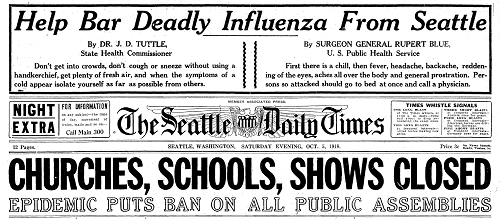
1918 newspaper article on flu
A digitized copy of The Daily Seattle Times’ coverage of the 1918 flu pandemic.

Unlike the influenza pandemic of 1918 during which news was primarily conveyed by newspaper, today we have twitter feeds, websites, streaming video and a variety of other online news sources.

Special Collections has an active website archiving program in partnership with the Internet Archive. Since 2013, we have routinely captured the content contained in over 500 URLs documenting the wide range of our communities with the focus being on the Pacific Northwest. Many of the websites captured by this ongoing program are now documenting local reactions and initiatives in response to the novel coronavirus. These sites are updated regularly. For example, the Mountlake Terrace News is one local site regularly captured.

In addition, Special Collections is contributing local website URLs to an effort by the International Internet Preservation Coalition (IIPC) to capture websites from around the world related to the novel coronavirus pandemic; our contribution will be websites from communities and institutions of the Pacific Northwest. As one might imagine, there are many websites to be captured and there is currently a backlog of website URLs to be crawled, but they will be captured and made available in due time.

Our work in Special Collections is ongoing. In addition to preserving the past, we also collect for the future.  One day, when the crisis has long since passed, tomorrow’s scholars will be looking back at these materials for insight, context and answers—answers that can be found in the documentation of our region’s response, captured by UW Special Collections.

photo of Librarian Ann Lally
Ann Lally, Digital Collections Curator for Special Collections, working from home.

For more information about the COVID-19 archive, please contact me, Ann Lally, Digital Collections Curator for Special Collections: [email protected] 

###


Stories

UW Libraries donates N95 respirators and personal protective equipment (PPE) to UW Medicine Emergency Response

The needs of our health care workers are top of mind right now, evermore so with consideration of our own UW medical community. Many libraries and museums stock protective gear for collections processing and disaster response and there is a growing effort among institutions to donate these critical supplies during this unprecedented time of need.

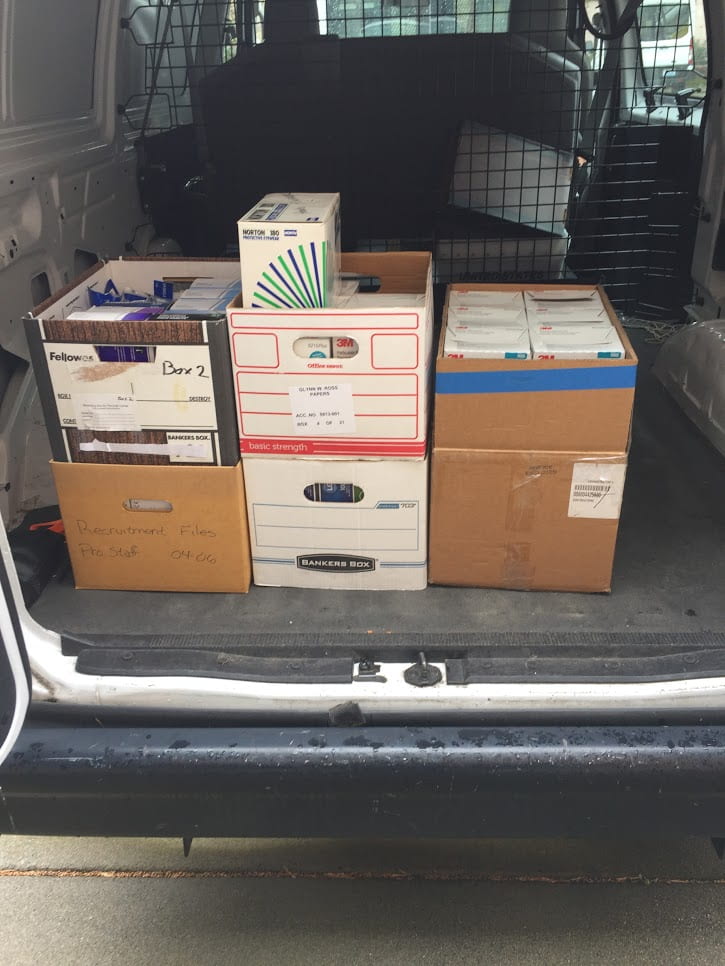
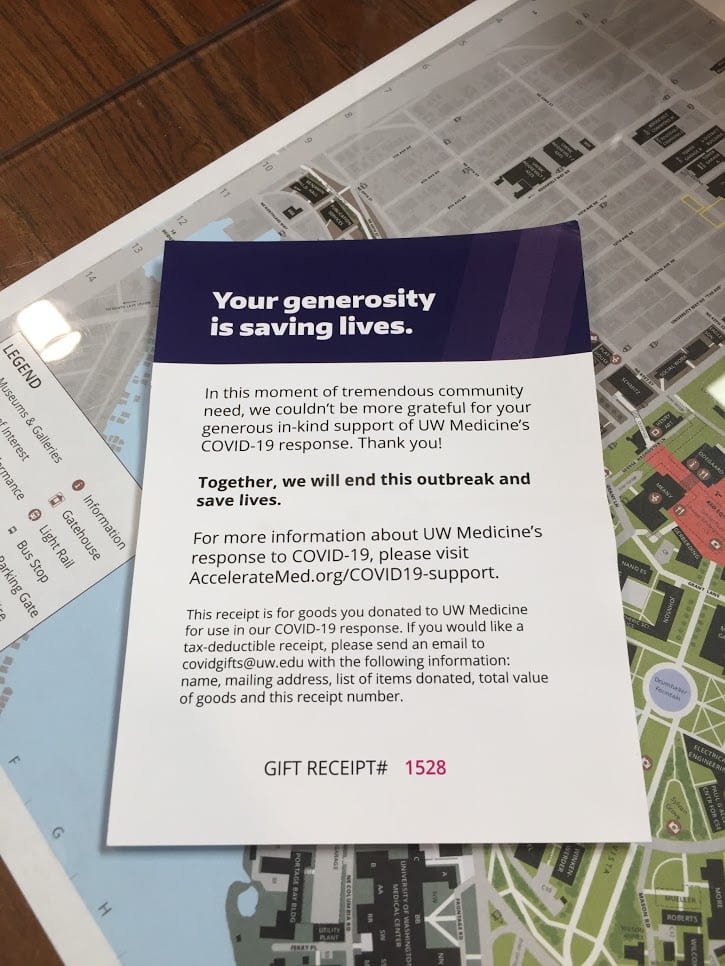
The UW Libraries responded to the call, delivering 350 N95 respirators, 3,200 nitrile gloves and 18 safety glasses to UW Medicine via the Emergency Response Fund, which accepts in-kind donations of approved PPE.  Stephanie Lamson, Director of UW Libraries Preservation Services, and UW Libraries facilities manager Brad Van Horne worked with other UW Libraries staff to collect, package, and deliver these critical supplies.

“Knowing that we had respirators and gloves that could be used during the shortage, it was just a matter of time and coordination to effectively pull everything together,” said Lamson. “I’m glad that the Libraries could help contribute in some small way to help support UW Medicine and the caregivers who need these supplies right now.”

UW Libraries PPE supplies are loaded on to a truck for delivery March 25th.

Typically, PPE supplies are kept by collecting institutions like libraries and museums primarily for disaster response. For example, in the event of a water leak or earthquake, preservation teams may need to enter contaminated spaces to retrieve materials, requiring PPE.

Part of the UW Libraries existing PPE supplies were originally donated through a collections disaster workshop with Seattle Heritage Responders, sponsored by the Foundation for Advancement in Conservation (FAIC) and Seattle Heritage Emergency Response Network (SHERN) and funded by the National Endowment for the Humanities. The workshops were held at the Seattle Art Museum and UW Libraries in 2018.

To donate PPE equipment to UW healthcare workers, visit the UW Medicine Emergency Response Fund page.

Many other libraries and museums are also donating their PPE or contributing to the effort in other ways. Learn more.

###


Stories

Course Reserves: Online Alternatives vs. Equivalents

As we head into our online spring 2020 quarter, we know that instructors and students are searching for ways to access course texts and readings.  At the same time, for the health and safety of all, UW Libraries’ physical spaces are closed to staff and users until further notice, and there is no access to physical library collections. The Libraries is asking everyone to work under an assumption that students will not have access to physical materials that would have been available for courses for spring 2020. 

When it comes to previously-planned physical texts and course reserves materials, we are encouraging a motto of “first alternatives, then equivalents.” 

Alternatives: We encourage all instructors to consider online alternatives to planned physical course texts and DVDs — alternatives include open textbooks, and e-books and streaming media already licensed by UW.

Why choose alternates over equivalents? 

 1) Ease of use. These resources are immediately available and will avoid potential delays that may occur in trying to source equivalent materials.

2) More equitable access for all. In particular, open textbooks provide students with equitable access to content in many subjects; they are available for free online; and students can have copies printed locally at low cost. 

Information about these alternatives may be found on the “Online Resources for Teaching” and “Streaming Video” sections of the Libraries Services for Remote Learning page.

Equivalents: At this time, new course reserves requests are limited to electronic resources. For previously-submitted requests for required physical materials, librarians and staff are working to identify equivalent online e-book/streaming resources that are available from publishers. However, data show that online equivalents don’t exist for all physical texts; and, when equivalents do exist, licensing them will take additional time, so they may not be available for course use immediately.  

We encourage everyone to review the resources we’ve pulled together on Libraries Services for Remote Learning, and don’t hesitate to reach out to your subject librarians if you need additional assistance. 

Contributor: John Danneker,Director / Learning Services
University of Washington Libraries

###


Stories

The New National Emergency Library and Why It Matters for Huskies

The New National Emergency Library and Why It Matters for Huskies

The Internet Archives recently announced the creation of a National Emergency Library, opening up more than 1.4 million ebooks to address the increased global demand and need for electronic reading and research material to serve the nation’s displaced learners.

Why is this action important? Are others following suit?

Understanding the anticipated need for increased e-resources, earlier in the month, the UW Libraries officially endorsed the move to open the Internet Archives. The new National Emergency Library is a huge development in supporting our faculty and students in teaching and learning online in spring quarter. HathiTrust is also planning to expand fair use access to its corpus to ensure that the academic communities of its members can continue to utilize HathiTrust for teaching and learning. UW Libraries will continue to post news about access to these types of resources on our UW Libraries COVID-19 web page.

As a Librarian, how does this impact your work to facilitate e-book orders for classes?

UW Librarians have been fielding ebook requests for required textbooks over the last week. Before the Emergency Library was announced, Librarians faced a common challenge– in many cases, there was simply no multi-user ebook available for the Libraries to order — this changed dramatically with the opening of the National Emergency Library.

History Librarian, Theresa Mudrock says this has made a real difference, but challenges still exist.

“Today, I was able to inform 10 instructors that the books they needed were now available, whereas yesterday they were not,” said Mudrock.

“That said, this increased access will not address all of our needs for e-resources, particularly for certain disciplines.”

“All of us across the UW Libraries are working hard to identify alternative solutions and provide best practices for selecting e-resources which we will continue to document on our Libraries Services for Remote Learning Page,” noted Mudrock.

Some groups are criticizing the Internet Archive’s move to create the Emergency Library- what is the response to this criticism, and what are the facts?  

The Internet Archives posted a new blog outlining its response to criticism, fact-checking misinformation about the Emergency Library.  Updated FAQs are also posted here.

What should students and faculty be aware of when requesting ebooks? 

Your librarian is the key to finding if an ebook is available. They can check to see if we already own a copy, check the National Emergency Library and other ebook collections, and if need be, order a multi-user ebook for your class needs. Keep in mind not every book will be available so flexibility is the key. Your librarian may also be able to suggest substitute readings.

The National Emergency Library allows an individual to borrow up to 10 books each. To read these ebooks, create your free Internet Archives account. Books can be borrowed for 2 weeks and renewed until June 30th, 2020.

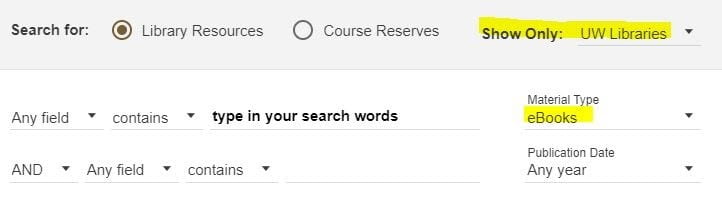
Search First: Be sure to also use UW Libraries Search to find ebooks that we own. Just follow this example to limit your search to ebooks!

For questions on selecting course reserves, reach out to your subject librarian.

#YourLibrary is here to help you, Huskies!

Contributors to this blog:

  • Corey Murata- Director, Collection Analysis & Strategy
  • Theresa Mudrock- History Research Librarian
  • Sandy Hawley- Communications Director, UW Libraries

###


Stories

Moving to Online Learning: Top 5 Resources For Faculty

The UW Libraries is committed to supporting UW students, staff, and faculty to prepare for online teaching and research in Spring 2020.  We are continually evaluating our services and working with partners across the university to support faculty during this time of significant change. Please see also our LIBRARIES RESOURCES FOR REMOTE LEARNING page, accessible through on our main COVID-19 page. This page provides a centralized resource for finding tools and support for both students and faculty.

In addition to many remote resources that we routinely provide, we are working on some additional ways to adapt and respond to a remote teaching and learning environment.  With the abundance of the information being shared, we want to make it easy for you to find what you need from the Libraries.

Our top 5 resources to help support a transition to remote teaching and research:

1. Research Guides  Librarian-curated “Research Guides” provide links to subject specific journal databases, ebooks and more.

2. Our Librarians:

    • Chat with a librarian 24/7! This service is staffed by UW Librarians but at peak service times or off-hours you may be chatting with a librarian from another academic library.

3. E-Resources for your class. We are expanding purchasing of e-resources to support remote teaching. When requested and available we will be purchasing multi-user e-books and removing restrictions on duplicating print reserve items. Check-out our ebooks guide here. Before you make course reserve requests, a few important things to note:

    • Not all resources are available to purchase for online,  educational or classroom use.
    • With Libraries buildings closed, students will be unable to borrow physical copies of library course reserve textbooks — a challenge especially for those who are unable to afford the expense. Traditionally, textbook publishers do not sell e-books to libraries, but check out our Resources for Remote Learning -Online Resources for Teaching to see what you can do — and how the library can help.
    • You may want to explore alternatives like Open Educational Resources (freely available, openly licensed materials) for use in your course. Use the search tools available on our guides UW Seattle OER GuideUW Bothell OER GuideUW Tacoma OER Guide to find existing open textbooks or create and publish your own open resources for your course.  Curious about creating or revising existing OER?  Sign up for spring quarter Pressbooks workshops (there is one happening next week!) https://tinyurl.com/uwpressbooks

4) Streaming Video: The Libraries already provides access to thousands of streaming videos that you can use to support online learning. We are also expanding purchasing of streaming media as much as possible including strategies to expand the corpus of films, documentaries, and other streaming media available to faculty to use in their classes.

5) Libraries in Canvas.  The Libraries supports instructors using Canvas in many ways, including a “UW Libraries” page which can be added to the navigation of any Canvas course. For more customized content or assistance, instructors can add a Subject Librarian to their course using the “Librarian” Canvas role. The Libraries also provides instructors with research-specific course content via the Canvas Commons repository.

Other Important Things to Know:

Can’t remember it all? Don’t worry! All of these resources and more can be easily found on our LIBRARIES RESOURCES FOR REMOTE LEARNING web page.

Thank you for your patience and support as we navigate these unusual circumstances, and please continue to share your ideas and questions by contacting us here. 

#YourLibrary – We are here to help!


Stories

A Message from the Dean: FAQ and Libraries Response To COVID-19

Betsy Wilson
Lizabeth (Betsy) Wilson is the Vice Provost for Digital Initiatives and Dean of University Libraries at the University of Washington in Seattle, Bothell, and Tacoma.

This post was updated on 3/21/20 6:40PM .

Along with many other public institutions, businesses and community members in our region, UW Libraries has been working continuously to respond to the COVID-19 outbreak in accordance with the University’s and Public Health – Seattle & King County guidelines. We recently announced additional changes to operations this week – all tri-campus Libraries are closed to the public effective 5PM March 17th. We are working at the forefront of this response, together with the University leadership and other partners, developing new policies and procedures and evolving our approach in real-time based on new data and information as it becomes available. While the University remains open, facilitating remote coursework and alternate ways to conclude the quarter, this is certainly not business as usual.

Changes will continue to happen quickly, and at times, without notice. We acknowledge the challenges of an unpredictable environment and the hardships that everyone in our community is facing in finding alternative options for working, studying and simply living life in this new normal.  It’s not easy. That said, I know that the collective ingenuity, creativity and generosity of our community will prevail, helping us all to move through these challenges together. I am inspired by the work that is happening in the Libraries and across campus that demonstrates this resolve and perseverance.

When it comes to operations planning and ensuring the safety and well-being of our staff and users, many factors go into the decision-making process and approach.  When changes happen, we expect questions.  To provide some context and insight into our process, a few of the most frequently asked questions are highlighted here:

How do you make the decision to close Libraries?

Recent closures reflect real-time decision making – where information and input received changes the approach from one day to the next. Balancing the critical needs of students during finals week with the ever-evolving situation in our community is an hour-by-hour, day-by-day assessment.

Last week, a very limited operational schedule was implemented, considering the current student demand, available staff, new information, and our robust capacity to use an online service model. The decision allowed for some modicum of technology access for those students who need it as well as faculty consultations for teaching and learning through finals week.

Based on site evaluations, even in this limited capacity, it was untenable to support stronger recommendations from public health for social distancing, and together with UW’s tri-campus leadership, the decision was made to close all Libraries.

Given that the University has provided free access to collaboration tools, it is possible for all students and faculty to continue collaborative work remotely in order to complete required work through the end of the quarter.

Is the policy the same for UW Tacoma and UW Bothell Libraries?

At this time, UW Tacoma and UW Bothell have announced closures to campus Libraries. Campus web sites should be consulted for the most up-to-date information on operational changes. That said, depending on the circumstances, campus Libraries may make different decisions at different times in consideration of the unique nature of the campus environment, capacity and governance structures.

How can Libraries support faculty and students?

While physical buildings will be closed for onsite use, the Libraries will fully staff our digital services such as 24/7 chat services, research consultations offered through Zoom, and so on.  We are confident we will be able to provide high quality support for teaching, research and clinical care, albeit remotely.

We are also expanding our bandwidth for working with faculty as they move their courses to online modalities. We’re expanding purchasing of ebooks of class readings and streaming media to support remote teaching.  Services and guidance for both students and faculty are outlined on the Libraries Services for Remote Learning. This page provides one, centralized resource to help support you as we move into a completely online spring quarter.

These modified operational changes allow us to continue to serve students, staff and faculty but also reduce risks for our users and our staff.

Where else can students access computers and technology equipment?

The student-run UW Student Technology Loan Program is allowing students to continue to check out equipment through the end of the quarter.

Will the Libraries re-open at the start of the quarter?

At this time, the Libraries will continue with its existing operational plan until the beginning of spring quarter.

As the University’s policies for classroom learning evolve, the Libraries will work in coordination to reassess and evaluate when and how to adjust operations as the situation evolves. We have not yet made a decision on whether or not to adjust our operational plan for spring quarter.  Priorities and decision-making are continually evolving as the situation evolves – on our campus, in our local community, and at the national/global level. We are taking steps to prepare and think through a variety of scenarios that include a case for extended remote services during spring quarter.  Above all, the health and wellbeing of our staff and users are at the center of these decisions.

How are Libraries staff able to work remotely?

The Libraries already had an existing and robust online service delivery model with a host of online services, and a campus community adept at accessing collections and services remotely. Many of our Librarians routinely work remotely via online chat, phone or email consultations, so that part of our work remains unchanged.

Thanks to the University of Washington’s robust infrastructure – IT, communications, professional expertise across diverse industries, and lightning fast work to make teleworking capabilities available, it was possible to execute a remote workforce plan essential for a successful and timely response across the University, including the Libraries. The majority of our staff our working remotely to provide a continuity in service that is possible as outlined here.

How can UW Libraries work with other Libraries to share information and tools?

By responding as quickly as possible to our colleague’s questions and participating in industry forums to share what we have learned through the process, we hope to contribute to the documentation on best practices that are being developed and honed in real time.  I want to underscore however, that every institution is unique. The size of an organization (and/or its user base), the timing of the academic year or other external factors, the existing infrastructure to execute system-wide implementation of new policies and procedures—these are just a few factors that could influence planning in a particular context. As with most solutions, there is no one singular approach that is going to be right for all, but we can help each other by sharing resources, tools and insights as we move forward collectively along the same path.

I have a question about Libraries operations- where can I go?

First, be sure to check out Libraries’ COVIV-19 web page and Libraries Services for Remote Learning. We welcome input, questions and opportunities for collaboration as we continue to learn from and respond to this unprecedented situation. If you have new ideas for how the Libraries can improve digital and remote services, or any other questions, please send your comments to us.

Thank you.

I would like to extend a huge thank you to UW Libraries staff, facilities crews and UW leadership for their support, guidance and overtime hours spent helping our community manage and respond to COVID-19.

As a reminder, the Libraries Coronavirus Update page is the best source for real-time updates and changes to UW Libraries operations.

###