UW Libraries Response to New WA State Guidance for Libraries
October 9, 2020
The UW Libraries Cabinet has reviewed our current plan for phased re-opening, and have decided to maintain our approach at this time. Based on the protocols outlined within University of Washington COVID-19 Safe Start Phases, Libraries spaces will remain closed to the public during Phase 2. Per our current plan, limited study spaces will be opening up in Phase 3. As always, the health and safety of our UW community remains at the center of our planning decisions.
Though the Governor’s recent guidance permits libraries to open facilities for limited in-person services, that guidance also encourages libraries to facilitate services through no contact pick-up to limit interaction between staff and patrons within enclosed space. Further, the statement generally discouraged libraries from allowing the use of group meeting or study spaces by patrons.
The UW Libraries Leadership will continue to monitor new information, guidance, and recommendations and incorporate this into our planning. Any changes to our current plan will be communicated on our COVID-19 update pages and announced as soon as there is a change.
Betsy Wilson
Vice Provost for Digital Initiatives and Dean of University Libraries
Stories
UW Libraries Launches No Contact Pick-Up Service
October 7, 2020
UW Libraries is pleased to announce the launch of no-contact pick-up service– now available on all three campuses– Seattle, Bothell and Tacoma! The health and safety of our UW community has been our number one priority in planning for this new service. Anyone with an active UW Libraries borrowers card or current UW student, staff and faculty can request materials. Before you request an item for pick-up, there are a few things you need to know to ensure a safe and hassle-free transaction.
1.Search and Find: Log in and search to find your item in UW Libraries Search (standard process). You must log in via the green tab FIRST before making a request for pick-up.
2. Make Your Request (standard process). If an item can be requested, you will see a “Request” button in the record for the item. Select the “Request” button to initiate a pick-up and choose your preferred location.
If you do not see the purple request button, the item is not available to request for a variety of reasons (see below)*.
Delivery to campus mailboxes is not available at this time since some mailboxes are not accessible.
3. Wait: It may take a week or more to prepare your item for pick-up, depending on its location, destination and staff availability. Thank you for your patience. To check the status of your holds at any time, log in to your Library Account.
4. Get notice and follow instructions:
The Libraries will send you an email with specific instructions for pick-up when your item is ready.
If you have any questions, please reply to your email notification.
Requested materials will be held for 14 days after they arrive on the hold shelf.
TIMES/LOCATIONS: Pick-up days and times will be limited to start, and expanded over time. Pick-up instructions and requirements may change/vary by campus. Be sure to check your campus Library web site FIRST for current information.
PICK-UP TIMES: Pre-scheduled pick-up appointments must be scheduled online.
KNOW BEFORE YOU GO: Pick-up instructions and requirements may change/vary by campus. Be sure to follow the instructions in your email and check your campus Library web site for current information. Generally, the following requirements apply for all pick-up locations:
Bring a cell phone to call when you arrive. If you do not have access to a phone, follow the procedures listed on the website for your pick-up location.
Wear a mask or other face covering when you pick-up items.
Leave 6 feet of distance between yourself and others who are waiting in line.
Be prepared to verify your identification over the phone by providing your name, school ID number or Libraries card barcode, and a piece of contact information (e.g. phone number). This is how staff will check materials out to you.
Remain behind the designated marker and wait for your item(s) to be delivered to the cart/table.
After the staff member has delivered your items to the cart and returned to the building, you may approach the shelf/cart and pick-up your items.
In order to prioritize health and safety, please avoid face-to-face conversations with libraries staff. If you have questions after you pick-up your items, please refer to instructions listed on the website for your campus Library/pick-up location.
We appreciate your flexibility and patience as we launch this new service. Updates to the Libraries phased re-opening plans are always posted on the Libraries COVID Update page and shared on social media as planning evolves including these helpful links:
*Here are some reasons you might not see a request button:
You haven’t logged in to the UW Libraries Search through the green bar. That is a necessary step even if you think you’re already logged in with your UW NetID. The green bar will disappear after you’re logged in and the request link will appear for books that can be requested.
Books at Summit libraries are not available for requesting.
The book is labeled “library use only”.
Items are rare or fragile items that cannot be checked out.
The item is part of the HathiTrustAccess Service (ETAS), providing access to over 1.7 million books in our collection for which we would normally not have online access because of copyright. In order to comply with the ETAS rules, we cannot allow print items that are available in this online collection to circulate. HathiTrust ETAS provides crucial access to our many students who are learning remotely and not in proximity to our physical libraries.
###
Stories
How WordPress Templates Can Transform Your Online Teaching This Fall!
October 2, 2020
Calling all instructors! Are you looking for opportunities to teach digital and public scholarship skills in your classroom? Are you looking for alternatives to the traditional research paper? We’ve got you covered with WordPress site templates! WordPress templates are simple to set up and can be as easy to use as filling out a simple form. Templates (with examples from other institutions) include:
Tru Collector, which collects student images and descriptions through a form submission and compiles them into a WordPress site. See Animal Body Plans and Online Ecosystem Maps as examples.
Tru Writer, which collects short student essays through a form submission and compiles them into a WordPress site for ease of reading. See the Community Performance Toolbox and Into the Pulterverse as examples.
Big Picture Calling Card, this template is perfect for image-focused sites with a text teaser that links to more information. See Just Lego 101 as an example.
Get Access and Help Using These Templates:
These templates are part of the Libraries’ three year digital scholarship infrastructure pilot. We are currently in year one of the pilot right now. Our Digital Scholarship Team is excited to work with you to reimagine your course to include these tools! Please contact us today for more information or to get set up with one of these templates.
On behalf of UW Libraries–16 libraries across 3 campuses—a warm welcome to all new and returning students, faculty and staff. The start of the fall quarter always feels like a jumping off point – a time to learn new things, make new connections and refocus. The current remote learning circumstances are creating more opportunity for academic communities to adapt and learn differently. All of UW Libraries staff are actively building on our robust online capabilities to maximize support for teaching, learning and research. Our staff have adapted, increased e-resources, and are continuing to help you navigate and plan for a successful, Safe Start to fall quarter. Curbside-pick up services will be the next service available, and this updateoutlines the next steps of the process. The following highlights all of the new and existing resources you can expect from the Libraries:
For students: Everything you need to know about UW Libraries plans and available resources is in our Student FAQ for Fall;
For faculty:
A new Teaching Support “hub” on our web site provides centralized resources for instruction support.
Since March, UW Libraries has purchased more than 250,000 additional electronic resources and through the HathiTrust Emergency Temporary Access Service, made an additional 1.7 million electronic resources from our print collections available to you from any location.
A new virtual Media Arcade provides access to more software aps, tools, online tutorials and online help with audio, video, graphic design projects and related technical needs.
Libraries events, workshops and trainings online engage the UW community across disciplines, and prepare students through events like the GSRI and fall orientation DawgDaze events.
Research and writing consultations continue online through the Odegaard Writing and Research Center, providing personalized support for all students.
Graduate student services continue remotely with the Research Commons including online consults for graduate funding information.
The Special Collections team is working remotely to help users navigate our extensive digital collections and create high quality digital exhibits to enhance historical and cultural learning in class and for our community.
Interlibrary loan continues to fill requests for scans of articles and book chapters from e-collections and through other Libraries.
UW Libraries staff are always here to answer questions via 24/7 chat services, Zoom consults, and email – just ASK US!
Your subject Librarians provide expert advice and support relevant to your area of study
All information and resources are available on our web site, and the latest updates on services are always posted on our COVID-19 update page.
The health and safety of our users and staff continue to guide our planning. Our phased reopening plan remains unchanged at this time. As health conditions and guidance change, we will expand access and services as soon as it is feasible to do so safely. As noted in the Libraries phased re-opening chart, we plan to open limited spaces for student study in Phase 3, and we will update and share our plans as they evolve and change.
This fall, students, faculty and staff will continue to adapt and improve our collective resources and capacity for online and hybrid learning. We are working together to make this quarter and this year the best it can be in these challenging times. We appreciate your patience and welcome your questions, suggestions and concerns to help us better support you.
Vice Provost for Digital Initiatives and Dean of University Libraries at the University of Washington Libraries
Stories
Reflections: 2020 Graduate Student Research Institute
September 24, 2020
On Friday, September 4, the UW Libraries capped off its final session of the 2020 Graduate Student Research Institute (GSRI), a free and asynchronous five-day online workshop aimed at helping UW graduate students learn the tools and strategies they need to research “smarter, not harder.” First developed by the Libraries’ Instructional Design & Outreach Services team in 2016, GSRI has become a core part of the Libraries’ strategy for supporting students online, not only by providing students with flexible Canvas learning modules that address their needs, but by matching students with trained library mentors and disciplinary peer groups to build community across programs.
This year, GSRI registered a record-breaking 561 graduate students from across all three UW campuses, and was supported by over 30 librarians and staff who provided guidance and answered questions in both Slack and Zoom. Through post-event evaluations students commented on the benefits of the event:
“There was so much content covered over just the course of a week, and a ton of resources for connecting with both UW Library staff and databases.”
“GSRI has really helped my mental health at this time. The library team really rocks during ordinary times and I needed to be reminded that you are here for us during these extraordinary times.”
“GSRI was incredibly helpful, and really well organized.”
Staff volunteers were equally effusive about their experience supporting students, citing the unique opportunity to interact meaningfully with students in ways that meet their needs.
“The most positive moments for me were the moments when I felt I was making an authentic connection with a student,” wrote one 2020 mentor. “GSRI’s mix of things is a strength. Canvas and Slack. Synchronous and asynchronous. We’re all Zoom weary, so having things mixed up keeps people engaged.”
The Libraries continues to review feedback from experiences like GSRI 2020 in shaping the design of its quarterly online workshops, examples of which include Podcasting and Research Data Management. To learn more about GSRI, visit the 2020 public course site or email [email protected].
UW Libraries hosts workshops, trainings and open office hours on a wide range of topics throughout the year to support all students– from digital media production, data management, publishing, research, writing support and more.
Check out and subscribe to the Libraries calendar, and follow our social media for updates on events throughout the year.
###
Stories
UW Libraries Curbside Pick-Up Update
September 24, 2020
The first group of UW Libraries employees enteredthe Libraries for the first time just over a month ago. They have been working diligently to assess and build systems to allow for expanded services. Earlier this month, book drops were opened. We understand our users are eager to access physical materials, and the next service we plan to launch is curbside pick-up. Our team is currently working on testing and final logistics to provide that service as soon as possible.
The following provides some additional context on progress and planning for this service:
Preparation: The initial work over the past month focused on preparation effortsand to develop new service delivery models fora variety of work, including curbside-pick-up.
Right now, Libraries staff are testing those new models, assessing and adjusting to ensure curbside service is safe for both users and staff. This is our number one priority, and we are making great progress. The data from these testing efforts are critical to the future success of curbside pick-up service.
One of the most time-intensive,final steps is the update to back-end systems and integrations to ensure compliance with ourHathiTrust Emergency Temporary Access Serviceto 1) ensure adherence to copyright laws of the partnership, and 2) facilitate continued access to 1.7 million electronic volumes essential for this remote learning environment.
Supply chain issues outside of the Libraries have been unpredictablefor required curbside pick-up supplies. The situation is very fluid, and we are updating and recalibrating plans in real time.
Prioritizing the health and safety of our community is our guiding principle in this work.The UW Libraries—16 Libraries across 3 campuses— is a unique environment. Our approach is based on UW requirements for this phase aligned with state guidelines andthe current rate of COVID in our community.Other Universities and municipal systems have differentrequirements for operationsand public health scenarios, allowing for different timelines and availability of services, depending on the local context.
The ability to provide an accurate date for the launch of curbside pick-up service depends on a number of complex and connected variables as noted above. When the testing is completed, and the requiredlogistics are in place to run the service safely, we will be able to provide alaunch date and plan.
The UW Libraries staff bring a wealth of expertise informed by experience and connection with our colleagues across the country and the world. They are bringing the best of that learning to this work, and to our UW community, including providing existing and new virtual services, support, and collaboration.All of our resources are available on our web site, and the latest news and information is posted on our COVID-19 update page, including the following guides:
Thank you for your patience during this unprecedented time. If you have questions, we are here to support you. Connect with your department’s Libraries liaison or contact usviaAsk Us.
We look forward to sharing more information soon.
Stories
I Wish My Parents Knew: A New Message For Parents From First Gen Students
September 16, 2020
Meeting user needs on the basis of equity and inclusion is embedded in the UW Libraries Mission, Vision and Values. A central part of Libraries outreach and education efforts focus on collaboration with UW First Year Programs, including parent orientation to over 500 parents, many of which include those of first generation college students. In these orientation sessions, Libraries share information about services and resources, as well as helpful tips for new students and parents.
Five of the students by the George Washington statue on the day we filmed the video. (pre-COVID)
Thanks to the ingenuity of an enterprising group of first generation college students, this year’s summer parent orientation program was inspired by a new video for parents by students. It’s part of the Libraries’ ongoing effort to utilize participatory design to inform and improve programs and services. In the fall, the Undergraduate Student Success team is offering a virtual orientation specifically for first generation students during Dawg Daze, and it wouldn’t have been possible without these six phenomenal students.
Twice-weekly sessions combined participatory design principles with activities and open discussions to accurately understand the first-generation college experience and work together to co-create a resource addressing those needs.
In a post-project interview, students reflected on their experience working together with other students and what the project meant to them…
“It was really cool to be part of a project that I put some of myself into, my own experience. It meant a lot to know that I could have an influence to help others, and helpful to see that there are people who have the same confusion, uncertainty and that others are struggling along with you.”
“My grades are not my whole story. My performance academically is not my whole story, and that’s been true for most of my life – although I haven’t been able to tell that to many people. It was really refreshing and different to see someone actively looking for first generation viewpoints.”
“For me, it was super valuable to have that community. Building those relationships, and understanding that we’re not all alone in our struggles and understand there’s a ton of other students that are going through this too, and there are resources we can fall back on.”
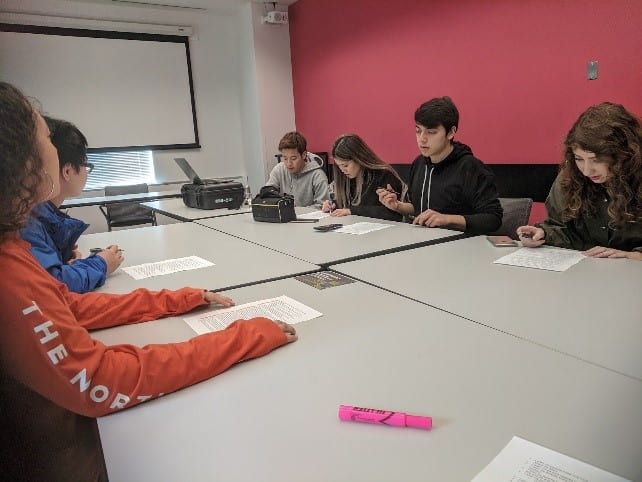
(Pre-COVID) Students in Research Commons Red C preparing to record the voiceover for the video. They had borrowed audio recording equipment from the Student Technology Loan Program and were assigning parts of the script.
Through a series of reflection and ideation activities, the students felt a shared need for parents to have more information and context about what it’s like to be a first-generation UW student. With Libraries already leading many parent orientation presentations, it was a natural fit to use this project as a platform for telling their story and experience.
In addition to producing the video, activities included storyboarding, interactive planning and visual artifact creations that all contributed to themes expressed in the video.
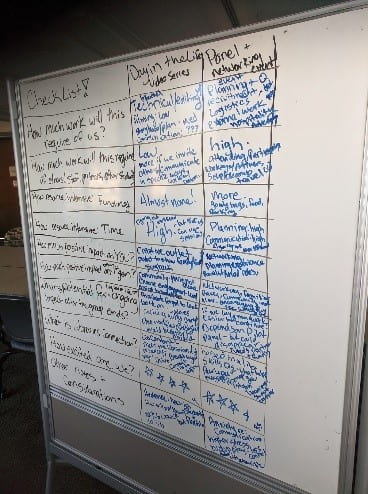
The “Checklist” activity helped the team evaluate top ideas and make a decision about which one they wanted to move forward with.
Students also shared feedback on how this project helped them to understand the Libraries better and what is important for new students to know:
“Being a freshman, I didn’t even realize there were more than three libraries on campus. It was so helpful – both being able to make a difference and just have the knowledge of the resources I had on hand to use.”
“The Libraries are so complex, that sometimes it feels overwhelming. Actually hearing all of the resources laid out was super beneficial to me.”
“UW librarians are awesome. Give yourself a chance to connect – they are more than willing to help with any problem you have.”
“Librarians are there to help us succeed and that there is no need to be scared of them.”
Maggie Faber, Libraries Assessment & Data Visualization Librarian and Emilie Vrbancic, Undergraduate Experience Librarian, collaborated and co-led the project.
“The Libraries began this work to explore new, more meaningful ways of involving students in the process of data collection and decision-making to improve Libraries services, and to more substantially center equity in our work,” says Faber. “It was so rewarding to co-create that improvement with students; it will shape the way we connect and engage with students moving forward.”
“It was so rewarding to co-create that improvement with students; it will shape the way we connect and engage with students moving forward.”
“The most impactful part of this project was the relationships we made with students and the small but mighty community they made with each other,” said Vrbancic. “This was evident when we had to switch to fully online facilitation— we didn’t miss a beat, and the students showed up for one another in thoughtful and caring ways. Over the 10 weeks, we had time to really listen. Students shared such personal parts of themselves, reflecting on all of the challenges and triumphs that come with being a first-generation UW student. This will have a lasting impact on my work at the UW Libraries.”
“This project will have a lasting impact on my work at the UW Libraries.”
While COVID-19 has certainly impacted the way orientation will be held, and how students will interact this fall, nearly all of the services and support programs featured in the video are still providing services for students remotely, including the Libraries! Students can sign up for a personal consultation, or ask for help 24/7 through our online chat service. Just ASK US!
This project was funded in part by the Odegaard Parents Fund and the Kenneth S. and Faye G. Allen Library Endowment Fund. A secondary participatory design project is currently underway with a focus on online students and online only learning.
Questions?
If you would like to learn more about our participatory design activities and methodology, contact Maggie Faber, Assessment & Data Visualization Librarian.
Stories
Dawg Daze With UW Libraries
September 14, 2020
Hey New and Returning Students!
We know you’re excited to start the new quarter at UW, and we are too! Although the library buildings aren’t open right now, the Libraries staff have been busy creating some fun Dawg Daze events online to welcome you and help you get oriented to the great resources and services the Libraries has to offer. Also, don’t forget to check out our Libraries Student FAQ For Fallfor helpful tips and answers.
Thursday, September 24 – Saturday, October 3rd 11AM
A mysterious creature has been roaming through the UW Libraries since most of the campus closed in March. We need you to use the UW Libraries to track it down. How? Complete tasks that will hone your library know-how, collect raffle tickets that enter you to win awesome prizes including a Nintendo Switch Lite and Bose micro bluetooth speaker, and capture the elusive creature so that it may be revealed to all. Participants will get limited edition Dawg swag mailed to your home! Huskies, let’s go!
Attend our virtual library orientation for first year students (including dedicated sessions for transfer students and first generation students) to find out how the UW Libraries can help you succeed at UW. Although the library buildings won’t be open, we still have lots of great resources that you can access remotely. We’ll show you how to connect online, find course materials, start your own research, and more! In addition, you’ll have a chance to meet other students and ask any questions you might have. Student attendees will be entered into a drawing for e-gift cards. Click the links below to add to your calendar:
Test your trivia skills with UW Libraries in this virtual trivia contest! We’ll have five fun rounds of questions covering pop culture, the UW, Seattle and more! Prizes will be awarded to top finishers. Sign up here.
Undergraduate Research for Community College Transfer Students
Tuesday, September 29, 2020, 5 – 6 pm
Are you an incoming community college transfer student interested in undergraduate research? Get a jump-start on research with this workshop intended for incoming transfer students in all disciplines to get up to speed on the resources and opportunities available for you to engage in faculty-mentored research at UW! In addition, learn about key library resources and services that support all forms of undergraduate research. Join Undergraduate Research Program advisers, current undergraduate student researchers, and UW Libraries staff for this interactive, informational session. Register/add to your calendar.
Politic debate icon in flat style. Presidential debates vector illustration on white isolated background. Businessman discussion business concept.
Tuesday, September 29th 5:45
Join your peers for a non-partisan debate watch party. It’s a night of virtual civic engagement, community building AND a great place to get your voter registration questions answered! Hosted by UW Libraries and partners — Kelly Ethnic Cultural Center and Community Engagement, Leadership Education, and WashPIRG.
You can also add any these events to your personal calendar via the Dawg Daze calendars. We hope to see you there!
Go Dawgs!
Stories
Special Collections Library Launches New Digital Exhibit on Protest History in Seattle
August 12, 2020
For the last few months, I have been working on creating a new digital exhibit: We Are All The Conspiracy: The Day After Protest, Seattle 7, and Community Activism in 1970s Seattle, featuring material about the Seattle Liberation Front (SLF), a political group founded on the University of Washington’s campus in January 1970. Seven members of SLF were indicted by federal courts for their alleged role in conspiracy to incite a riot at The Day After protest (TDA) at the Federal Courthouse in Seattle.
Seattle Liberation Front and Young Socialist Alliance demonstration crowd, outside United States Courthouse, Seattle, February 17, 1970.
The final product is a far cry from where it began way back in early 2020—before COVID’s enormity was known and before the context of a Civil Rights movement ignited by the death of George Floyd and #BlackLivesMatter protests. I began planning to do an exhibit in October 2019 featuring material from Special Collections, but I was unsure what to feature. At the same time I was looking for exhibit ideas, I was also processing the Grant Haller Photograph Collection for the visual materials department and noticed a lot of photographs from protests and demonstrations. As I was processing the collection, I kept seeing material related to the Seattle Liberation Front and The Day After Protest. I was intrigued by how many years of coverage the protest and SLF received, especially considering that the SLF was only officially an organization from 1970 to 1971. After doing a quick dive into the history of SLF, I learned about the conspiracy charges leveled against the organizers by the federal government and the long court battle they faced. The initial goal of the exhibit was three-fold: to celebrate the protest’s 50th anniversary in 2020, to daylight some photographs from the newly-acquired Grant Haller photograph collection, and to contextualize how long the organizers and protesters dealt with the consequences of a single protest.
COVID-19 and #BlackLivesMatter both helped shape the digital exhibit into
a resource far beyond the original vision. A digital platform provided a more dynamic and accessible environment than would have been possible with a small display inside the Libraries. Preparing these materials while experiencing protests in our community and around the world, emphasized the critical need to document these activities and to continue to highlight collections that speak to revolutionary Black history to ensure adequate representation of historically underrepresented voices.
The Seattle Liberation Front
We Are All the Conspiracy uses a narrative approach accompanied with digitized images and flyers to walk viewers through the history of the Seattle Liberation Front. Images featured in the exhibit are from the Vietnam War Era Ephemera Collection, the Joe Karpen Photograph Collection, and the newly-acquired Grant Haller Photograph Collection.
SLF is most well-known for its role in The Day After Protest (TDA Protest) at the Seattle Federal Courthouse on February 17, 1970. The protest in Seattle was one of many coordinated protests in cities across the country protesting the sentencing of the Chicago 7 for conspiracy, inciting to riot at the 1968 Democratic National Convention, and for the treatment of Bobby Seale during his separate trial.
Political cartoon on a flyer for the Seattle Conspiracy Defense Fund, a group that supported the members of SLF charged with conspiracy to incite riot at The Day After Protest in Seattle on February 17, 1970.
Bobby Seale, a founding member of the Black Panther Party, had a separate trial from the Chicago 7. When Seale tried to represent himself in court, Judge Julius Hoffman ordered him to be bound and gagged for the remainder of the trial. Hoffman sentenced Seale to four years in jail for contempt of court. Protesters saw the conspiracy charges and the treatment of Bobby Seale as an attack on all people opposed to white supremacy and its wars—particularly the Vietnam War— and sought to stop the courts for a day as part of their demonstration.
In an ironic twist, leaders of SLF were charged with identical conspiracy to incite riot charges for their role in the TDA protest in downtown Seattle that ended in nearly 80 arrests and roughly $30,000 in property damage. One of the SLF leaders charged was University of Washington’s newest philosophy professor, Michael Lerner.
This digital exhibit explores the formation of SLF, the group’s activities and politics, the TDA protest and the resulting trial. For those following the current civil rights protests, there are many similarities and themes. Police brutality, inflated charges for protestors, concerns about “outside agitators”, police infiltration, and white people protesting in support of Black liberation are just some of the similarities between past and present protests.
Changing formats
The exhibit was created using WordPress rather than its initial plans for a small one case exhibit in Allen Library. Though the coronavirus made an in-person exhibit out of the question this year, using a digital format created new opportunities for reaching a wider audience and an opportunity to spotlight some of Special Collections’ digital materials. As a result, the exhibit contains over 30 photographs and over 8,000 words of text—much larger than a one exhibit case would have fit! The necessary format changes due to COVID also led to an opportunity to apply user-centered and universal design principles to this resource with a web format.
The exhibit has accessibility features that would not have been possible in the initial plans. As a result, the final product ended up being more equitable and accessible to people who would not have been able to visit an in-person exhibit and people with vision impairments and learning disorders. One of the best parts about universal design is that its payoff is for everyone, not just people with different accessibility needs. Not only did the shift to an online exhibit help support the needs of more people, but it also created a way for anyone with an internet connection or cell service to view the exhibit anytime and anyplace.
Relevance to today’s protests and organizing
Like the unplanned complications COVID presented to this project, the unplanned context of Civil Rights Protests in 2020 required some necessary and beneficial changes to the exhibit’s original plan.
Page one of a flyer from the Seattle 8 Defense Fund announcing a rally on November 8, 1970 to support the Seattle 7 as they stand trial for their role in The Day After Protest in Seattle on February 17, 1970.
We Are All the Conspiracy features a section called “Reflections on the Seattle 7 Today”. This section includes an acknowledgement of the similarities between activism in the 1970s and today, while recognizing that there are also crucial differences in identity and power, too: “This similarity is not an equivocation – the Murder of George Floyd and its resulting demonstrations are entirely different from the trial of seven white people in Seattle in 1970… However, they are both inseparably connected to the same mortal wounds in American culture and society – racism, white supremacy, imperialism, and state-sanctioned violence against political dissenters”.
“This similarity is not an equivocation – the Murder of George Floyd and its resulting demonstrations are entirely different from the trial of seven white people in Seattle in 1970… However, they are both inseparably connected to the same mortal wounds in American culture and society – racism, white supremacy, imperialism, and state-sanctioned violence against political dissenters”.
Connecting previous protesters’ ideologies and goals to the work of protestors and organizers today is important work to represent in our archives and collections. One of the Libraries’ strategic areas of focus is to enhance equitable environments for research, teaching and learning. We Are All The Conspiracy: The Day After Protest, Seattle 7, and Community Activism in 1970s Seattle is an example of how we are continuing to work to achieve our goals by elevating the voices of historically underrepresented communities at UW and in the Pacific Northwest and by partnering to create, preserve and increase access to culturally-relevant information resources.
As more people are requesting material about anti-racism and revolutionary history, it is vital that University of Washington’s archival collections are put to use to help draw connections between the past and present. In doing this, the Libraries are fostering an inclusive and respectful environment by listening and responding to the needs of our user communities.
Questions, Comments, or Changes
If you have any questions, comments, or would like to suggest changes or additions to the exhibit, emails can be directed to me, Abbey Maynard.
If you see any place for a link to this digital exhibit in any of the content you manage (whether it’s a lib guide, website, internal communications, Canvas course materials, or something else!) I’d love to talk to you about plugging/linking the exhibit there, too.
Abbey Maynard (She/Her)
About the Author
Abbey Maynard is a 2020 graduate from the University of Washington’s Masters of Library and Information Science program, focusing primarily on archives and public services. Abbey worked for Special Collections as a Student Reference Assistant for a year and a half, and as a Visual Materials Student Assistant for the last year. As a student worker, Abbey provided reference assistance to patrons and processed visual materials collections. Abbey will continue to work at Special Collections this fall as an intern for the Labor Archives of Washington processing the RIDGE records, a new archival acquisition documenting coalition-led environmental activism in the Pacific Northwest. Her internship is sponsored by Northwest Archivists through their inaugural Archivist-in-Residence program.
Stories
A Message for Undergrads!
August 7, 2020
Dear UW Undergraduate Students :
We are experiencing the dual pandemics of COVID-19 and racial injustice and violence together, but in very different ways. We hear your concerns, we stand with you, and we are humbled by your resilience. Although this year is not like any other year, the UW Libraries is here to support you whether you’re in Seattle, Wenatchee or Taipei–wherever you are, we got this, Huskies!
We know you might be missing Odegaard Library for study spaces, trusted help, social time with friends (and naps between classes!). While we can’t hang out in Odegaard in person just yet, we’ll make sure there are still ways for you to build community remotely — follow our Instagram for details.
And don’t forget…
UW Libraries staff are working from home to provide services you can access remotely, like research and writing help via Zoom, e-book displays, and so much more. Help is available 24/7 – just ASK US!
New! UW Seattle Student FAQ: We have been listening to your feedback and gathering your questions. In this new UW Libraries Student FAQ for Fall, get answers to questions about the Libraries’ current plans for reopening, textbooks, technology, how to get help, and more.
Dawg Daze + UW Libraries: Check the Dawg Daze calendar in late August so you can participate in fun library orientation events to connect with fellow students and the UW Libraries: online trivia, a scavenger hunt, virtual library tours, and more. All students are welcome.
We’re Listening: UW Libraries staff are working with departments and programs across campus to make sure students have what they need to succeed, and your input is needed to help us understand what you need and how we can improve. Let us know: What can we do to help? What services are most helpful to you? What’s not working for you? Share your ideas and feedback with the UW Libraries Undergraduate Student Success team via email.
We can’t wait to connect with you this fall!
About the authors:
The Odegaard Library Undergraduate Student Success Team collaborates with the UW Libraries and UW partners to design memorable and meaningful experiences with the library, both social and academic, for undergraduate students, specifically first year and first year transfer students, international students, students from underrepresented communities, and first generation UW students. The team focuses on strategic planning, creativity, and leadership in designing and coordinating Libraries’ programs and services that contribute to undergraduate student academic success and engagement.