Skip to content
Stories

The Top 5 Things You Should Know About the Census 

UPDATED 3/31/2020

April 1st is Census Day! The 2020 Census kicked off mid-March and runs through July 2020. UW Libraries is here to help you understand all the ins and outs about the Census, how to do it and why it’s important. Check it out:

1. The COVID-19 pandemic won’t change a lot about how you fill out the census.

Due to the COVID-19 Pandemic, you might be wondering where you should be counted or what might have changed about the census. The answer is not too much. Due to your ability to complete the census online, you can do your civic duty from the comfort of your own home and continue to help stop the spread of COVID-19! If you are wondering about where to count yourself continue reading below and visit this site that will help you know where you should be counted.

2.You should participate in the Census.

Responding to the census is required by law, however, you should complete your census form for many other reasons as well. The results of the census help to determine how many seats your state has in the House of Representatives. If your state is counted incorrectly, it might not gain another seat, even if its actual population merits one. The results are also used by state governments to redraw the boundaries of their congressional and state legislative districts. Not only does responding to the census make sure you are represented fairly, but it also helps to create data that can be used to impact funding for things like federal financial aid, school safety, student wellness programs, and more! In fact, because UW is a public institution and receives federal funding, the census results will directly impact us in many ways.

3. You can complete the census online, but beware of email scams!

This year is the first year that households are invited to complete the census online instead of on paper. Beginning around March 12th households throughout Seattle and the country will begin to receive these invitations in the mail. These invitations will have instructions for how to fill out the census online. It is important to note that the Census Bureau will NEVER send you anything through email, so just keep an eye out for a letter in the regular old snail mail!

4. How you complete the census depends on where you are living on April 1st.

The Census Bureau defines where you live as where you sleep most of the time. So, If you live with your parents, you will be counted in their household. If you live in the dorms, you will get an email from housing and food services that will let you know what you need to do. This still applies to those of you who might have moved home due to the COVID-19 pandemic. Although you might be at home with your parents on April 1st (Census Day) you will still be counted at the dorms. Similarly, if you live in Greek housing, the Census Bureau will be contacting each of the houses to make sure you are also correctly counted. If you live with roommates or housemates off-campus you can fill out the online form together. If you choose this option you will need to coordinate with them and decide when to fill it out together. You could even make a party out of the occasion! However, if you are all busy and can’t find time to get together you can just individually fill out the form, only answering the questions about yourself and skipping the rest. The Census Bureau wants to count everyone who is living in the U.S. on April 1st, so International students should fill out the census as well. For more information about this please read this press release from the Census Bureau about how to be counted correctly.

5. It only takes 10 minutes to complete.

It only takes 10 minutes. Perhaps you need a break from studying or have a spare 10 minutes during your day, then fill out the census! The census helps to shape so many things about our future, the future of our university, and the future of our country. It’s really important and 10 minutes is worth being able to shape our future.

If you would like to learn more, visit the census website here. You can also read this blog post written by President Cauce about the importance of participating in the census, and check out UW Libraries Digital Exhibit and Guide: Census 2020!


Stories

HEALWA: The On-Call Library for Washington State Healthcare Practitioners

Medicine, more so than many other disciplines, is a rapidly changing field. According to some estimates, medical knowledge doubles every few months, up from the fifty years it took to double in 1950.1 Using evidenced-based resources to provide the best care is imperative in the healthcare industry. Yet, unless healthcare workers are affiliated with an academic medical center or clinic, (or work in a large hospital system) they may not have access to a medical library and the up-to-date information, tools and subscription-based resources they need.  From a small urban clinic to the sole provider serving a rural community, to your local hospital; HEALWA is an essential tool for healthcare professionals.

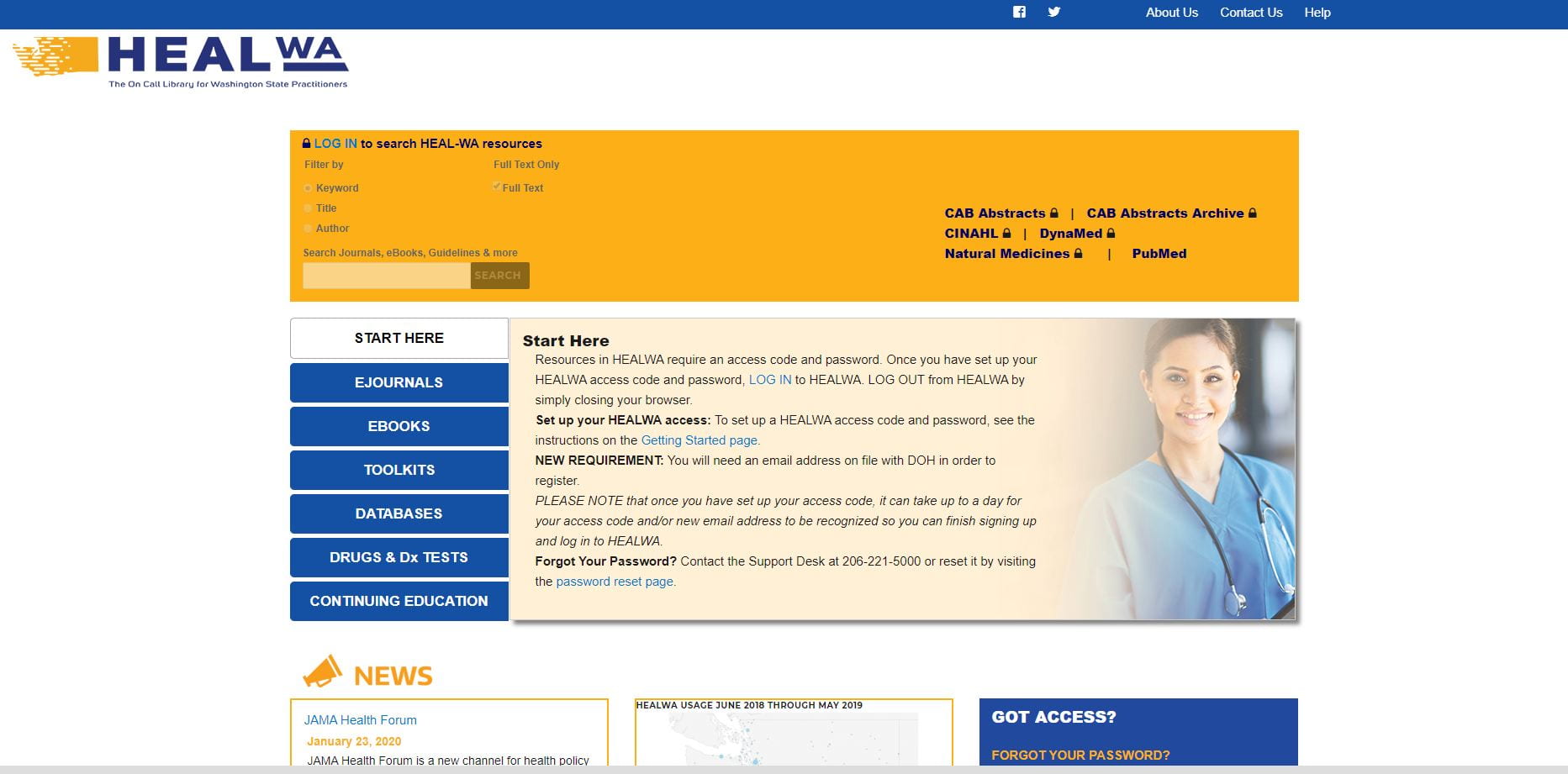
The HEALWA project (“Heal” Washington) was created in Washington State to ensure that providers, regardless of their location or size, can access these critical tools. HEALWA is a portal to online resources for selected medical professions in Washington State. It is funded by a portion of the professional license fees. HEALWA provides online access to journal articles, databases, and other tools needed for evidence-based practice and research.

However, the HEALWA initiative is much more than a collection of tools and resources. We are also educators and advocates working to increase awareness and access to HEALWA for all medical professions.

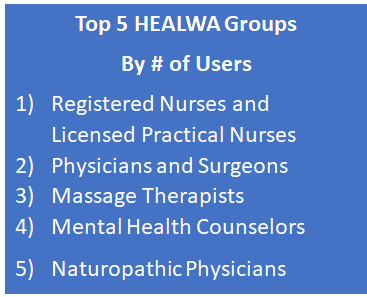
Currently, 27 professions are served by HEALWA representing a wide range of providers and specialties and 219,287 eligible users. As part of our mission, we are continually working to increase outreach and access to HEALWA across the state. One of our most recent focus areas is Eastern Washington.  Working in collaboration with the National Network of Libraries of Medicine Pacific Northwest Region (NNLM PNR) and Washington State University (WSU) Spokane, HEALWA partners taught webinars and workshops and engaged with stakeholders across the region to introduce and increase access to HEALWA.

HEALWA, UW and UW LIBRARIES

The project is conducted under a contract between the University of Washington and the Washington State Department of Health. It was started by a former director of the UW Health Sciences Library, Sherri Fuller, and Peter Dunbar, a former president of the Washington Medical Association. They approached the legislature and were successful in getting the original legislation passed in 2007, and the HEALWA website launched in 2009.  Today, HEALWA continues to be managed by our own UW Health Sciences Librarians’ who are uniquely qualified to create and maintain the online library that is HEALWA.

“HEALWA is managed by our own UW Health Sciences Librarians’ who are uniquely qualified to create and maintain the online library that is HEALWA.”

Each biennium, the legislature approves our funding to continue, and additional professions are also added by legislation, as a result of partnerships between HEALWA and the professional associations of the provider groups.

When students graduate, if they are licensed in Washington, they will have access to HEALWA.

For more information

  • Tania Bardyn, Associate Dean of University Libraries and Director, Health Sciences Library, is the Principal Investigator for HEALWA
  • Patricia Devine, Community Outreach Coordinator, is responsible for the day-to-day operations of HEALWA.


  1. Densen, Peter. “Challenges and opportunities facing medical education.” Transactions of the American Clinical and Climatological Association 122 (2011): 48-58.


Stories

The Seattle Sound: A Tribute to Kearney Barton

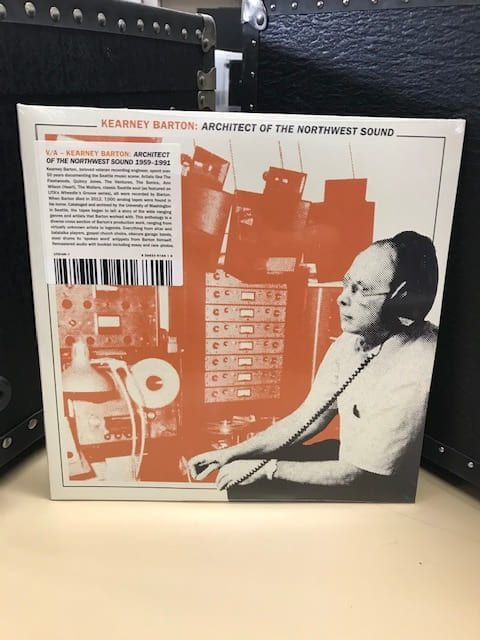
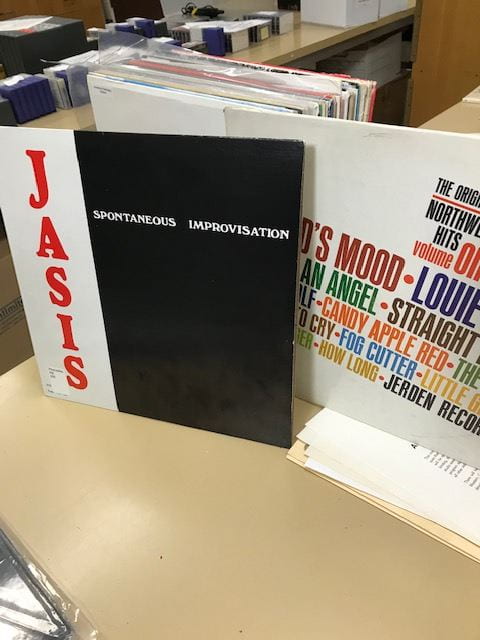
album cover
Album cover of the new compilation to be released by Light in the Attic Records February 21st. On Saturday, March 7 (2-4 pm), Light in the Attic Records (LITA) will host a record-release party with KEXP DJ Greg Vandy. Several of the musicians on the comp are expected to attend and sign records.

Seattle’s Evening show on KING 5 recently visited the UW Libraries to uncover the story behind the soon-to-be released tribute album Kearney Barton: Architect of the Northwest Sound. The album was made possible through the generous donation of Kearney’s masters and support to UW Libraries from Barton’s niece, Patricia Maltsberger (THANK YOU!). This work is one of the many ways UW Libraries protects and preserves the works that shape our local culture and reflect local  history.

Watch the Story HERE

We caught up with UW Libraries’ ethnomusicologist and curator, John Vallier, to learn more about this important documentation of Kearney’s legacy.

Why is this collection and record release important?­

Say “Seattle Sound” and most think grunge. No doubt, Seattle based bands such as Nirvana, Mudhoney, and Soundgarden helped define that vintage punk infused sludge rock genre. But if you dig deeper and look for a broader understanding of the “Seattle Sound” you’ll find more than just one genre. From jazz to folk, soul to funk, avant garde noise to synth pop and beyond, what one discovers are Seattle sounds.

Seattle-based recording engineer and producer Kearney Barton (1931-2012) embodied this diversity of sounds. While he is considered the so-called Godfather of the “original Northwest sound”–a raw and reverberating analog sonic signature considered to be a 1950s and 1960s precursor to grunge–he is also known for recording across a constellation of genres and styles in his Seattle studios: opera, sitar rock, lounge, calypso, piano jazz, funk, synth pop, doo-wop, garage rock, brass band, prog rock, and so on. In short, Kearney Barton’s lifework reflects the manifold nature Seattle’s past.

With Kearney Barton: Architect of the Northwest Sound a curated selection of tunes have been re-mastered into a double LP release. Its 29 tracks give the listener a representative sample of his collection without having to dive into the archives. However, if what that listener needs is more Kearny Barton, no worries. The UW Ethnomusicology Archives can provide it by way of the over 11,000 items in the Kearney Barton Collection of Pacific Northwest Music.[1]

Why is this collection at the UW Libraries?

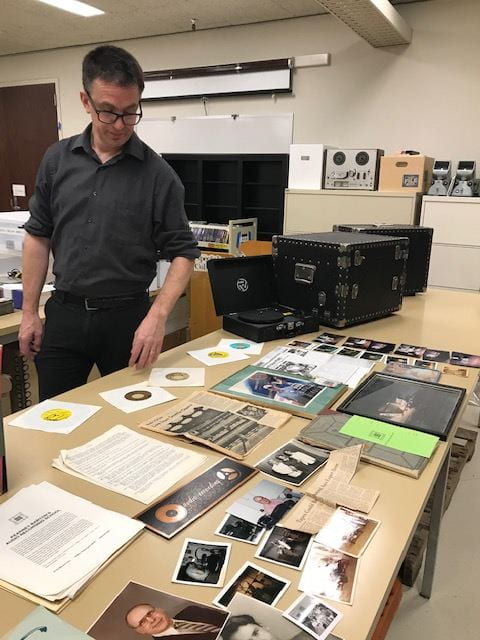
UW Libraries’ ethnomusicologist and curator, John Vallier displays Kearney-related items from the UW Libraries collections

In 2010 Kearney Barton, age 79, thought it was time to retire and move his collection of recordings out of his home/studio to UW. Matt Sullivan at Light in the Attic Records and mutual friend Scott Colburn of Gravelvoice Recordings contacted me. I had started a local music preservation project at UW a few years earlier, so Barton’s collection seemed like it would be a good fit. Barton agreed. A short time later, thanks to some initial seed funding from the UW Simpson Center for the Humanities, a small legion of student workers helped move and process the materials on the Seattle campus.

Sadly, in 2012, Kearney Barton passed away but at least he knew his legacy would live on at UW. His collection is now a cornerstone of the Seattle Sounds Archiving and Preservation Project (SSAPP).[2] SSAPP is a part of the UW Ethnomusicology Archives and includes many other collections, such as the Crocodile Café and 206 Hip Hop collections.

records produced by Barton


About UW Ethnomusicology Archives and Program

UW Libraries’ Ethnomusicology Archives (UWEA) includes music from around the globe and around the block.[3] It is one of the largest collections of its kind with some 50,000 recordings. The newly added BA degree in UW’s Ethnomusicology Program is drawing in undergraduate students who are intrigued by the diversity of the world’s musical expressions and are interested in interdisciplinary perspectives that illuminate music’s cultural contexts and meanings. Learn more about the BA in Ethnomusicology.

>>>Support the great work of UW Libraries<<<


[1] https://archiveswest.orbiscascade.org/ark:/80444/xv40075

[2] https://guides.lib.uw.edu/research/ps

[3] https://guides.lib.uw.edu/archives


Stories

The ‘story behind the story’ of No-No Boy: Shawn Wong Impresses at this Year’s Friends of the Libraries Lecture

Stunning. Provocative. Unselfish. What a treat for the record-breaking attendance at the Friends of Libraries Annual Lecture last week.

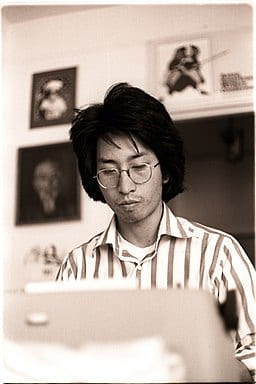
Author Shawn Wong at his IBM typewriter in his San Francisco apartment at 780 Chestnut Street #3 in 1974. The images counterclockwise over his head are: a poster from the First Asian American Writers’ Conference at the Oakland Museum, a snapshot of Shawn as a child wearing a sailor’s outfit, an oil painting by his mother of his grandfather, and a black and white photo of friend, Nancy Wong from 1969. PHOTO BY NANCY WONG

UW’s Professor Shawn Wong showed an audience of almost 500 that words matter in every generation. As keynote for the 2020 Friends of UW Libraries Annual Lecture, Shawn shared how “The publishing history of No-No Boy by John Okada is part of Asian American literary history, and that story is almost as important as the novel itself.”

Wong took the audience on a highly entertaining look back at the journey of No-No Boy – from Wong’s days as an English major at UC Berkeley, eager to discover and share Asian American literature– to the battle royale de copyright against publishing behemoth, Penguin Books, nearly 50 years later.

Through Shawn’s eyes, the audience got to go behind the New York Times headlines to truly understand how powerful and important this book is to the history of Asian American literature.

As Nicole Mitchell, Director of the UW Press noted, “Asian American literary history dawned with UW Professor Shawn Wong.”

photo of s wong on stage
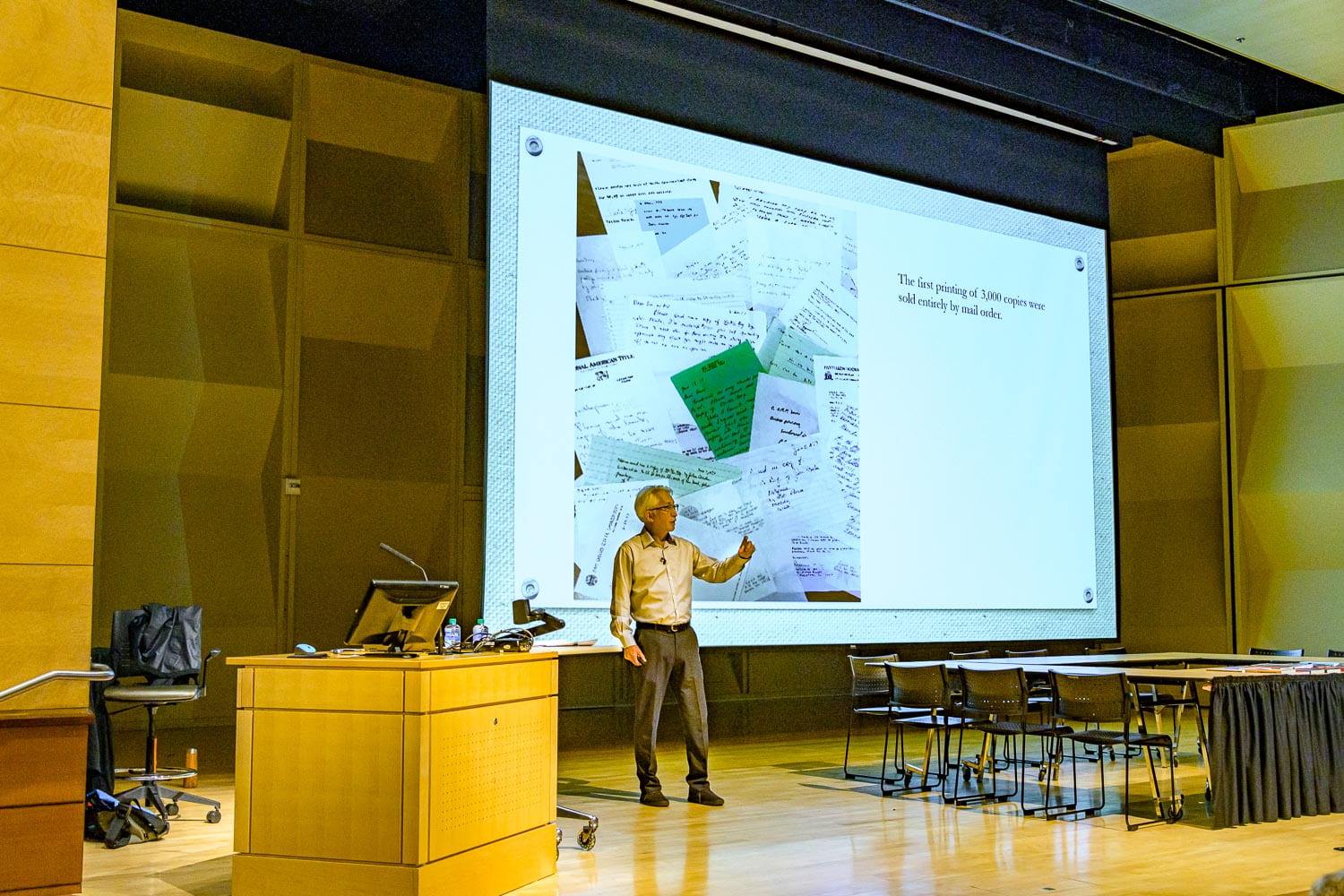
Wong shares a photo of hundreds of letters requesting a copy of No No Boy. PHOTO: Bruce Hemingway, University of Washington

Throughout the lecture, Wong expertly wove together his experiences in a way that authentically and humbly underscored his life’s work to preserve the integrity of No-No Boy. From his painstaking quest to find Okada, to dealing with rejection from every publisher he met, to eventually going it alone and distributing books out of the trunk of his 1966 Mustang. Perhaps one of the most compelling moments was seeing hundreds of hand-written letters to Wong, effectively a word-of-mouth mail order system to distribute the book in the mid 1970s. These letters were written by a generation hungry for their own stories — letters Wong keeps in his office to this day.

While the legal argument over No-No Boy’s copyright dominated the media narrative, Wong’s lecture gave us unique insight into his hard-fought battle that eventually resulted in victory—including his first foray into social media as an advocacy tool, and the invaluable support of one of the nation’s leading copyright experts. But the lecture didn’t leave the audience pondering at the incomprehension of Penguin’s selfish and tone-deaf defense; rather, it reminded us of the importance of continuing to work with, not against, those who have the platform to reach a broad audience, and to continue to invest in authors and publishers who give voice to the stories of underrepresented populations — publishers like UW Press.

On behalf of UW Libraries, Friends of the Libraries and UW Press, we are honored and grateful to Professor Wong for sharing ‘the story behind the story’ of “No-No Boy by John Okada: The Story of How a Novel Goes from 1,500 Copies Sold to 158,000 Copies.”

  • No-No Boy, and other UW faculty-authored books are available for purchase through UW Press here.
  • Videotape of the presentation will soon be available online. If you would like to receive a link to the video, please provide your name and email address to Deb Hemingway, [email protected].

The UW Friends of Libraries helps stimulate private support and encourages an appreciation of current and evolving library resources and services.  Learn More 

Related Reading:

Blog Post by Frank Abe: Shawn Wong’s 49 year journey to No-No Boy

The Legacy of No-No Boy” by Vince Schleitwiler in the University of Washington alumni magazine.

Stories

Five Things You May Not Know About the Tateuchi East Asia Library

We are celebrating our new name at the Tateuchi East Asia Library in conjunction with the recently announced endowment from the Tateuchi Foundation – a transformative investment that will help us grow and provide more services and programs. Our dynamic librarian staff are always thinking of new ways to engage students, faculty, and the community to “raise the bar” of excellence in support of East Asia studies, including some things you may not know!

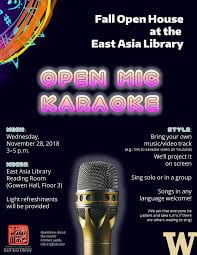
Did you Know?2019 karaoke flyer

1) We like to sing! When it comes to supporting language learning, singing is one of the most fun ways to engage students — from last year’s open-mic Karaoke program to this quarter’s Korean Singing Club led by Professor EunYoung Won from the Asian Languages & Literature department, the library isn’t just for reading anymore!

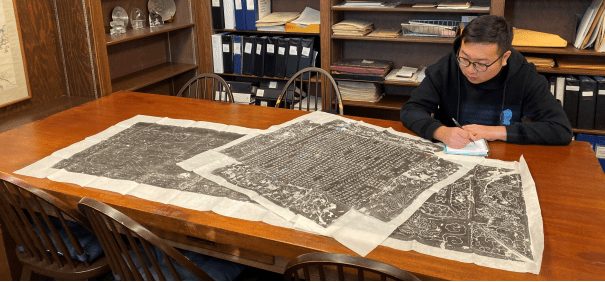
2) Our student employees are AMAZING. From taking inventory of more than 97,000 volumes last quarter to cataloging rare, ancient Chinese inscription rubbings, our students perform all kinds of critical operational and research tasks that are vital to our mission. Thank you student employees!

Student employee Xianda “Nick” Hou examines Chinese stelae inscription rubbings

3) We are teachers. Our libraries staff teach all kinds of classes and workshops. One of our recent initiatives is Digital Scholarship for East Asia Studies, a program designed to introduce digital resources and methodologies relevant to ALL scholars of East Asian studies.  Workshops are led by our librarians, specialists or invited experts, and provide students the opportunity to discuss or present their own research. With twenty-one workshops per year, this ambitious undertaking will have a considerable impact on UW’s East Asian studies graduate student community. Check the EAL calendar and our Facebook for event details. Upcoming workshops:

4) We love book clubs.  From Booksori, a series of Korean-language book talks — to Japanese Tadoku Club and a soon-to-be established Chinese Reading Club, we are committed to making the Tateuchi East Asia Library a place to build community with all of our patrons, inside and outside UW.

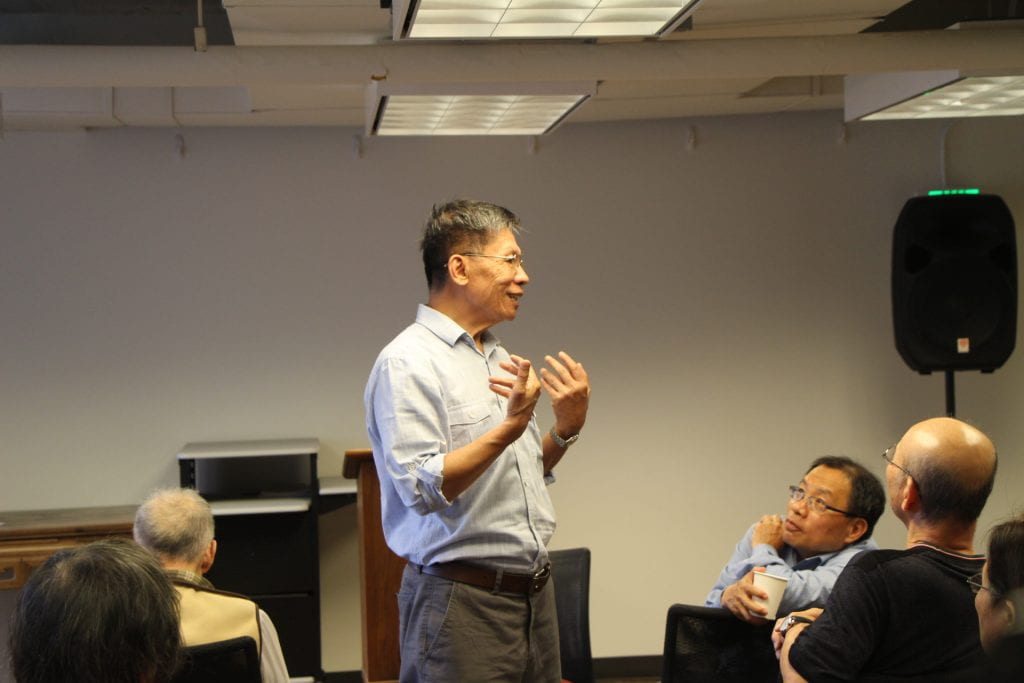
Dr. Fu Hsiung Shen alumnus and former faculty of the UW School of Medicine and political activist, shares recollections on August 25, 2019 through the library’s East Asia Oral History Project.

5) We are history keepers. The library is home to the East Asia Library Oral History Project at the University of Washington Libraries to document the life and experiences of Seattle’s Chinese immigrant community from Taiwan, Hong Kong, Mainland China, and other areas of the world. We host Community Forums for members of Seattle’s Taiwanese and Chinese community to share their stories and experiences with one another, to receive updates on the project, and to learn from and exchange knowledge with guest speakers — academics, oral historians, and community leaders with specialized knowledge.

Okay, it’s actually six (6) things you didn’t know about the Tateuchi East Asia Library — we can’t leave this last one out!

 6) Our team wins awards! In 2019, we celebrated our award-winning staff:

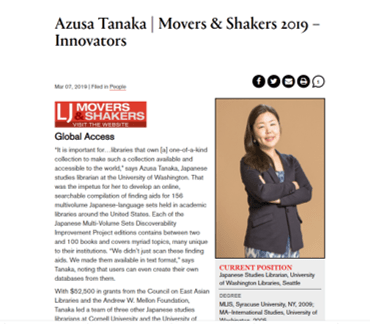
    •  Library Journal named Azusa Tanaka, Associate Librarian of Japanese Studies one of the 2019 Movers & Shakers.
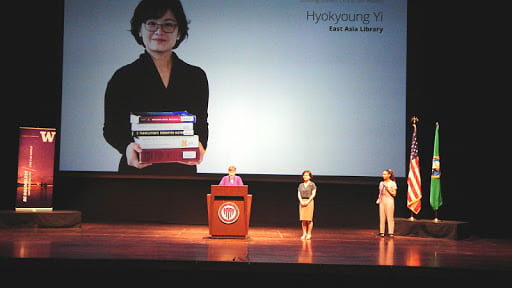
    • University of Washington Libraries’ 2019 Distinguished Librarian Award, the highest honor available to a UW librarian went to Hyokyoung Yi, Korean Studies Librarian and Head of Public Services.
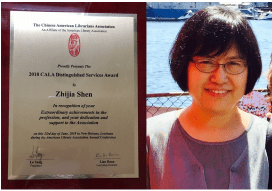
    • Zhijia Shen, Director and Chinese Studies Librarian received the 2018 Chinese American Librarians Association (CALA) Distinguished Service Award, one of the five ethnic caucuses of American Library Association, and is the highest recognition given by the Association “to individuals who consistently demonstrate outstanding leadership and achievement in library and information services at the national and/ or international level.”

To learn more about the Tateuchi East Asia Library, come visit us on the 3rd floor of Gowen Hall or learn more online here.

library photo

Stories

Founding Stories: The Origin of UW Tacoma

On the eve of our 30th anniversary, the UW Tacoma Library is spearheading a project to document the origins and development of UW Tacoma through oral history.


Gathering the Voices of Those who Built UW Tacoma

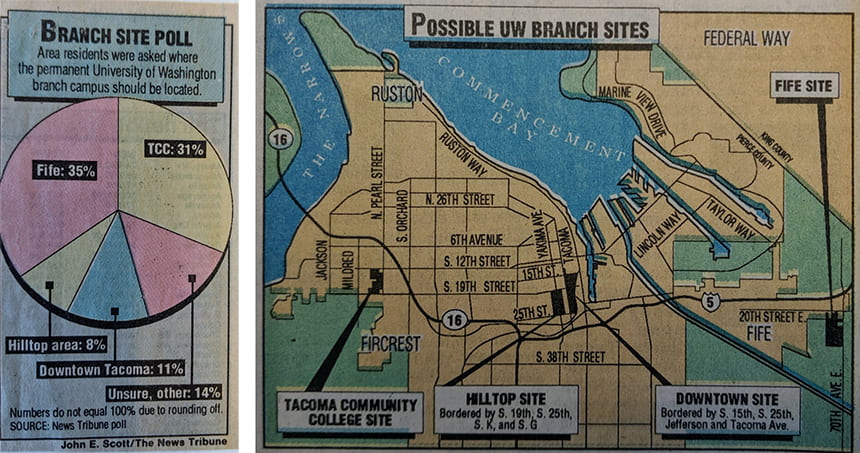
Nearly 30 years ago, in March 1990, the News Tribune asked residents of the Tacoma area where the new “branch campus” should be located. Folks could choose among the four locations under consideration: available farmland in Fife, an area on the Tacoma Community College campus, a site in the Hilltop neighborhood, or a location in downtown Tacoma. As the numbers came in, residents clearly favored the Fife and TCC locations over the downtown site.

1990 maps and survey
Clips from two Morning News Tribune stories about the site selection for the UW Tacoma campus. Left, from March 15, 1990; right, from March 17, 1990.

With the University of Washington Tacoma campus so firmly placed in downtown Tacoma, these numbers might seem surprising today, but they show just how hard it was to imagine a university in downtown Tacoma 30 years ago.

Even as the News Tribune story ran, the legislature had already approved funding to start the campus. Its new temporary quarters in the Perkins Building in downtown Tacoma were already under construction and 13 new faculty had been hired to begin teaching classes.

In the face of clear location preferences among the public, how did the university and the legislature ultimately settle on downtown as the place for the permanent campus?

As UW Tacoma approaches its 30th anniversary, it is an opportune time to begin asking this and many other questions about the beginnings of what was then referred to as a “UW branch.” UW Tacoma Oral History: The Founding Stories aims to do just that: inquire into the origins and influence of this campus by gathering the voices of students, faculty, staff and community members who have shaped it over the years.

Thanks to generous support from Rod Hagenbuch, the Founding Stories project publicly launched in the fall of 2019 with the aim of collecting several dozen oral history interviews. Led by Joan Hua, oral history project manager, it will focus on people who can provide insights into the founding and development of campus: early graduates, founding faculty of the academic programs, campus administrators, long-serving staff members, and community members. All of these oral history interviews will be transcribed, publicly available and searchable in a digital collection hosted by the UW Libraries. Together, they will begin to create a collective portrait of individual experiences of the birth, evolution, and impact of the UW Tacoma campus.

Read the full post on UW Tacoma News and listen to the oral history stories HERE

Stories

Beyond Books: Building Community through Bothell/Cascadia’s Community Reads  

As public spaces devoted to teaching and learning, our Libraries have a duty and responsibility to steward diversity, equity and inclusion.  At UW Libraries, this is embedded in our Libraries Strategic Plan. At the UW Bothell and Cascadia College Campus Library, this work has long been a part of our professional learning and community engagement efforts in the form of events, exhibits, trainings, our social justice group and more; however, one of the most engaging parts of this work has been the Community Reads program.

Established in 2016, UW Bothell’s Community Reads program brings together members of the Bothell and Cascadia campus communities through quarterly book discussions to encourage dialogue on themes of equity, social justice, and diversity.  Students, faculty and staff from both campuses gather to discuss issues raised in the chosen book, as well as selected tie-in materials that go beyond a typical book club—artwork, poetry, music, etc.  The events provide space to build connections and understanding through shared experiences, diverse points of view and ideas for action.

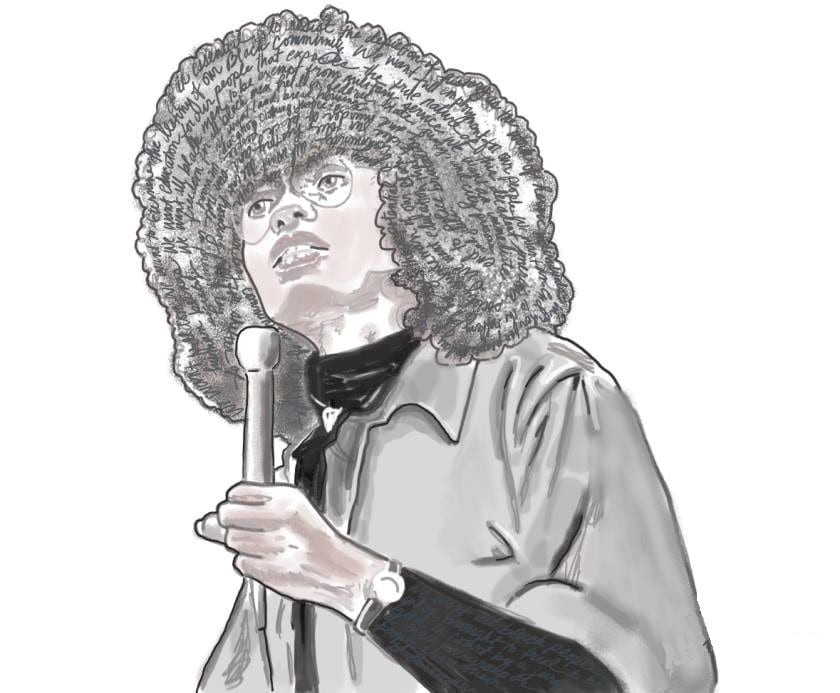
sketch of Angela Davis
Angela’s Voice | by Donna Sullivan (click on image to view)           
“The Angela Davis image incorporates a powerful quote from the book, ‘It is essential to resist the depiction of history as the work of heroic individuals in order for people today to recognize their potential agency as a part of an ever-expanding community of struggle.’ The rest of the text in her hair are the 10 points from the 10 Point Program of the Black Panther Party, which she mentions in her book and to which her legacy was forever tied through her arrest and trial. The last two points are on her sleeve.”                                 
– Donna Sullivan, Cascadia College Staff member


Inspired by Angela Davis’s visit to UW Bothell last year, the Community Reads team chose Davis’ Freedom is a Constant Struggle: Ferguson, Palestine, and the Foundations of a Movement for the 2019/2020 program, with an emphasis on the theme of democracy.

In our fall quarter event, the discussions focused on chapter 1 “Progressive Struggles against Insidious Capitalist Individualism” and chapter 5 “Closures and Continuities”.  Tie-in materials included the Black Panther Party’s Ten-Point Program, Dr. Martin Luther King Jr.’s Letter from a Birmingham Jail, and the poem by Langston Hughes, Let America be America Again. A Cascadia staff member, Donna Sullivan, was inspired to create a digital portrait of a young Angela Davis entitled Angela’s Voice, which was featured in Fall Quarter marketing materials.  Following the small group discussions, participants were asked to reflect on how they would use their voice, or engage in democratic life.  The Community Reads Team has been conscious of incorporating an element to the events that asks participants how they might apply or act on what they heard and learned.

Community Reads underscores the Libraries’ role in advancing equity, diversity and inclusion within the communities we serve.  These types of events not only shine a light on underrepresented authors and topics, they provide outlets for expression and connection that are essential to community-building, especially where socio-economic lines can sometimes act as barriers for connection.

Community Reads is one example of how Libraries are evolving by providing a wider range of services and programs “beyond books” – opportunities that encourage connection, learning and collaboration for the public good, enriching the cultural fabric of our communities.

Join the next Community Reads at UW Bothell & Cascadia College Library !

Community Reads is open to all. The Winter events will focus on the theme of mass incarceration, drawing upon chapter 2 of Angela Davis’ book, Freedom is a Constant Struggle.  We will also be showing clips from the film 13th, by Ava DuVernay.

When:

  • Tuesday February 18, 1:30-3:00pm
  • Wednesday February 26, 12:00-1:30pm

Where: Bothell Campus Library room LB1-205

Please join us!    https://guides.lib.uw.edu/bothell/communityreads/w20


Stories

What We Can Learn from Ancient Chinese Inscription Rubbings:

I have been working at the UW East Asia Library  since I was a freshman. With a strong interest in ancient Chinese history and some good fortune, I got the opportunity to work on a collection of epigraph rubbings rich with historical information from the Northern Wei, Tang, and Song dynasties. The East Asia Library received these valuable rubbings from a previous donation. The set includes approximately thirty-six complete inscriptions from the Tang (618-907), Zhou (690-705, led by China’s only female emperor Wu Zetian), and Song (960-1279) dynasties.

Student employee Xianda “Nick” Hou examines Chinese stelae inscription rubbings

Many of them preserve historical information and literary texts not found in contemporary historical writings, enriching our understanding of events like the An Lushan Rebellion, linguistic phenomena such as the distinctive characters associated with Empress Wu,demographic trends such as Iranians resident in China, and religions such as Buddhism, Daoism, and Zoroastrianism. One interesting inscription records that a Samarkand chief/king led his people, comprising 5000 “tents,” to commit their allegiance to the Tang empire. It also provides evidence of Zoroastrian religious practices such as sun and moon worship. Another records the life of afemale Buddhist devotee from Samarkand who married a man from Bukhara (modern Buxoro) and lived in Shendu (Luoyang). One portrait tablet of a warrior from the Northern Wei dynasty (386-534) depicts the dress of a military officer from the dynasty. An inscription commemorating Emperor Wu Zhao’s cousin reveals details about the Wu family and Tang dynasty political structures.

There is much more interesting information to explore. Inscription rubbings hold a special place in Chinese culture and history. These examples enrich the East Asia Library’s collections, and provide fruitful material for historical and literary research. I learned traditional stone rubbing techniques in China, and have studied medieval Chinese arts since primary school. I am impressed by the quality of these rubbings and the clarity with which they render the inscriptions. I feel very fortunate to have had the chance to help catalog them over the summer.

Related Story:

Coveted link to China’s past found in a basement at UW – Seattle Times, 2005

Stories

Connecting business students with professional information tools

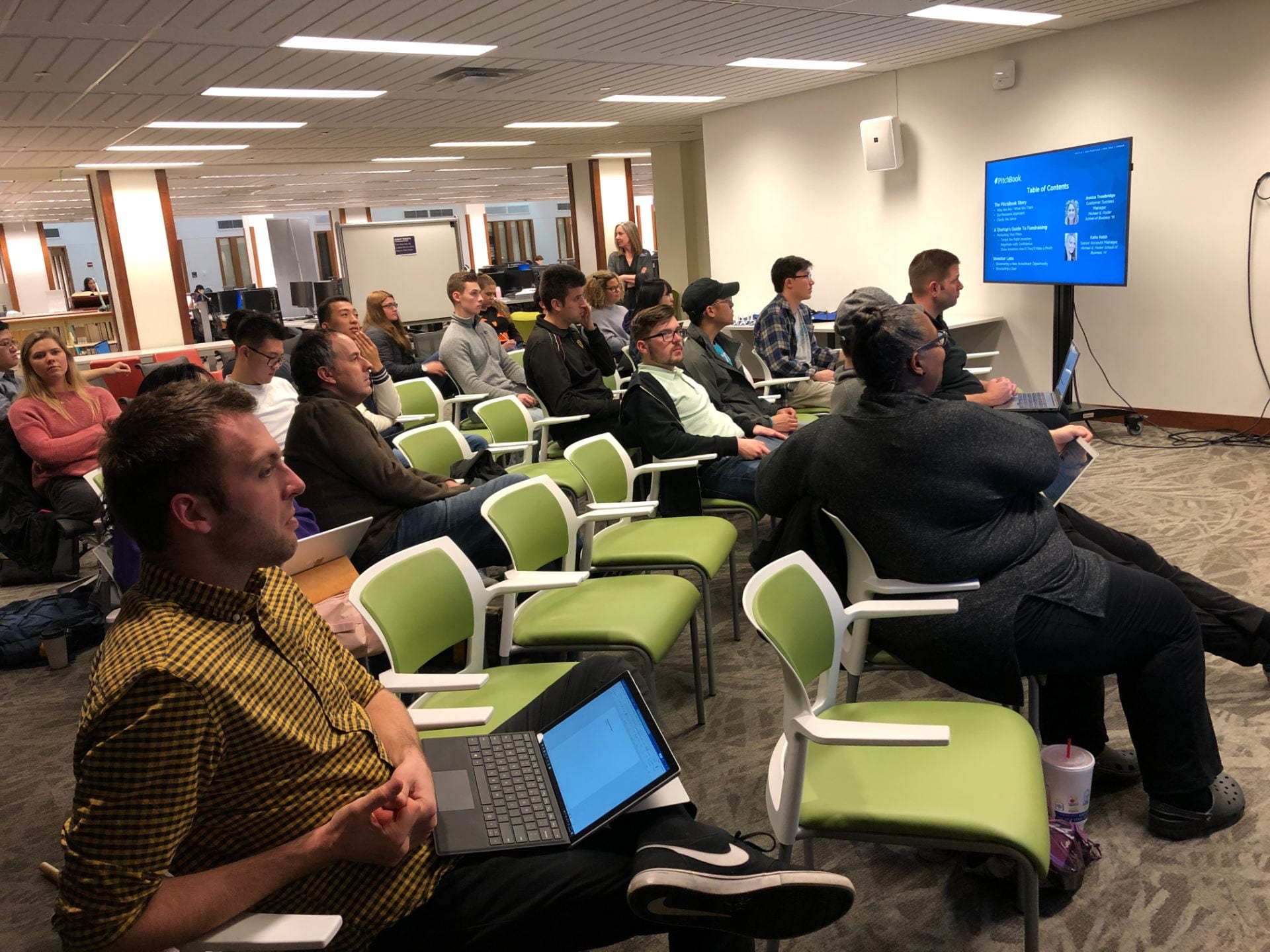
Alongside the Libraries’ ongoing efforts to expand student information awareness, the Foster Business Library hosted “PitchBook Night” on November 12, a dynamic session on how data informs the work of entrepreneurs and private-sector investors. In this first-of-a-kind event for the Foster Library, the session attracted 25 Foster School of Business undergraduates and MBA students to learn more about PitchBook, a library-subscribed search platform that tracks private-equity and venture-capital market data.

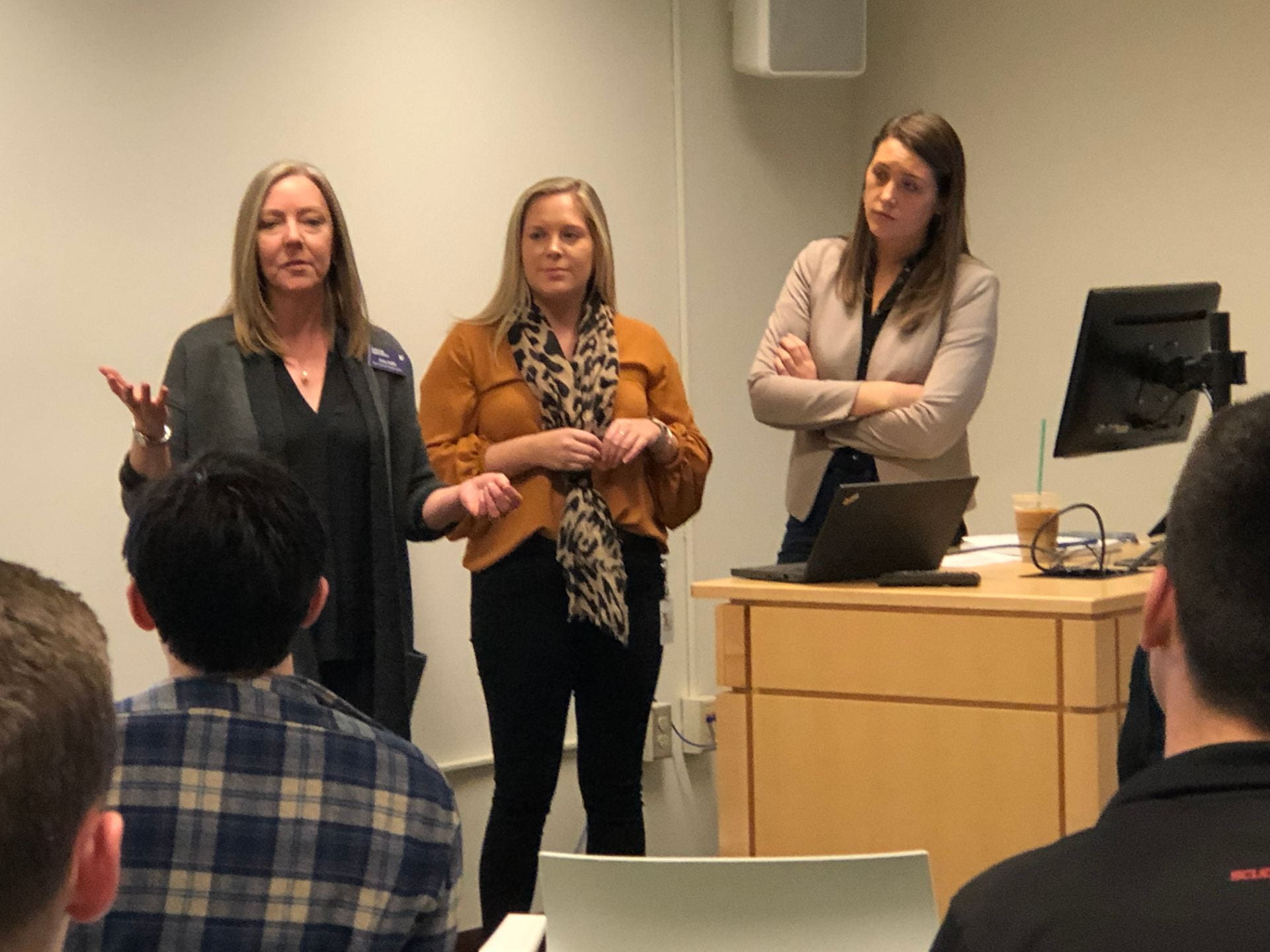
Following a welcome by Amy Sallin, director of the Buerk Center for Enterpreneurship, PitchBook account managers Katie Kelsh and Jessica Trowbridge (both UW alumni) described PitchBook’s data gathering process and its applications in startup fundraising, venture capital investing, and related business decision-making and due diligence.

“PitchBook Night” was the first of a planned series of similar events that will improve students’ abilities to locate and apply business information available through Foster Library subscription resources.

Located in Paccar Hall, The Foster Library has over 60,000 books, over 400 student study seats and 11 tech-enabled group study rooms. Foster Business Librarians provide a range of student and faculty support services, from student research consultations to classroom teaching and training, and partnering with faculty on research assignment development.

Learn more

Students seated in rows of seats
Foster business students learn about PitchBook in the Foster Business Library
Three presenters behind a podium, addressing an audience.
Buerk Center Director Amy Sallin introduces PitchBook account managers Katie Kelsh and Jessica Trowbridge.
Stories

Mythbuster: The Facts About Greta Thunberg’s Photo Twin

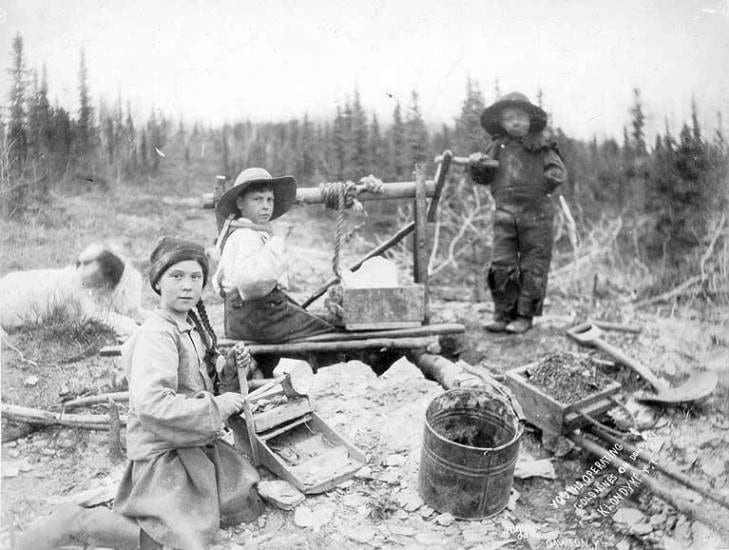
One of the images within UW Libraries Special collections has garnered a lot of media attention lately regarding the resemblance of a young girl in a photograph from 1898 to 16-year-old Swedish climate change activist Greta Thunberg. Several creative theories abound from time travel to how Greta’s image may have been inserted into a historical photo, which is most definitely not the case.

Greta ThunBerg Conspiracy The Truth
University of Washington Libraries, Special Collections, Hegg 3209

As part of the UW Libraries Special Collections, the photo in question is an original.  It is one of many photos taken by photographer Eric A. Hegg (1867-1947). It is one of the Libraries’ cornerstone collections, and one of the largest Klondike-era documentary photograph collections in the region, if not the country.  The Hegg collection came into the Libraries Special Collections in the 1960s, pre-dating modern record keeping that would illuminate more detailed information such as who donated the collection, or prior ownership. There are no notes or documentation regarding the identity of the subjects.

Much of what we do know about Hegg is detailed within the UW Libraries digital collection record. As noted in the record, in 1902, Hegg’s negatives and photographs were sold to a Seattle, Washington firm of Webster and Stevens, who removed the Hegg studio imprint from the negatives and sold prints made from Hegg’s negatives as products of their studio. The remaining assets of the Skagway studio were absorbed by Dedman’s Photo Shop, which continues in business to this day in the town of Skagway. That said, there is no way to confirm if the images within the collection originated from this third party, or from other sources.

ABOUT THE PHOTOGRAPHER AND THE COLLECTION

Hegg was born in Sweden and arrived in the Puget Sound region in 1888, settling in Whatcom County.

In the fall of 1897, after hearing of the gold strikes in the Yukon Territories, he joined the thousands of gold seekers heading north, eventually opening up several photography studios in Alaska. He captured the people of Skagway, Bennett and Dawson City during the Klondike Gold Rush from 1897 to 1901. Hegg took one of the most iconic photographs of Chilkoot Pass of miners and prospectors climbing the ice stairs upwards to the top and the awaiting Canada–US border.

In 1997, the Libraries hosted a special exhibit to showcase the collection: Klondike Gold Rush: The Perilous Journey North. In addition to featuring the Hegg collection, people from the community also contributed additional photographs and lent their expertise to further help identify images, some of which feature family members who lived in the area.

“Conspiracy theories aside, we are delighted that the collection is receiving attention because it underscores the historical importance of the images as well the unique role that Libraries and other archives play, not only in safekeeping, but in telling these stories, and ensuring accessibility,” says Lisa Oberg, interim director for the UW Libraries Special Collections.

The University’s Special Collections brings together the University of Washington Libraries’ most rare and unique resources. From papyrus to born-digital, our holdings span history and the globe, and offer boundless opportunities for exploration and discovery. Learn more.

Instructions for Use of Images from UW Special Collections

  • Single use fees apply to any for-profit entity (news).
  • In order to use photos legally, permission is required. Please refer to the UW Libraries Permission for Use Instructions. And the corresponding application form.
  • Any use of the image requires the appropriate citation: University of Washington Libraries, Special Collections, Hegg 3209.


For all media inquires, please contact the UW Libraries Communications Director, Sandy Hawley: [email protected]