Choices for textbooks: Student survey and focus group findings
December 12, 2024
Re-posted from UW Tacoma Library, originally posted on by piroga
How do you get access to course materials? What would you consider a reasonable price for a textbook? These were two of the questions we asked UWT students in spring 2024 about their experiences acquiring and using textbooks and course materials. Open to all current undergraduate and graduate students, we heard from 180 students that high textbook costs are hard to bear but when choices are actively promoted, students can find affordable books that work for them.
Since 2018, the UWT Library has purchased textbooks $75 and over as part of our course reserves program — textbooks and other materials required for classes and made available for short-term checkout at the Library. Our textbook purchasing is modeled after a similar program at the UW Bothell/Cascadia College Library where a survey of their students found $75 as the maximum amount students felt they could pay for a textbook.
Our survey showed Tacoma students were comfortable with a much lower price range for textbooks — $32 – $42. To reduce costs, students searched for free copies online, purchased from online retailers and searched for used editions, and used the Library’s course reserves program. Unfortunately, these strategies didn’t work for all students or for all assigned books. 51% of students continued taking a course without having the required texts, 18% received a poor grade in a class because they couldn’t afford the course materials, and 25% did not take, dropped, or withdrew from a class because of an expensive textbook.
“I have had to purchase so many textbooks, many of which I will never read again. It’s a lot of money. I think requiring expensive textbooks is not inclusive or equitable.” – survey response
In addition to these responses highlighting the negative impact of expensive textbooks, we heard from students in a series of focus groups that choices and having adequate time to make choices was the best way for them to alleviate the burden of expensive books.
Focus group participants started their search for textbooks by looking for free or low-cost books first and would purchase a new textbook as a last resort. The sooner students found out what their assigned books would be the more time they had to search for the best option. Students mentioned using and appreciating having a free option for textbooks through the Library but all students agreed that the current four-hour checkout period was not long enough.
“If a textbook is available for a four-hour checkout period but you have another class that begins in an hour… actually it would only be available for an hour.” – focus group student
Based on both survey and focus group feedback, the Library increased the length of time students can check out course reserves from four hours to 24 hours at the start of this autumn quarter. Now, students can keep Library course reserves throughout a full day on campus and take textbooks home overnight. We also updated our website to make it clearer that course reserves are textbooks for checkout, not books that need to stay in the Library.
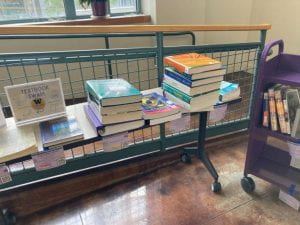
Donated books at the UWT Library Textbook Swap (photo credit: Amanda Pirog)
To provide an additional option for textbooks we piloted a textbook swap in the Library for the first three weeks of autumn quarter. The textbook swap will be returning at the end of this quarter (Monday, December 2 – Friday, December 13) in the Snoqualmie Building lobby. Students can also donate and browse used books at any time by visiting the UWT Little Free Library on the fourth floor of the TLB.
When students mentioned wanting to find out about their textbooks as soon as possible, they consistently noted the important role that faculty play in sharing both the title of texts and available options for free or low-cost materials on campus.
“I would like to hear from them [professors].” – focus group student
“I wish professors would encourage us to use it [course reserves]” – survey response
With this feedback in mind, Library staff reached out to Faculty Assembly Executive Council and on November 15 presented our survey and focus groups findings. As winter quarter approaches, we will continue talking with faculty and campus partners. We look forward to continued conversations and promoting choices for UWT students to access textbooks and course materials.
###
Stories
Game On! A New Odegaard Tradition is Here to Stay
December 5, 2024
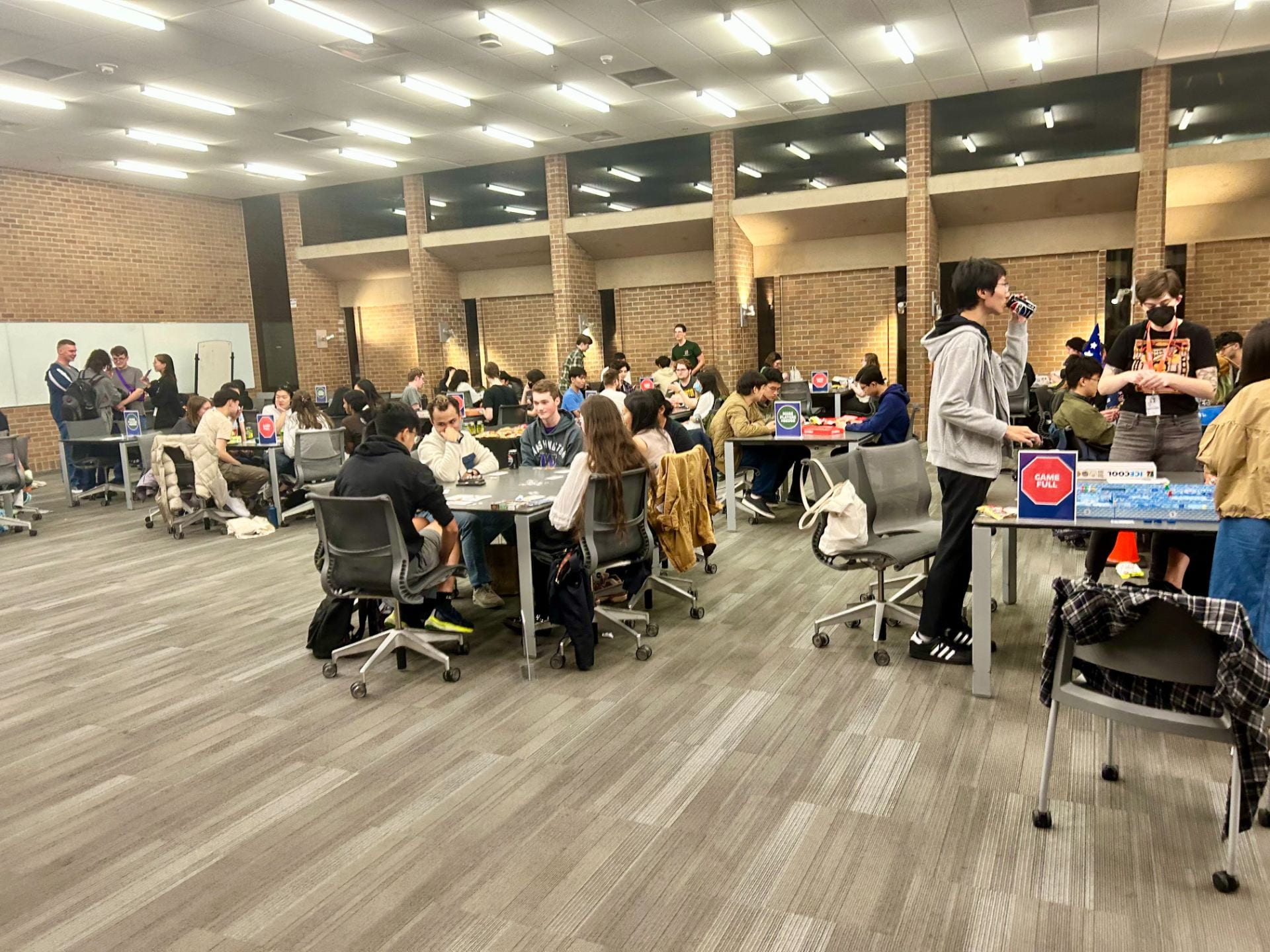
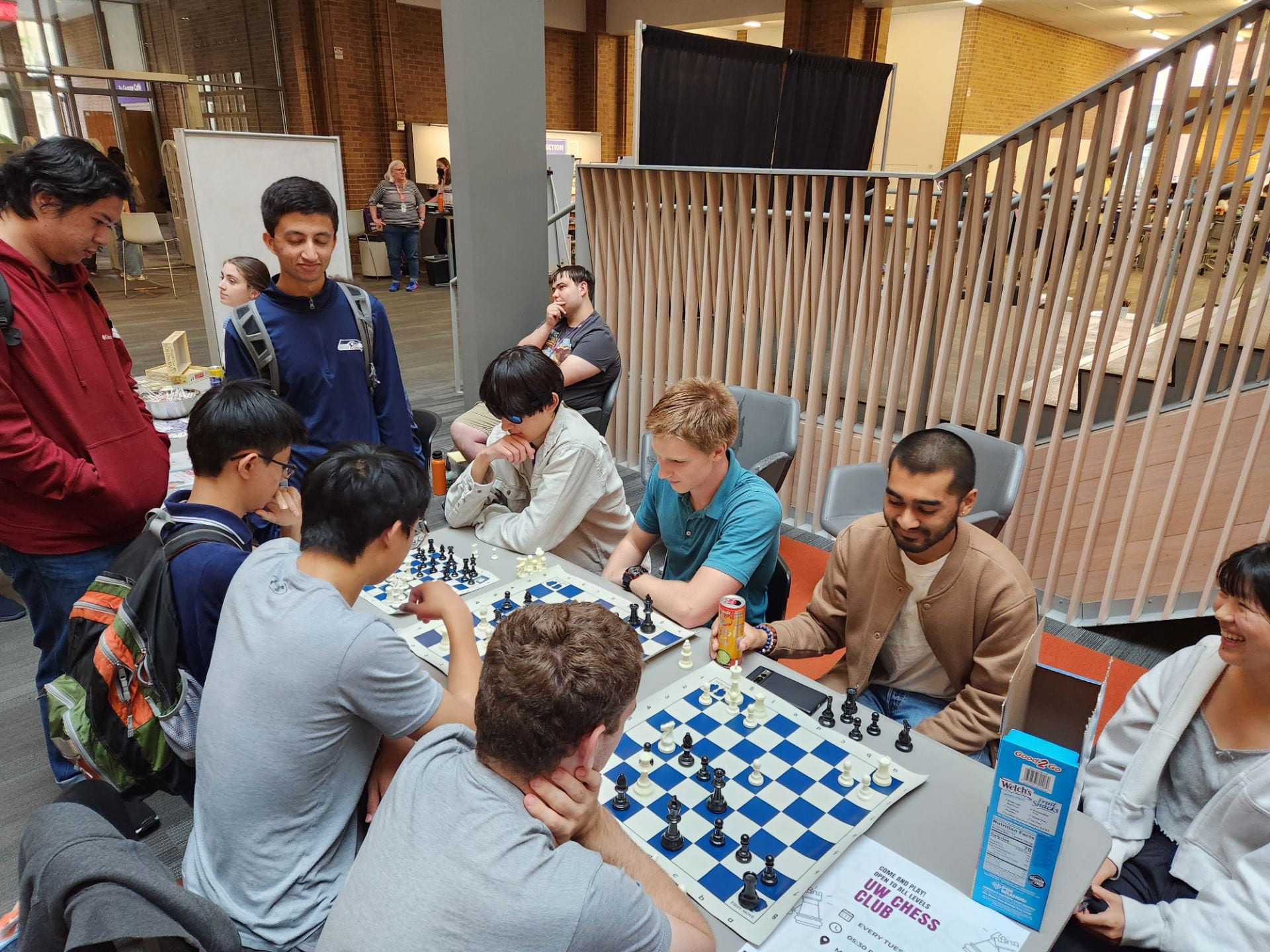
A packed room during September Game Night
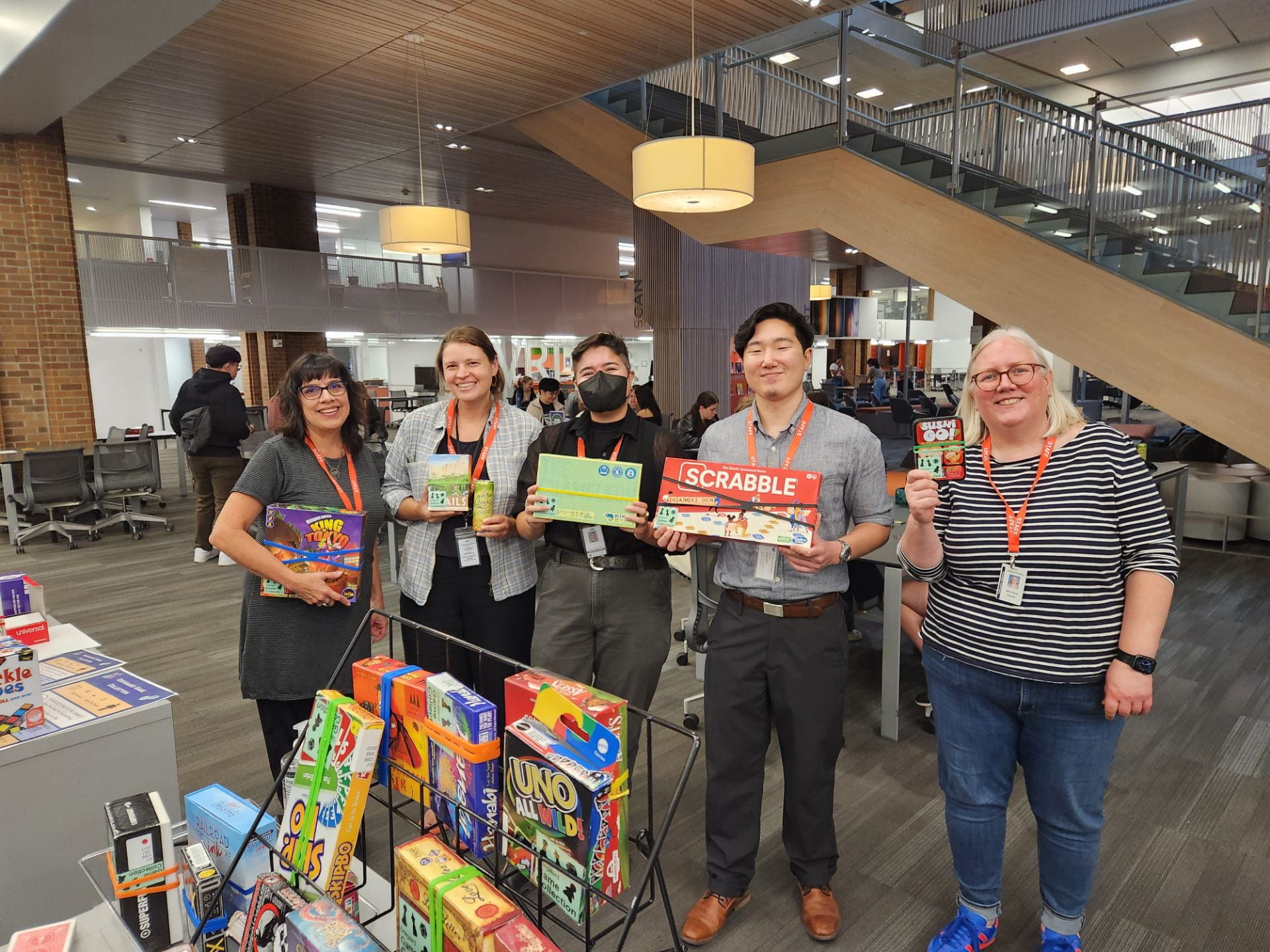
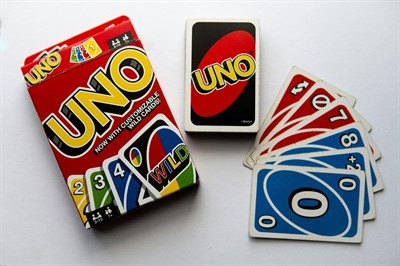
On September 30, nearly 800 people gathered at Odegaard Library’s Tabletop Game Night! As part of Dawg Daze Welcome Week, it was a great opportunity for incoming students to meet new people and start the year off with a night of fun by playing board games together. Dozens of games were available to play from Odegaard’s Game Collection and staff facilitators recommended games and helped match solo players with groups. Attendees also had the chance to meet students from some of UW’s tabletop gaming RSOs who attended and helped run games including: Pen & Paper Gaming Association, Board Games @ UW, Yugioh Club, Pokemon Trainer Club, Chess Club, and Husky Gaming Nation.
Based on survey responses, many attendees said the best part of the event was meeting new people and meeting students across different programs. “Staff friendliness” and “help finding games” were also mentioned.
“I liked that staff members helped people find games and groups to join.”
– Game Night Participant
Libraries staff helping to make Game Night a great success!
THANK YOU FOR YOUR SUPPORT!
The Dawg Daze Tabletop Game Night in September was made possible by the generous support of the UW Parents Collections and Programs Endowed Fund. Starting in fiscal year 2024-25, game collection purchases are being funded from the Herschel V. III and Janet Schraegle Jones Endowed Library Fund and game events are being funded through the Parents Fund.
Because Game Night was such a hit, Odegaard’s game team decided to plan and host quarterly game events for students throughout the year!
Why Board Games? Why Libraries?
One of the Libraries’ key strategic directions is to enhance the student experience. We strive to do this through activities and programs that encourage student success, belonging, inclusion, and the holistic well-being of diverse student populations. A desire to update and refresh programming for new student events led to the initial idea. A lot of Odegaard staff play board games and tabletop roleplaying games themselves, so we were excited to find a way to share those interests with students! We held the first Game Night in 2023 which led to the development of a new board game collection at Odegaard. Through this experience, we learned that UW students are eager to make personal connections, and that games and other social activities are an important way of facilitating those connections for new students.
Through Game Nights, we hope to create a welcoming and inclusive environment for students to connect during their transition to university life; showcase the Libraries as a vital community hub; and raise awareness about our collections and services, including the Odegaard Game Collection!
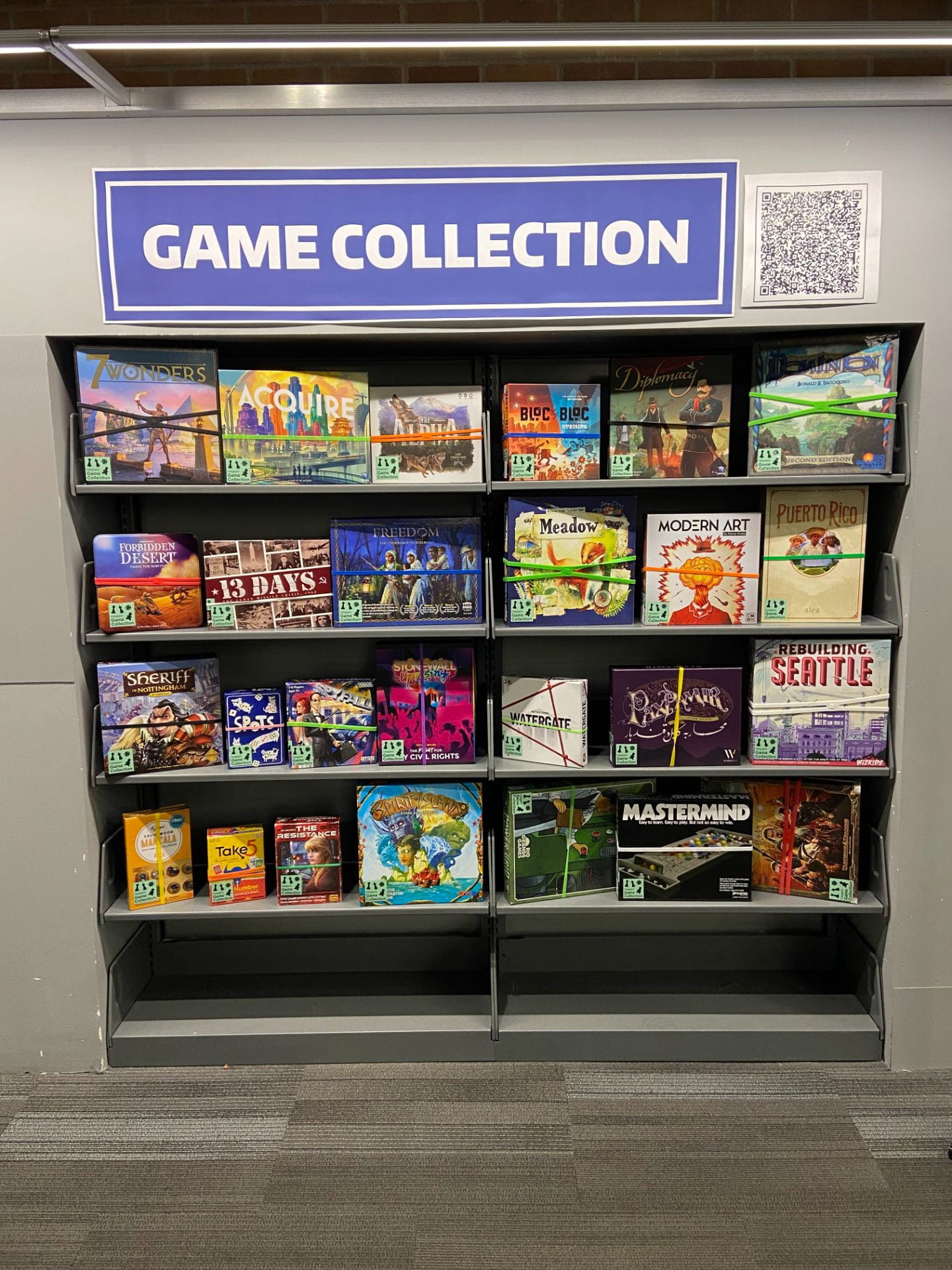
FUN FACT: As of December 4, 2024, the game collection as a whole has a 528% turnover rate— that means that each game in the collection has been checked out an average of 5 times each. At any given time, one-third to one-half of the games in the collection are checked out—so students are definitely responding to the new collection! We hope that the games are helping them foster fun social time with friends, family, and new acquaintances.
Gaming is Good for You!
Taking breaks from work and studying is important for your mental and physical health. Not scheduling time for breaks can lead to stress and burnout. We want to encourage UW students to take some time out of their busy schedules to play board games with their friends. We hope that the game collection can help students find a work-life balance that includes extracurricular fun. But games aren’t just for fun and social connection — although that’s the most important part! Games can also foster critical thinking, strategic thinking and learning, and there are a handful of classes at UW that study games more closely. Odegaard Library’s Curriculum Support team even uses card games in our information literacy workshops!
So, When Can I Play?
Odegaard will host themed game events each quarter. The first game event after Dawg Daze, “Card Games & Cup Noodles”, was held on October 30th. The next game event will be “Games For Two” on February 13th, but you can check out games from the collection at any time! And of course, we look forward to continuing this new tradition for incoming students with an even “bigger and better” 2025 Dawg Daze Game Night!
UW students on a walking tour of Ljubljana (the country’s capital)
The University of Washington has a long, productive history of collaboration with the University of Ljubljana, Slovenia’s flagship research institution, going all the way back to the 1960s (see side bar)! In 2019, UW Study Abroad decided to formalize a student exchange with Ljubljana, in part to provide UW students with a more personalized, high-quality alternative to other typical European study abroad programs based out of “mega-cities” like London, Paris and Rome. While the launch of the new program was interrupted by the pandemic, it is now back, and drawing student participants. This past September’s UW Early Fall Start (EFS) program in Kamnik, Slovenia, provided an opportunity to showcase Slovenia for prospective participants in the academic year exchange.
In September, UW Libraries’ Michael Biggins (Affiliate Professor; Slavic, Baltic, and East European Studies Librarian) designed and led 14 UW students on a 3-week, 5-credit intensive study abroad program titled Slovenia: Language, Culture and Society at a Crossroads. The home base for the program was a former Ursuline convent built in 1682 on the outskirts of Kamnik, a picturesque town set against the bucolic backdrop of snow-capped mountains and lush landscapes.
Kamnik Residential Cultural Center
Each day, students divided their time between classroom learning and field trips. Every field trip was preceded by a classroom module that had something to do with the selected destination, providing students with some background and cultural context ahead of each new experience. Through this multi-modal approach, students explored the geology, geography, archaeology, history, art history, and current affairs of the country, as well as Slovene literature (in English translation) and introductory Slovene language skills.
After a recent presentation to UW and Libraries colleagues on the new program, we caught up with Prof. Biggins to ask him about this inaugural study abroad experience in Slovenia.
How often do you teach/lead these types of trips?
“I’ve been on study or research trips to Slovenia some 15 times, and I’ve led student groups to Russia, but 2024 was the first time UW offered this particular program. We’ve planned it again for August-September 2025, and are excited by the initial response.”
the medieval hill town of Štanjel a guided tour of the town of Škofja Loka and its environs a 14th-century walled church with original frescoes preserved at Hrastovlje
What inspired you to create this unique study abroad program?
“One of my goals was to engage UW students from a wide range of disciplines with a broad cross-section of the humanitiesas manifested in acontextcompletely new to them, enriching their perception and understanding of the world. I was especially interested in raising awareness of and respect for the many small, distinctive cultures around the world that have survived the vicissitudes of history and the pressures of globalization and continue to thrive. I wanted to offer an opportunity for students to step away from the continuous feedback loop of American mass culture and to see, from close-up, how very differently and distinctively another society can function. And, amidst that difference, to keep an eye out for what may well be widespread — if not universal– patterns and dynamics common to most or all societies, in hopes of using those insights to become wiser about our own.”
FUN FACT: The UW Libraries has one of the three most outstanding research collections for Slovene studies in North America numbering around 8,000 volumes, which Prof. Biggins drew on heavily to prepare course material for the program. Many new additions to these collections are purchased with funds from UW’s Boniecka Slovene Studies Endowment.
a visit to Kamnik’s Franciscan monastery, with its impressive library showcasing Slovene incunabula, including the 1584 Dalmatin Bible, the first complete translation into Slovene, and a chapel designed by architect Jože Plečnik
How are study abroad experiences like this beneficial for students and the faculty who lead them?
“Purposeful foreign travel and study abroad can be transformative for students. The mere fact of living in a non-English environment where the operative language is not one of the better-known world languages, but a small, obscure, unique, yet absolutely thriving, dynamic and creative medium of communication for a community of just two million, supported by an omnipresent linguistic ecosystem (newspapers, magazines, radio, TV, film, theater, a massive (for the country’s size) vernacular book industry, and of course signage everywhere) is somehow mind-blowing for Americans, or at least it should be. We’ve come to take English for granted as the world’s lingua franca and expect everyone to speak it. Many do, but it’s not the language of their heart and soul – the domains that are by far the most interesting, that we can truly connect to only by trying to inhabit their language with them.
What’s more, in a compact society like Slovenia’s, you as a visitor are at barely more than one degree of separation from the country’s leading experts in virtually any discipline that matters to you.
Over the decades that I’ve been engaged with Slovenia, I’ve made the acquaintance of creatives with ease — artists, writers, scholars and scientists who produce world-class work, in part because the scale of the place means that you inevitably know someone who knows those people. That scale works to the advantage of our students, too, since it’s so much easier to facilitate mentorships for them with leading experts in the fields that interest them.”
Did you know?
UW has longstanding cooperative relationships with the University of Ljubljana, which began around 1963 when UW specialists in nuclear physics and engineering began a series of reciprocal research visits. Our ongoing UW-University of Ljubljana Scholars Exchange, which grew out of that first encounter in the 1960s, sends 2 to 3 UW faculty and PhD candidate researchers from all over campus to the University of Ljubljana and we host 2 to 3 of their faculty members here.
As a result, UW has a wide and constantly expanding network of U of Ljubljana faculty with longstanding ties to UW – in fields ranging from biomedical informatics, aeronautics, astronomy, human centered design, and law to music, English, classics and, of course, Slavic languages.
Ask any past UW participant in that exchange what they thought of it and they will tell you at a minimum two things – that their Slovene colleagues were outstanding, and that they fell in love with Slovenia. In many cases, the collaborations have continued for years.
What were some of the highlights of the trip from your perspective?
Student presentations: “As part of the course, each student was tasked with keeping a journal in which they recorded their observations on some aspect of their academic major or a non-academic pursuit of considerable interest to them – as it’s manifested in Slovenia. Students had the opportunity to connect with Slovenian experts in these fields, including at the University of Ljubljana. At the end of the program, each student gave an oral presentation to the class on their exploratory topic (as we called it). The presentations were quite good, and I enjoyed seeing each student’s individual discoveries through the lens of topics that were of paramount interest to them, personally.”
a day-long tour of Trieste, Italy, and its Slovene communities
Trieste Commemoration: “Along with a few thousand local Slovenes and Italians, we attended the commemoration ceremony on the Bazovica village commons in observance of September 6, where, in 1930, Italy’s Fascist authorities executed four young local Slovenes who were members of an underground Slovene organization that resisted Fascist Italy’s policy of ethnocide of its large Slovene population. Those four became icons of Slovene resistance and remain so to this day. While some minor Italian-Slovene interethnic tensions remain in greater Trieste, the legal framework for European Union member states now guarantees that autochthonous ethnic minorities– like the Slovenes of Italy—have full human and civil rights, which is a monumental achievement.”
a trip by cable car to mile-high Velika Planina (a vast late-summer upland pasturage for sheep and cattle); students enjoying local hospitality on the plateau
Access to natural environment: “I think the students were impressed with the proximity of extensive natural environments even in the largest cities, where you can walk to the end of your street and enter a forest or begin ascending a mountainside. A corollary to this is the apparent attention given by public policy in Slovenia to preventing urban sprawl and protecting the country’s spectacular natural environment.
…Slovenia has been a major innovator in sustainable forestry practices for going on a century, something that several UW Forestry faculty members have investigated on site.”
Prof. Biggins plans to continue leading trips to Slovenia for the foreseeable future.
“I would like to make this course and trip an annual feature of UW Study Abroad’s Early Fall Start offerings,” says Biggins.
“My hope is to continue organizing, leading and teaching this program or variants of it for the rest of my UW career and well into retirement, and to encourage other UW faculty to participate.”
Prof. Biggins also is encouraged by the prospect that, over time, the program will serve a secondary function of generating student interest in UW Study Abroad’s new academic year student exchange with the University of Ljubljana.
Winter is upon us and the end of fall quarter is here! We hope that UW Libraries has been part of your positive 2024 Husky experience thus far. A sincere THANK YOU to all who consider supporting UW Libraries in your annual philanthropy; your gift supports every student and a global community of teaching, learning and research–read our feature stories this month for some inspiring examples! Speaking of giving… grab the perfect UW gift from UW Press’ 40% off Holiday Sale! Whether you are going home, taking a trip or staying on campus, enjoy your break in whatever form it takes, and take advantage of free access to streaming media, games and more (see “Boredom Busters” below!). Stay connected with us in 2025 to learn about all of the exciting winter quarter of events, learning opportunities, exhibits and more.
Hours Reminder
Know before you go– be aware of adjustments to hours for end-of-quarter and interim/break.
UW Press publishes unique and compelling work (both fiction and non-fiction) with regional, national and global impact. With a wide range of topics, you’ll find something for everyone on your list. Take advantage of this special holiday savings today and give a gift that is uniquely “UW” for the holidays, that next birthday, or “just because” Now through January 3, 2025, browse our site and use the promo code WINTER24 at checkout to receive 40% off your purchase and free domestic shipping. Happy holidays, and thank you for supporting the University of Washington Press! Order/ Learn More.
UW Libraries’ Elliot Stevens listens to the podcast project from one of the UW Libraries Hight School Internship participants
News and Stories
UW Magazine Feature Story: UW Libraries’ internship program gives high school students an idea of what it looks like to attend the UW, especially if they don’t have family experience to lean on. Read the story.
UW Libraries’ Michael Biggins with UW students on a walking tour of Ljubljana (the country’s capital)
Libraries in the Classroom: International Edition – Take a trip to the gorgeous country of Slovenia with UW Libraries’ Michael Biggins for an inside look at the new study abroad program Slovenia: Language, Culture and Society at a Crossroads. Read the story.
A Legacy of Equality and Leadership Organizing, announcing new LELO collection: the Northwest Labor and Employment Law Office (LELO) emerged in 1972 from a coalition of Black, Asian American, and Latinx labor organizations, LELO made significant strides for workers’ rights, including increasing Black employment in construction trades and securing union organizers’ access to migrant workers. Now, an extensive collection of organizational records from 1972 to 2005 including audiovisual materials, publications, and artifacts documenting decades of LELO’s advocacy and campaigns are available to explore through the UW Harry Bridges Center for Labor Studies and the Labor Archives of Washington. Read the story.
UW Tacoma Library Spotlight – More Choices for Textbooks: This blog post from UW Tacoma Library explores how student feedback is helping to guide operational decisions to improve student access and use of course materials like a textbook swap pilot, and extended course reserve check-out times. Read the story.
Break Time Boredom “Busters”
Have some “down time” during the academic break, and not sure what to do? Explore these FREE entertaining Libraries resources!
Streaming Media:From foreign films, documentaries, musical and dance performances, public broadcasting archives and more, there are thousands of online videos to explore that you won’t find on your typical streaming services! The Game Collection at Odegaard Library contains board, card, and tabletop role-playing games (TTRPGs). The collection is located on Odegaard 1st floor, just inside and to the left of the main entry doors. Good Reads is a collection of fiction and nonfiction books for students to read for leisure. All the books in the Good Reads collection have been published within the last five years, so find your new favorite book here! Digital Collections: From old UW yearbooks and campus photos, vintage ephemera like postcards, menus, magazines, posters, rare books, manuscripts, maps and so much more to spend a few hours (or a few days) going down the “rabbit hole” of wonder and delight that is UW Libraries Special Collections – AND UW Libraries ethnomusicology collections!
For Faculty – UW Libraries 2024/2025 Subscription Review Update: Per the most recent presentation at the Faculty Council on University Libraries, please read this important summary on the timing and status of subscription reviews including feedback processes for proposed cancellations and deadlines.
Community Events and Exhibits
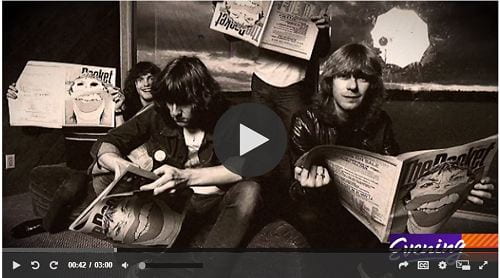
The Rocket publication ran from 1979 to 2000 and was the first to cover bands like Nirvana and Pearl Jam. #k5evening
Coming Soon!NEWEXHIBIT: Celebrating The Rocket, Seattle’s Music Magazine (Monday, Jan 6 – Saturday, Feb 15, 2025): Explore 20 years of music and culture as told through the pages of “The Rocket,” the influential Seattle publication that covered music venues and regional bands including Riot Grrrl, Mudhoney, Nirvana, Sir-Mix-A-Lot, Sleeter-Kinney, and Soundgarden during the 1980s and 1990s. This exhibit will also celebrate the Rocket’s late, long-time editor and publisher Charles Cross, by presenting its covers and coverage of the music industry and local culture. The exhibit highlights how the UW Libraries and the Washington State Library preserve and make it accessible to all.
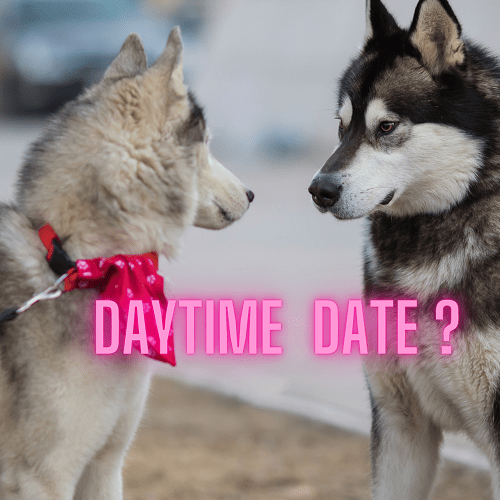
Visiting an exhibit at UW Libraries is a great NO COST date idea that will spark conversation and inspiration while viewing fascinating, rare and unique materials on display at UW Libraries Special Collections! Allen Library South, Basement (Open daytime hours Mon-Fri)
The Language of Flowers Exhibit: Enjoy the changing seasons with Special Collections through our annual lobby exhibit, The Language of Flowers. Each quarter will feature new material related to our botanical collections, local plants, and more.
Learning Workshops and Office Hours
Intermediate Data Science Office Hours: December 12: Come talk to the eScience Institute’s Technical Education Specialist to get some human help about how to advance your computational work. Tools we can help with include Python, R, OpenRefine, Git and UNIX shells, among others.
Get Libraries news like this directly to your inbox! Sign-up for our blog!
Your Email:
###
Stories
November Update
October 31, 2024
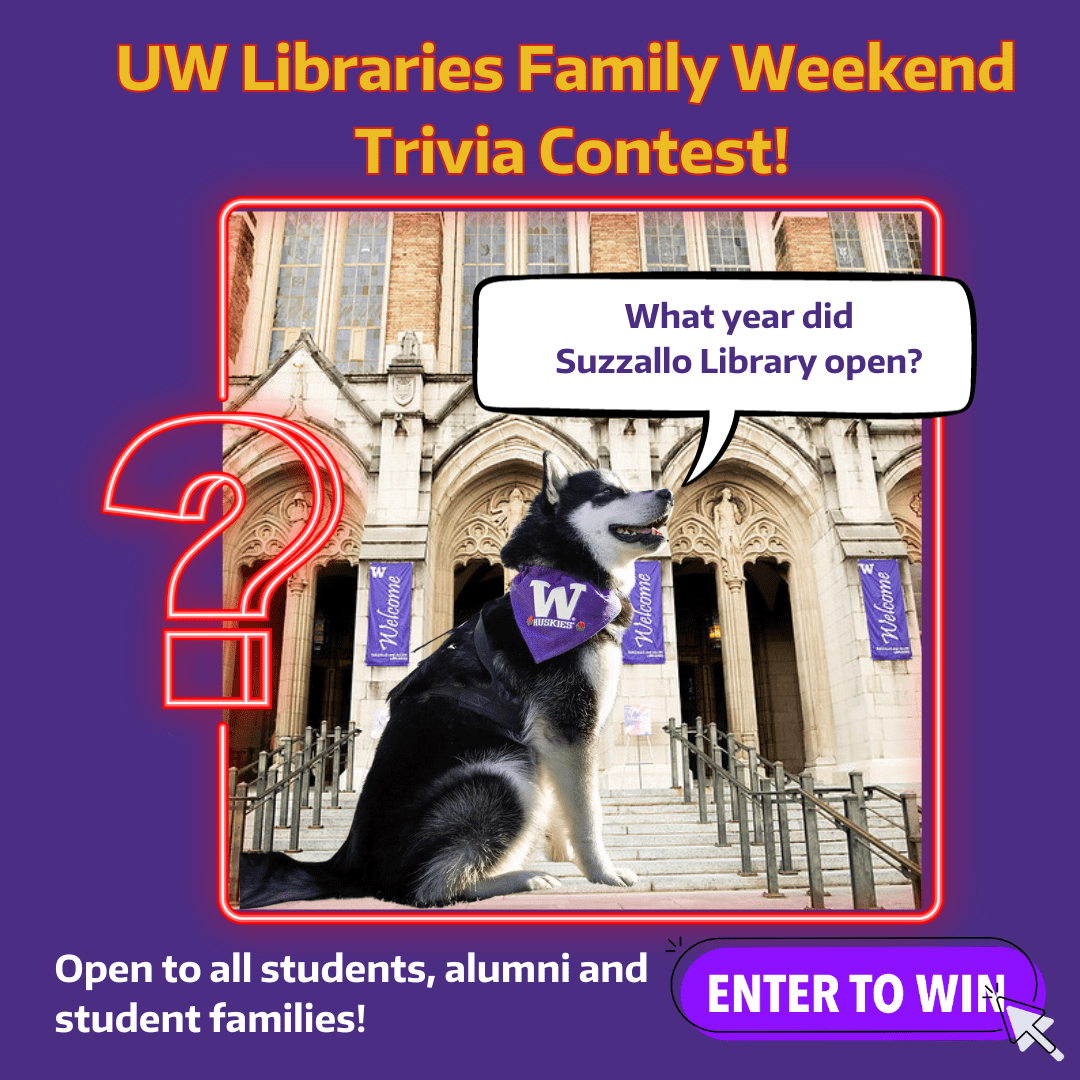
Enjoy UW Family Weekend is November 1-2! Enter to win now-November 30th! Open to all UW students, alumni and their family members!
Happy November, Huskies! We’re halfway through the quarter and there are still plenty of exciting things to see and learn at the Libraries this month. Don’t miss our 2024 election guide, try out Ground News, and get ready for finals with our Top Ten Tips! Looking to upgrade your data skills? The Open Scholarship Commons is hosting a number of workshops and office hours covering topics like web scraping, creating data visualizations, and publishing your own digital book! Check out two new amazing exhibits, and enter our UW Family Trivia Contest during Family Weekend!
UW Libraries Endorses The Right to Deposit: UW Libraries join a growing number of institutions in endorsing the wider use of the Federal Purpose License, so that federally funded research can be used by more people, more quickly, than ever before. Read the story.
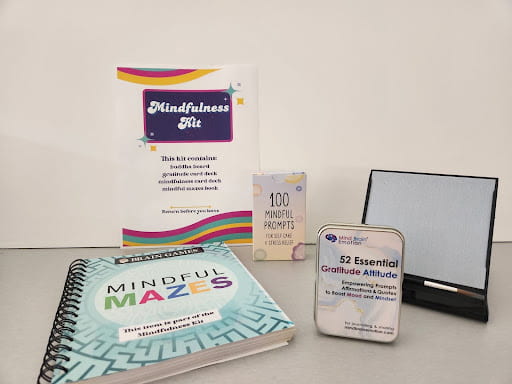
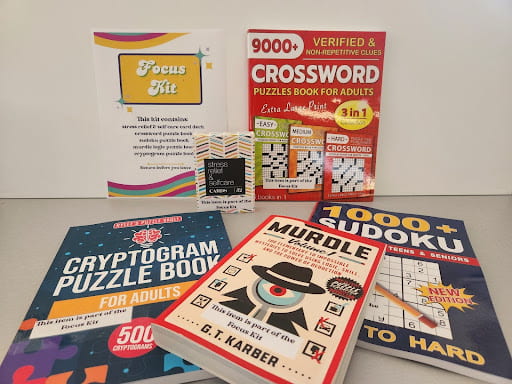
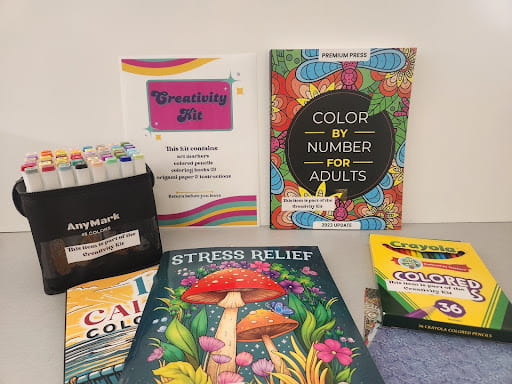
Examples of wellness resources in Odegaard Library
A Focus on Wellness: New resources for students in Odegaard Library offer unique supports and opportunities for student collaboration.
Maps, Yeah Yeah Yeah – Since June 2024, the Libraries’ GMM team has assessed more than 5,000 maps in the archives, but there is more to do. Learn how thousands more maps are making their way into the collection.
Featured Resources
Subscription Trial of Ground News: UW Libraries is evaluating Ground News for UW subscription. “Ground News empowers readers to compare how news sources from across the political spectrum are covering the same story. With Ground News, readers can expand their view of the news and easily compare reporting from a wide range of news outlets.” Students and faculty are encouraged to try Ground News and provide feedback on its value to your learning, research, or teaching. Learn more.
Top Ten Tips for Finals– Be sure to bookmark this page and learn more about these time-saving resources to help you succeed and stress less during finals!
Community Events and Exhibits
First Gen Celebration Events – Join UW Libraries and partners across all campuses to celebrate the experiences of first-generation students and learn about UW Libraries resources to support first-generation student success! Stop by a participating library to enjoy snacks, pick up first-gen buttons, meet other first-generation students, and take part in short activities reflecting on the first-generation experience. All students, staff, and faculty are welcome! See full calendar here.
November 4
Odegaard Library National First-Generation College Celebration Table; Odegaard Undergraduate Library, 10AM, 2nd floor (UW Husky Card required for entry)
November 7:
Health Sciences Li Lu Library, First Generation Student Celebration, Health Sciences Education Building, 11-1pm
Bothell/Cascadia College Campus Library, First Gen Celebration Pop-Up, 11-1pm
First Wednesday Concert- Students of the UW School of Music perform in this lunchtime concert series co-hosted by UW Music and UW Libraries.
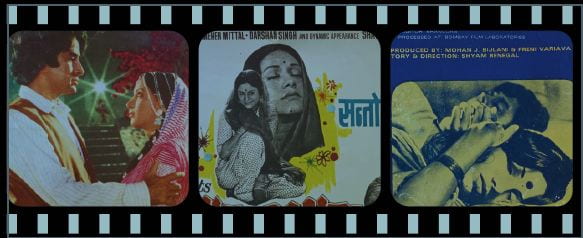
NEW! From Film Festivals to Songbooks: An Exhibition on Indian Film Memorabilia: From Film Festivals to Songbooks: An Exhibition on Indian Film Memorabilia showcases items from a collection of film ephemera donated by American cinephile and writer Lyle Pearson. The exhibition’s focus is mainly on the decade of the 1970s. The collection comprises songbooks of commercial films, brochures for serious art films, production stills and photographs documenting India’s film festivals, publicity posters, and Pearson’s correspondence with important figures in the world of cinema.
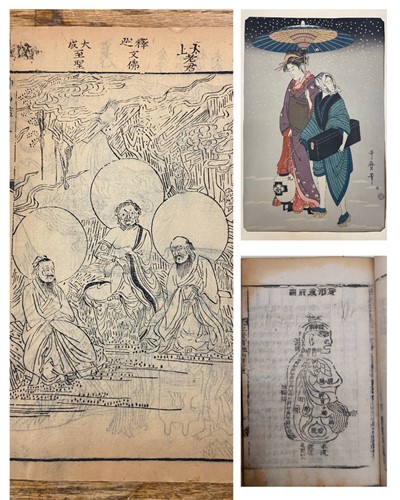
Tateuchi East Asia Library’s Special Collection Exhibit “Exploring East Asia’s Cultural Heritage Through Illustrated Works
EXHIBIT Talk November 7: Exploring East Asia’s Cultural Heritage Through Illustrated Works In conjunction with the Tateuchi East Asia Library’s Special Collection Exhibit “Exploring East Asia’s Cultural Heritage Through Illustrated Works”, we are pleased to invite you to a special workshop that delves into the cultural, technological, and artistic heritage of China, Japan, and Korea as represented through beautifully illustrated works.
The Language of Flowers Exhibit- Enjoy the changing seasons with Special Collections through our annual lobby exhibit, The Language of Flowers. Each quarter will feature new material related to our botanical collections, local plants, and more.
Online Text Mining Support – Text Mining Student Specialist Trisha Prasant will now offer text mining drop-in office hours. Learn about text mining techniques, data preprocessing, and analytical methods for extracting insights from textual data. 1st and 3rd Wednesdays of each month
Intermediate Data Science Office Hours- Come talk to the eScience Institute’s Technical Education Specialist to get some human help about how to advance your computational work. Tools we can help with include Python, R, OpenRefine, Git and UNIX shells, among others.
Unlocking Insights: Web Scraping Workshop – Join us for an engaging online workshop on Web Scraping! Whether you’re a beginner or have some experience, this session is designed to equip you with the skills needed to gather valuable data from the web. Learn essential techniques for scraping web content effectively. We’ll cover the basics, including best practices and common pitfalls to avoid.
Missed it?
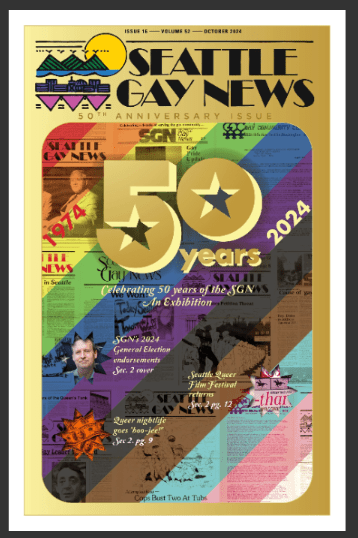
Seattle Gay News Archival Exhibit – Special Digital Edition: Last spring, UW Libraries curated an exhibit commemorating the 50th anniversary of Seattle Gay News and the multi-year effort to complete its digitization with community partners. The SGN paper recently published a special 25-page supplement and digital spotlight of the exhibit materials and the corresponding event and city proclamation, preserving this amazing exhibit (and the work of our incredible student employees and staff) for all to see, just in time for Gay History Month. View the special issue.
Launch of the UW Newspaper Archive:Through the contributions of many UW librarians and staff, the University of Washington Newspaper Archive is now live! The Archive is a project to provide digital access to historic newspapers published at the University of Washington, including The Daily and other UW student newspapers such as The College Idea, Pacific Wave, UW Bothell Commons, and UW Tacoma Ledger. Learn more.
Get Libraries news like this directly to your inbox! Sign-up for our blog!
Your Email:
###
Stories
Maps, Yeah Yeah Yeah
October 29, 2024
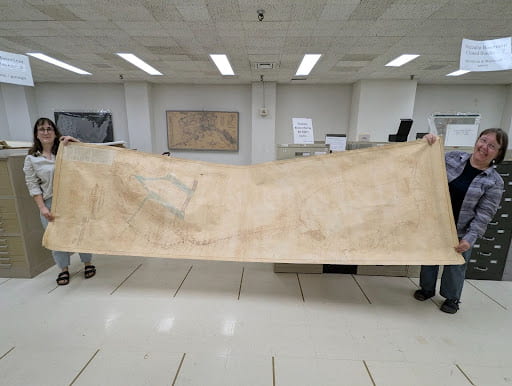
Okay, so we aren’t talking about the resurgence of the 2003 song, “Maps” by the Yeah Yeah Yeahs, but that would make for a fascinating research project on music history. We are talking about actual, physical maps! Thousands of them! Did you know – the University of Washington Libraries Special Collections Division’s Rare Map Collection includes maps from the sixteenth to early twentieth centuries covering the world, Western and Eastern Hemispheres, continents, countries and cities along with maps that document exploration of North America and the Pacific Northwest region from the seventeenth and eighteenth centuries? But that’s not all – the UW Libraries’ Government Publications, Maps, Microforms & Newspapers Collection unit (GMM) holds many more modern maps that you can use on site, or find online. Over this academic year, the team is embarking on a new project to assess a backlog of maps waiting to be cataloged for public use.
Since June 2024, the team has assessed more than 5,000 maps in the archives, but there is more to do.
We caught up with Matt Parsons, Geospatial Data & Maps Librarian who is leading this work with other library and student employees.
Chris Blomquist (staff) and Martha (student) with original harbor line map of Seattle from the mid 1890s
What types of maps are you finding?
The material in this project consists of primarily print maps, some aerial photography and government documents. We’ve found maps in the backlog dating as far back as the late 1890s. Most of the material is mid-twentieth century, however, geographic representation is global. We are finding a lot of local geographies (Washington State, Puget Sound, King County, etc.). Types of maps include everything from AAA road maps to highly specific thematic maps (harbor line maps, geologic maps, etc.).
A surprising find: there’s a very large collection of tactile/braille maps that are related to the late John Sherman, a former UW Geography professor who retired in 1986.
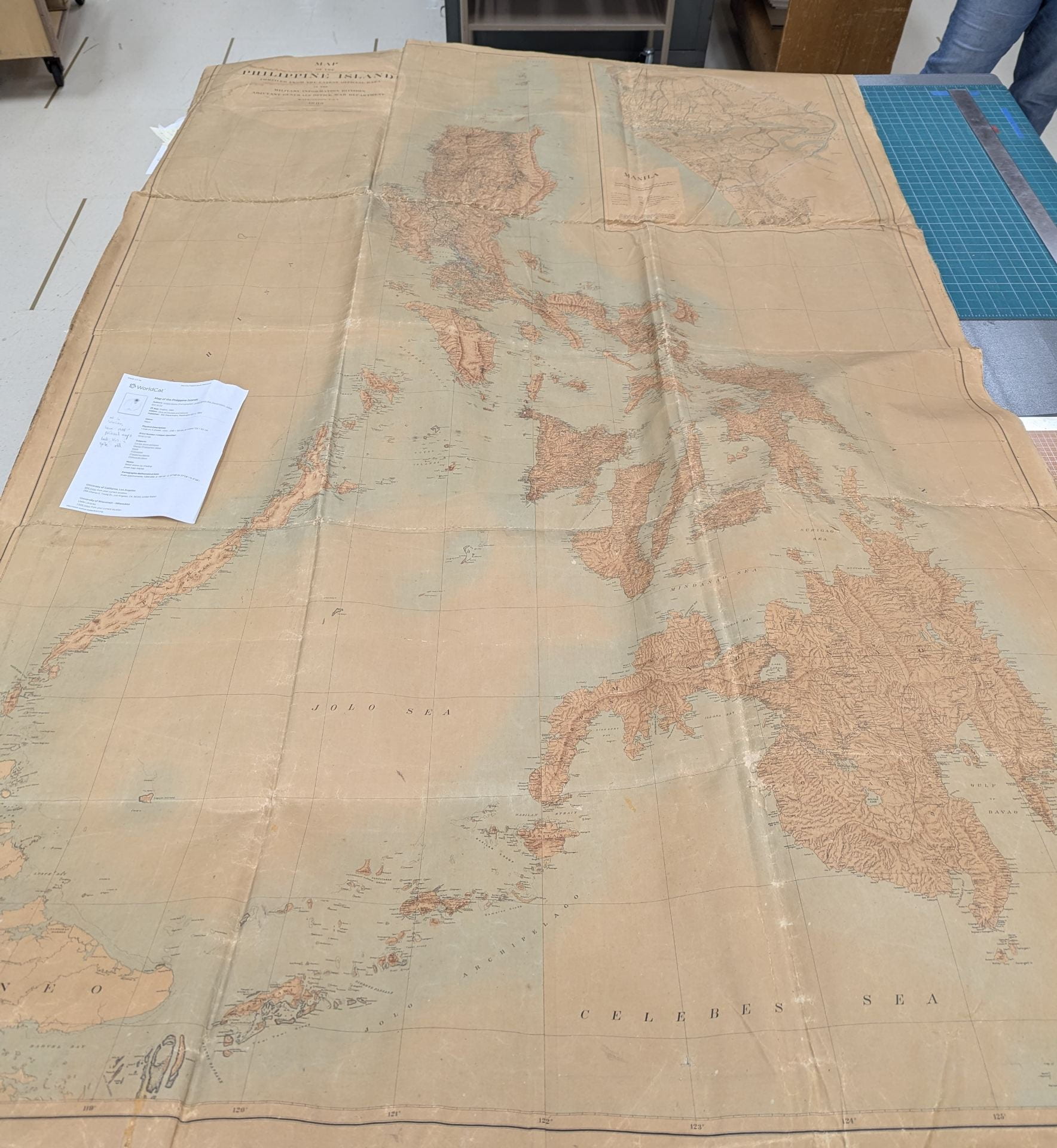
A 1903 map of the Philippine Islands, approx. 5ft x 7ft.
Why are maps important to collect, how do students use them?
Students, faculty and researchers from outside UW use our maps for all sorts of research purposes and across disciplines. For example, to learn how city, state and federal lands have changed over time, to study topography of a region, linguistics related to how people communicated at a certain place and time, historical documentation of government and military activity, inputs for GIS projects, to study papermaking of a particular point in time and more–the applications are endless!
How do you tackle such a large amount of material – what’s your process?
Large scale projects like this require dedicated time above and beyond our standard capacity, as well as dedicated funding. The project is made possible by an allocation of funds from the Dean of Libraries to hire students and a part-time staff person specifically to focus on the project. The students are all from the UW iSchool’s MLIS program and each was interested in gaining some collection development experience and working with unique formats.
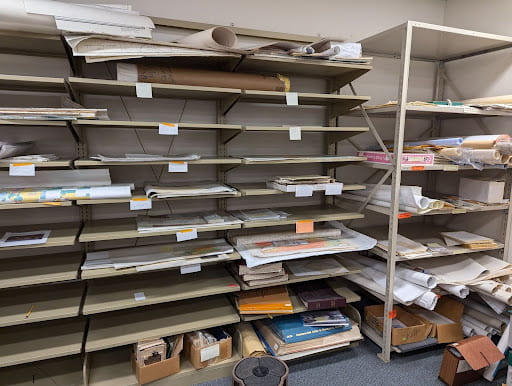
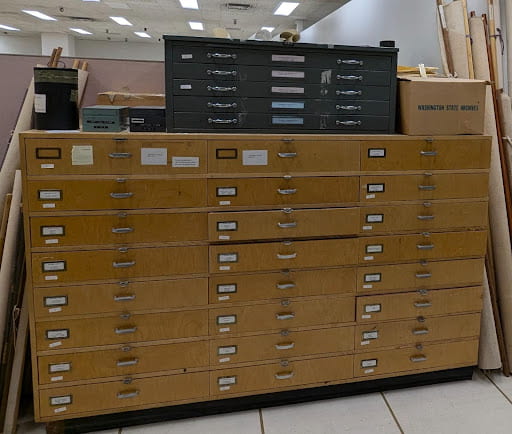
Shelves of unprocessed maps
There are a number of criteria we use to evaluate each map including duplication within our existing collection, condition of the material, prevalence and/or rarity within OCLC membership and whether or not it fits with our collection scope. All of these factors determine where the map will eventually go.
Cabinet full of USGS topographic maps of each U.S. state
Why are there so many maps?
Like all libraries, public and academic, the large volume of materials we take in often outpaces our ability to evaluate, document and properly catalog items as they come to us. With limited resources, it is a constant process of prioritization. This has long been a project we have wanted to tackle, and we are excited to be able to finally do it with the special funding from the Dean.
It is also fulfilling to know that with the right support, we can tackle large-scale projects like this, and it’s never too late to start.
When can we use/find these new maps?
The team will continue working through June 2025 to process as many maps as possible. It can take up to a few weeks to properly catalog, mark and shelve a single map. Some of the maps will go to our GMM collection, some will go to UW Libraries Special Collections and require conservation/preservation intervention, some will be transferred to other institutions. Maps that do not fit the collection criteria will be donated to UW Surplus and in some cases, recycled, depending on condition.
We look forward to sharing an update when the project is completed with links to some of the highlights within the collection.
Questions? Contact Matt Parsons, Geospatial Data & Maps Librarian: [email protected]
###
Stories
Supporting Student Wellness (and a Cat Naming Contest!)
October 28, 2024
At the UW Libraries, enriching the student experience is a key priority when evaluating our spaces, services, and events. This year, we’re focusing on a key element of student success and happiness- wellness. Or, more specifically, supporting student wellness, wellbeing, and mental health. There are many student wellness resources across campus, but we want to make sure there are also resources available where students spend much of their time studying, resting, going to class and socializing – the Libraries.
We’re excited to share with you some of the new wellness offerings coming to Odegaard Library!
WELLNESS KITS
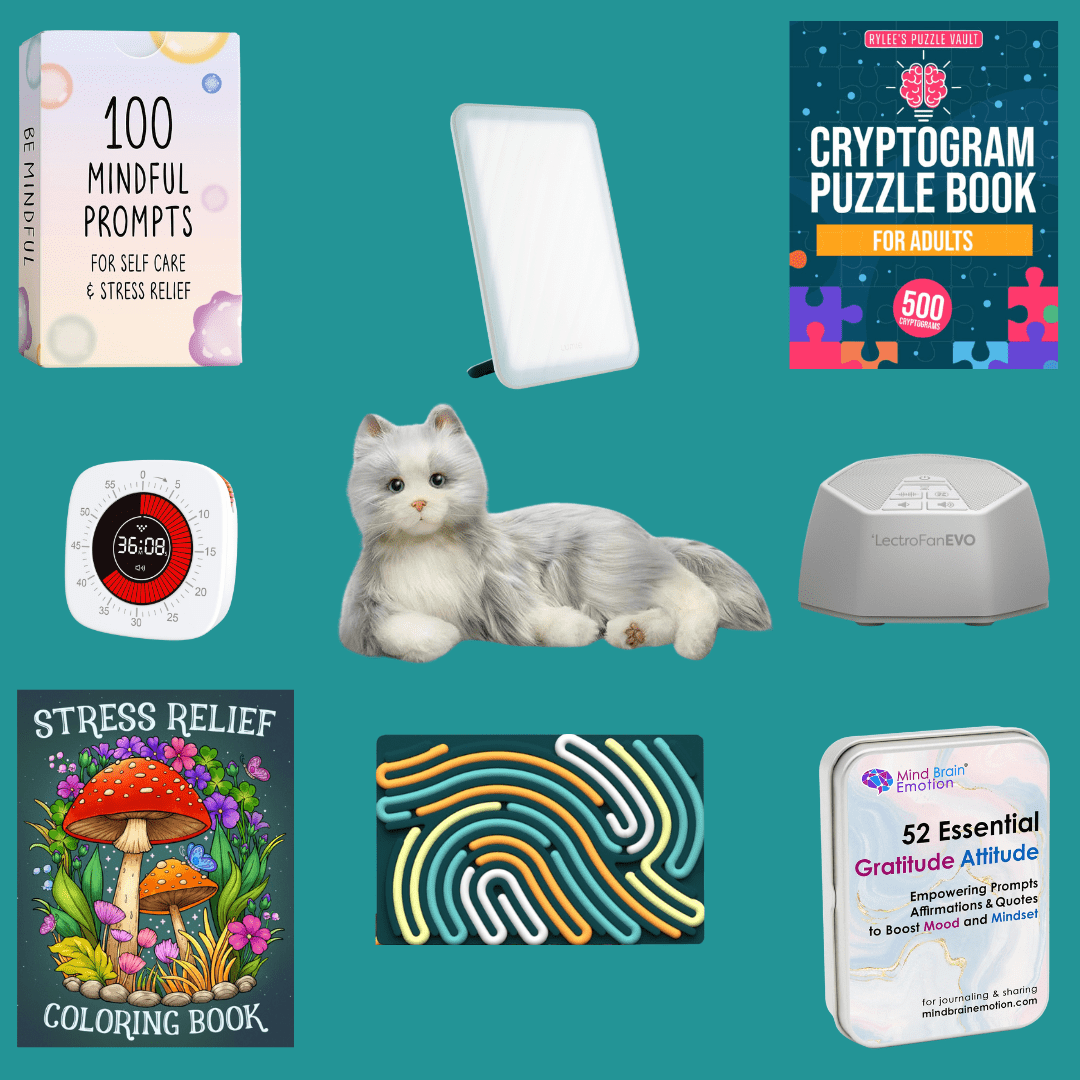
Everyone has a different method for de-stressing, so the Odegaard Library wellness team put together four kits consisting of items grouped by activity type. The Mindfulness Kit, Focus Kit, Creativity Kit and Sensory Kit contain items meant to de-stress, reinvigorate, and refocus you during long study sessions in Odegaard. Learn more about each kit on our new Wellness at Odegaard Library Guide.
In addition to our Wellness Kits, we also have available wellness technology for checkout and use in the library. These items were purchased with funding generously provided by the Student Technology Fee Program. You can learn more about each item on our new Wellness at Odegaard Library Guide.
Lumie Light Therapy Lamps for an extra dose of light when the days get dark.
White Noise Machines for when it’s too quiet to think.
Visual Timers for a visual way to track the time.
Cellphone Lock boxes for when you know you need to stop doom scrolling, but you need a little extra help.
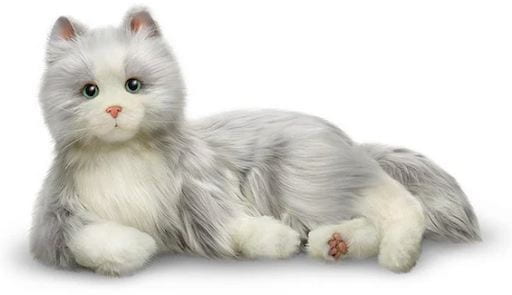
Companion Cats for when you just need a bit of furry companionship, minus the allergies. (9 out of 10 library employees agree that these look a bit uncanny valley, but holding them is actually very soothing.)
“Grey Companion Cat”, one of several available
CAT NAMING CONTEST
Speaking of our two new Companion Cats, we want your help in naming them! Please enter your suggestions usingthis form (requires a UW NetID to enter; safe-for-work suggestions only, please!) and there will be voting on the finalists later in Fall Quarter. One caveat in the spirit of transparency: We’re not naming them Catty McCatFace, no matter how many votes it may get.
UPCOMING EVENTS
We’ve been working hard to create events that give students a space to relax and connect.
A few of the upcoming events are smaller reprisals of popular Dawg Daze events where students asked for an encore:
We’ll also have some more study related events around finals, dates TBD!
FINALLY, A TEASER FOR THINGS TO COME…
In our quest to broaden wellness support for students, we’re planning some changes for spaces in Odegaard Library, including the development of an Odegaard Library Wellness Room! Keep an eye on this blog for updates and opportunities to collaborate and give feedback on the Wellness Room planning with us!
THE WHY
New literature and data connects student wellness and academic success. The Association of College & Research Libraries listed supporting student wellness, well-being, and mental health as a top trend for academic libraries in 2024. We are staying current and responding to user needs.
Equally important, we are invested in cultivating a culture of care in library spaces. Walt Whitman said he contained multitudes, and we know that you do, too – but it turns out multitudes are surprisingly heavy to carry around all the time. As UW Libraries employees who see you every day – happy, sad, stressed, excited, tired, maybe a little hangry – we want to lighten the load for you, even if it’s just for a little while between classes.
BE WELL, HUSKIES
We hope you try out all of the new wellness supports– check out a kit, pet a cat, come to an event, and stay tuned for more news as we expand wellness space at Odegaard! We’re all rooting for you!
Stories
UW Libraries Endorses The Right to Deposit
October 21, 2024
LEARN MORE, GET INVOLVED
Open Access Week with UW Libraries
This year’stheme is Community over Commercialization and is an opportunity to discuss approaches to open scholarship that best serve the interests of the public and the academic community.
UW Libraries join a growing number of institutions in endorsing the wider use of the Federal Purpose License, so that federally funded research can be used by more people, more quickly, than ever before. Simply put, the License allows the federal government to use–and allow others to use–the research publications that it funds. In its words:
“The Federal awarding agency reserves a royalty-free, nonexclusive and irrevocable right to reproduce, publish, or otherwise use the work for Federal purposes, and to authorize others to do so.”
In 2023, members of the UW community received approximately $1.52 billion in federal funding for research. Many grants require resulting research articles to be publicly available within a period of time. Thanks to new guidance in the Nelson memo, more articles and data resulting from federal funding will need to be publicly available without delay. This furthers authors’ and institutions’ shared values of equity and public benefit.
But the procedures for sharing may not align. Authors must navigate funder requirements, publishing agreements, and institutional Open Access policies, which can conflict with each other. Publishing contracts, in particular, can make it difficult to satisfy the public access requirements of funders and institutions.
“UW research attains its greatest impact on our most pressing global challenges when we advocate for open, public and emerging forms of scholarship.”
The Federal Purpose License makes it easier to share research results because it overrides all subsequent agreements and requirements about rights. It supports access to and re-use of research works; fosters uniformity across federal agencies; reduces the risks of non-compliance for grant recipients; and maximizes the return-on-investment for taxpayers and the public-at-large.
The Federal Purpose License existed for a long time without much attention. With the Nelson Memo’s emphasis on greater public access to federally funded research, librarians are recognizing its promise.
Learn about accurate sources, how and where to vote, UW events and more.
October brings countless opportunities for you to explore and learn with the Libraries! Are you interested in learning about podcast creation? Applications for the popular Storytelling Fellows course are now open! International Open Access Week is the backdrop for a variety of events, guest speakers and free learning workshops. Don’t miss our incredible new exhibits showcasing some incredible items from the archives — from local plants to ancient Chinese manuscripts, and a look back at Seattle in the 1920’s. With the election right around the corner, be sure to take advantage of all the resources and events offered through UW Libraries and partners across campus and COME READ WITH US at the UW annual US Constitution Community Reading on October 9th.
News and Stories
Recognize an outstanding librarian: Do you know a UW librarian who has been integral to your teaching, learning and research experience at UW? Nominate them for the Distinguished Librarian Award by Nov 30!
One of the first issues of The Daily in the digital archive
Launch of the UW Newspaper Archive: Through the contributions of many UW librarians and staff, the University of Washington Newspaper Archive is now live! The Archive is a project to provide digital access to historic newspapers published at the University of Washington, including The Daily and other UW student newspapers such as The College Idea, Pacific Wave, UW Bothell Commons, and UW Tacoma Ledger. For now, it includes the UW Daily student newspaper from September 1964 through August 1967. Work to digitize issues through 1975 is ongoing, with the goal of digitizing earlier issues of the Daily and the other publications as funding becomes available. Learn more.
The Secret Life of Catalogers and Metadata Specialists – Student Spotlight: Did you know that there is an entire department of librarians, staff, and students quietly working away behind the scenes to get new resources into the catalog and to find innovative ways to enhance the Libraries’ metadata? Learn about this important, often “invisible” work, and the widespread impact one UW Libraries student employee has made to correct industry bias in this practice. Read the story
Faster Requests with Special Collections: A new software system means faster turnaround time for retrievals and other researcher benefits. Learn what’s new and what to expect with the new system.
Seattle Gay News Archival Exhibit – Special Digital Edition: Last spring, UW Libraries curated an exhibit commemorating the 50th anniversary of Seattle Gay News and the multi-year effort to complete its digitization with community partners. The SGN paper recently published a special 25-page supplement and digital spotlight of the exhibit materials and the corresponding event and city proclamation, preserving this amazing exhibit (and the work of our incredible student employees and staff) for all to see, just in time for Gay History Month. View the special issue.
Applications Due for Autumn Programs
Storytelling Fellows
Scholars Studio
A free online program for UW students/faculty/staff that will guide you in the creation of your own podcast. Your podcast could feature recorded interviews, investigative reporting, panel discussions, fiction, comedy…. You can make whatever you want! Register by October 11!
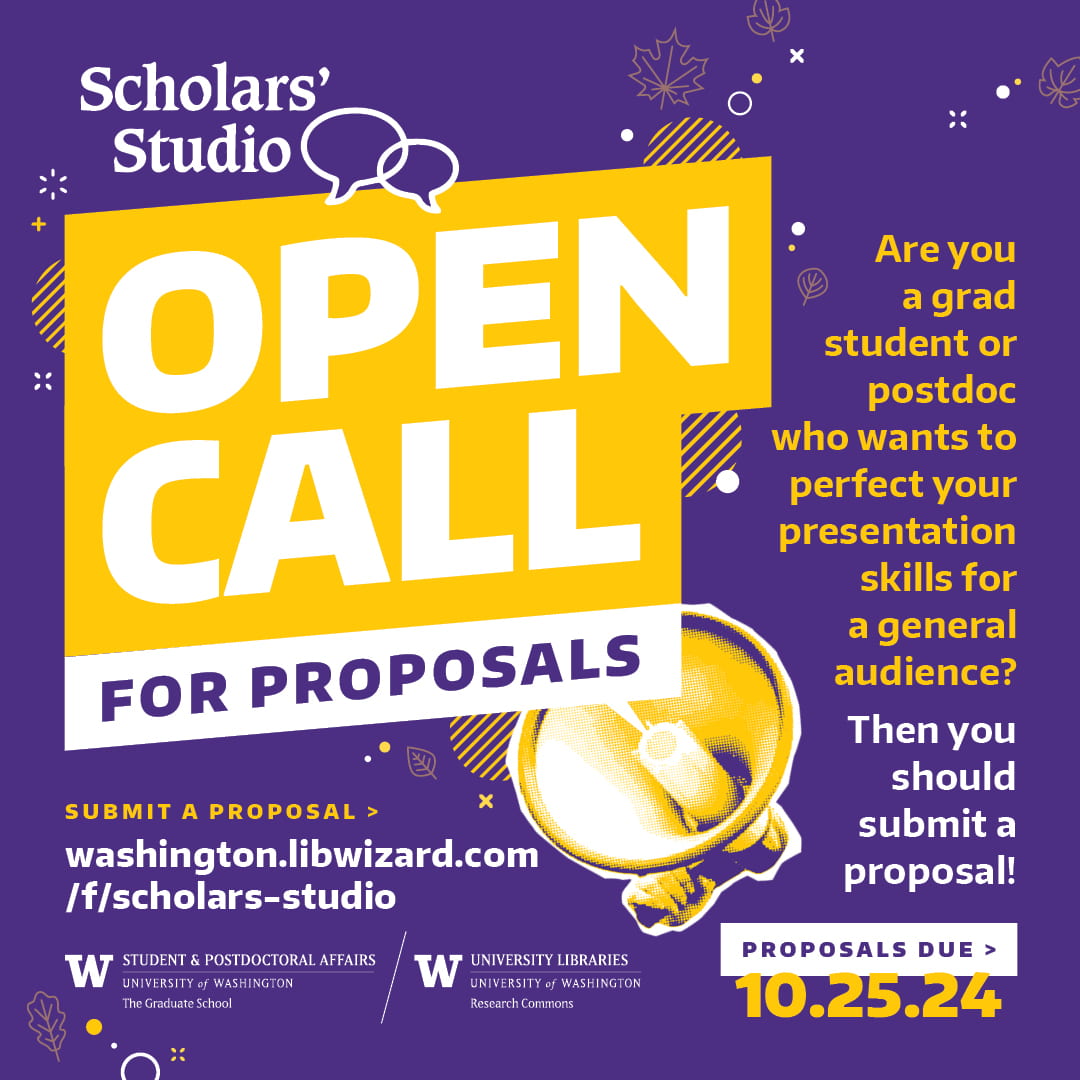
Scholars’ Studio gives students the opportunity to share their research across disciplines, make connections and build presentation skills. The Scholars’ Studio event is open to any research, practice, or teaching topic in any discipline. Proposals due October 25!
Students of the UW School of Music perform in this lunchtime concert series co-hosted by UW Music and UW Libraries.
Readers Wanted – Annual Constitutional Reading October 9! UW Libraries annual Constitution Read Aloud event encourages students, faculty, staff and community members to join us in reading the full text of the Constitution, along with our special guest speakers! A great activity for your class, office or community service group to participate in – all ages welcome. Sign-up to read and learn more.
Drawing from her new book “Oregon’s Others: Gender, Civil Liberties, and the Surveillance State in the Early Twentieth Century,” Dr. Kimberly Jensen will discuss the processes that shaped the growing surveillance state in the era of the First World War, share some of the compelling personal stories that tell its history, and consider how an analysis of this history can inform present day questions of civil liberties and community. Learn more.
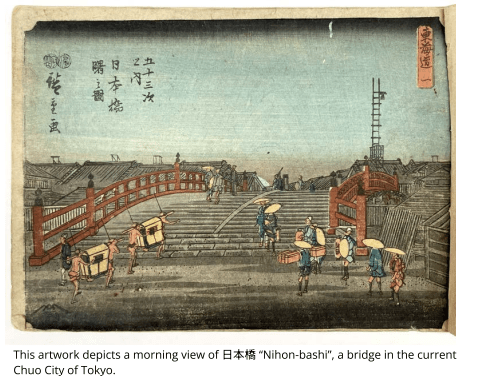
東海道五拾三次ノ圖 (Tōkaidō gojūsantsugi no zu)[安藤]廣重 [Andō] Hiroshige. Published in 1833-1868. Hiroshige was well known for his monumental project, the Fifty-three Stations of the Tōkaidō Road as well as One Hundred Famous Views of Edo, composed of woodblock landscapes, some of which are known for being imitated by Van Gogh.
Illustrated Special Collections at Tateuchi East Asia Library
The Tateuchi East Asia Library’s Special Collection Exhibit, “Exploring East Asia’s Cultural Heritage Through Illustrated Works,” brings together a rich array of illustrated materials from China, Japan and Korea, highlighting the cultural, technological, and artistic achievements of each region. Highlights include Chinese local gazetteers, geographic landscapes, and ancient manuscripts on craftsmanship and technology; Japanese Ukiyo-e and Cartography showcases Edo-era daily life and travel through ukiyo-e prints and historical maps, including the iconic Tōkaidō travel route; and illustrations on Korean ceremonial rites and medicine explore the Confucian traditions of the Chosŏn Dynasty through ceremonial texts and medicinal practices that shaped Korean society. Learn more.
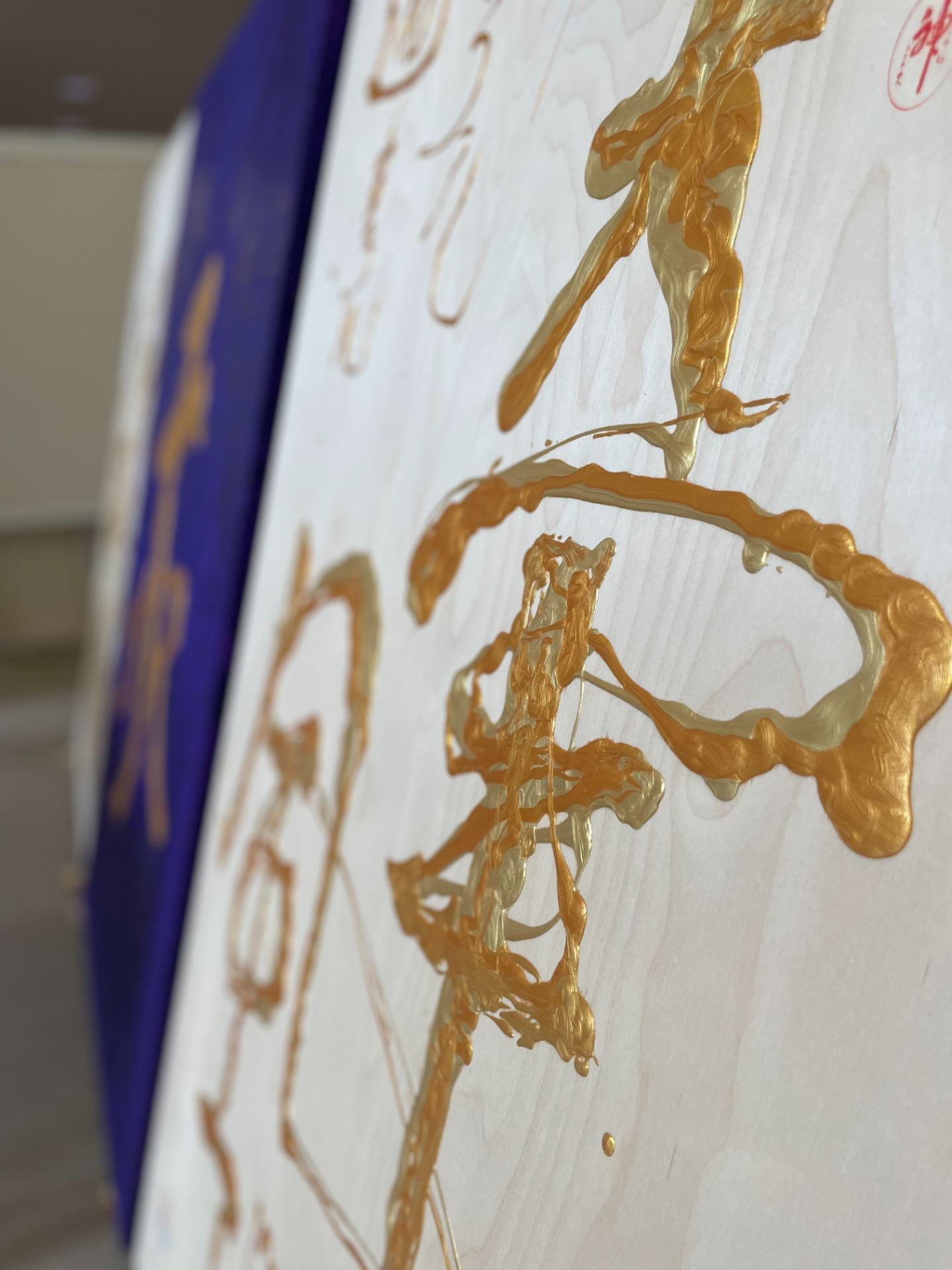
“Strolling Gold” 3D Calligraphy Exhibit Through October 17: See and appreciate the wonderful art of “Strolling Gold” calligraphy, first created by Layman, a Chinese immigrant, poet laureate, translator, inventor, entrepreneur, and calligrapher.
The Language of Flowers Exhibit: Enjoy the changing seasons with Special Collections through our annual lobby exhibit, The Language of Flowers. Each quarter will feature new material related to our botanical collections, local plants, and more.
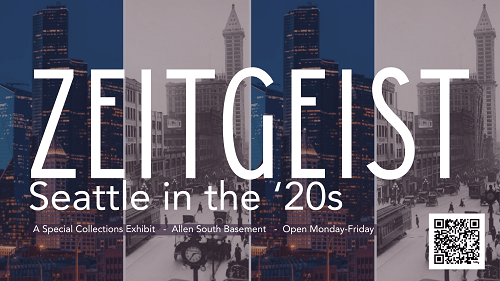
Zeitgeist-Seattle in the ’20s: In this exhibit, Special Collections explores popular culture and current events of Seattle in the 1920s and the 2020s!.
Learning Workshops and Office Hours
Online Text Mining Support – – 1st and 3rd Wednesdays of each month-ONLINE Text Mining Student Specialist Trisha Prasant will now offer text mining drop-in office hours. Learn about text mining techniques, data preprocessing, and analytical methods for extracting insights from textual data.
Introduction to Data Visualization – ONLINE Tuesday, Oct 8, 2024 A basic introduction to data visualization, including an overview of tools available at UW, and where to get help.
International Open Access Week!
The Challenge with Digital Publishing Tuesday, October 22 Explore the real and philosophical challenges of digital publishing around sustainability, longevity and practices like “minimal computing” and more.
Accessible Data Visualization Tuesday, Oct 22 Review ways to make your visualizations more accessible. We will work through a visualization together and add features to make it more accessible.
Queering Games, Gaming Imaginaries Thursday, October 24 Examine biases embedded in the many facets of gaming and how to address them. This discussion is led by Edmond Y. Chang, Associate Professor of English at Ohio University whose areas of research include technoculture; race, gender, and sexuality; video games, analog games, LARP, queer game studies; feminist media studies; cultural studies; popular culture; and 20/21C American literature.
Situating Data: Strategies for Curation and Contextualization
Friday, October 25
In this workshop, we will discuss important considerations for responsible data curation, metadata creation, and broader contextualization, and considering the importance of qualitative and humanistic perspectives and methods in data work.
Finding Datasets Tuesday, Oct 15 Learn how to find datasets for your research and assignments, as well as considerations for using them.
Missed it?
Showcasing BIPOC Student Research: Learn about theResearch Communication and Equity Fellowship showcase at the UW Libraries’ Research Commons celebrating the academic and creative work of Black, Indigenous, and People of Color (BIPOC) graduate students.See their work.
###
Stories
The Secret Life of UW Libraries Catalogers and Metadata Specialists
October 1, 2024
Student Spotlight #4: Ally Okun
By Crystal Yragui, Metadata Librarian & Interim Co-Head, Metadata & Cataloging Initiatives Unit · University of Washington Libraries
You may be surprised to hear that before you can access a library resource when you need it, a lot of work must be done to get that resource into the UW Libraries catalog.
Ally Okun
A whole department of librarians, staff, and students are quietly working away behind the scenes to get new resources into the catalog and to find innovative ways to enhance the Libraries’ metadata. This series of blog posts highlights our brilliant student employees and the work they do to make your tasks of searching, identifying, selecting, and obtaining library resources easier and more effective.
Ally Okun entered the University of Washington Information School’s Master of Library and Information Science Program after earning a BA in sociology and anthropology with minors in gender studies and classics from Lewis and Clark College. Towards the end of her MLIS program, Ally sought a Capstone project that would allow her to gain practical experience in knowledge organization through a social justice lens. The Homosaurus Implementation Project provided her with an opportunity to explore these interests in the professional context of the Orbis Cascade Alliance Cataloging Standing Group (CSG).
What is Knowledge Organization, and How Does it Work in the Library Catalog?
Knowledge organization is the discipline that has to do with the way information professionals organize, manage, and retrieve information. The library catalog facilitates information retrieval in several ways. When users search for resources in the library catalog, they often type terms into a search box. Sometimes they use advanced search options to target more specific catalog fields (or characteristics of a resource), such as subject, genre, author, or title. Most of the time, they rely on keyword searching. Catalogers have rules for recording this information so that users can find what they are looking for with as little effort as possible. Much of this work is uncontroversial.
Metadata professionals often use controlled vocabularies rather than the language resources use to describe themselves in order to populate certain catalog fields. Controlled vocabularies are used in library catalogs to mandate the use of predefined, preferred terms for single concepts that have been selected by the designers of the vocabularies. Controlled vocabularies make searching for things in library catalogs much more efficient. [Wikipedia, 2024] For example, users from the United States can search for “Garbage”, users from the United Kingdom can search for “Rubbish”, and the Library of Congress Subject Headings controlled vocabulary will lead both groups of searchers to all the resources in a library catalog that have been assigned the heading “Refuse and refuse disposal”. When they are created, maintained, and applied thoughtfully, controlled vocabularies are powerful tools that benefit users.
What Harmful Social Impacts do Controlled Vocabularies Have?
Catalogers around the world rely on shared controlled vocabularies in order to share data (and workloads). Historically, the most-used controlled vocabularies have been created and maintained by institutions such as the Library of Congress and for-profit companies. Standard vocabularies created by these institutions tend to reinforce oppressive perspectives and further marginalize already-marginalized groups and ideas. Standard controlled vocabularies like the Library of Congress Subject Headings (LCSH) provide language for LGBTQIA+ topics that can be inadequate, inaccurate, or even offensive, reinforcing dominant heterosexual, cisgender, white, male, Christian and western perspectives.
Ally teamed up with the CSG and a group of over fifty volunteers across the Orbis Cascade Alliance to try to address some of these issues by implementing the Homosaurus in the shared consortial library catalog, Alma/Primo, in 2023.
The Homosaurus Implementation Project
About the Homosaurus
The Homosaurus is a controlled vocabulary which describes itself as “An international linked data vocabulary of LGBTQ+ terms. Designed to enhance broad subject term vocabularies, the Homosaurus is a robust and cutting-edge thesaurus that advances the discoverability of LGBTQ+ resources and information.” The vocabulary has been around since 1997, and is currently on its fourth version (version 3). The Homosaurus Editorial Board oversees the editorial process, considering community suggestions and approving new terms, and releases changes quarterly.
Why Implement the Homosaurus?
In an effort to mitigate harm and expand discovery, the Orbis Cascade Alliance Cataloging Standing Group (CSG) felt that focusing on an intentional, retrospective implementation of Homosaurus was necessary.
Project People
The project built on the work of Adrian Williams, a metadata librarian at the University of Kentucky Libraries, who came to the Alliance to provide tools and training on how to implement the Homosaurus in the Spring of 2023. The Alliance Norms Rules Standing Group (NRSG) also paved the way for this work by enabling the display of the Homosaurus and other non-LCSH and non-MeSH controlled vocabulary headings in the library catalog.
At the beginning of the project, the CSG knew that it would need as much help as it could get with the work of designing the implementation project, authoring training modules, and performing subject analysis and metadata remediation. They submitted a proposal for a Capstone project with the University of Washington iSchool, met Ally, and found that Ally’s academic and professional interests were a great match for the project’s goals. Ally’s Capstone project ran as a sub-project of the larger Homosaurus Implementation Project (which is ongoing) during the 2023-2024 academic school year.
Project Design
The Homosaurus Implementation Project (HIP) invited volunteers from across the Orbis Cascade Alliance, with or without cataloging expertise, to participate in the retrospective enhancement of targeted bibliographic records in our shared consortial catalog with Homosaurus terms. Batches of target records have been extracted representing Alliance-held materials likely to benefit from Homosaurus vocabulary terms, and added to a central tracking spreadsheet. After attending several training sessions designed by the CSG with Ally’s help, project participants perform subject analysis on the selected records, either recommending terms from the Homosaurus for catalogers to add (in the case of non-catalogers), or adding the terms to the records. As appropriate, participants may request updates or new terms for inclusion in Homosaurus or Library of Congress controlled vocabularies. Work is recorded in the central tracking spreadsheet.
“Ally’s contributions to the HIP training materials helped all project participants get off to a good start and significantly reduced barriers to participation for non-catalogers”
– Lesley Lowery, Orbis Cascade Alliance.
During the project, Ally not only assisted the CSG with designing training, but learned to catalog and received one-on-one training from her capstone supervisor, Crystal Yragui. Ally thoughtfully added Homosaurus terms to over 45 records during her project, enhancing discoverability for those LGBT+ resources for institutions worldwide. Reflecting on the project, Ally had this to say:
“Being able to combine my own personal interest in LGBTQ+ representation with my professional interest in cataloging and knowledge organization meant that this project was always exciting for me to work on. I also got to see some of the inner workings of the CSG and how a project on this scale is organized, which I know will serve me well going forward in my career.”
– Ally Okun
Project Impacts
Through this project, the Orbis Cascade Alliance is forging a path to implementation of the Homosaurus for other libraries and vendors. This work is providing catalogers, staff, and students at Alliance institutions with hands-on training in Homosaurus implementation. This training can be carried forward through ongoing use of the Homosaurus in cataloging by member libraries. Participants contribute to and become part of the Homosaurus community of practice throughout the project. With more records populated with Homosaurus terms, search and discovery are enhanced for LGBT+ materials. After the project has concluded, CSG members will advocate for the inclusion of Homosaurus terms in vendor-supplied metadata with content providers and Ex Libris, and advocate for further Homosaurus training and implementation work within the ELUNA consortial community of practice.
Ally graduated from the University of Washington with her Master of Library and Information Science shortly after the completion of her Capstone project. She has taken an internship with Health Affairs as the Taxonomy and Information Architecture Intern. We are so proud of Ally’s accomplishments here, and know she is off to do great things!



 How are study abroad experiences like this beneficial for students and the faculty who lead them?




 A few of the upcoming events are smaller reprisals of popular Dawg Daze events where students asked for an encore:
 Recognize an outstanding librarian: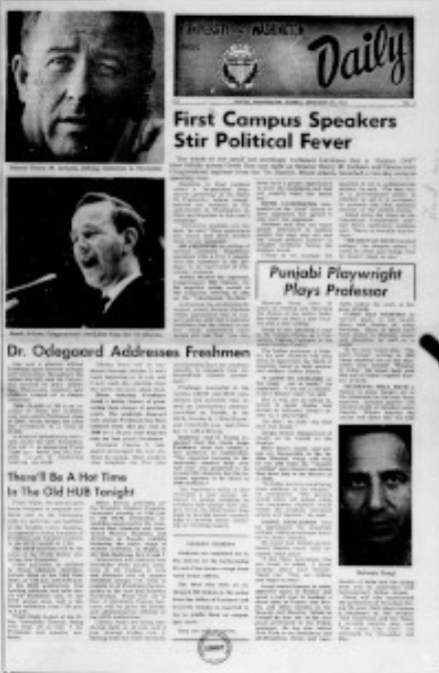
 Zeitgeist-Seattle in the ’20s:
  The Challenge with Digital Publishing